Transfer of Equity Legal Help: Your 2026 Guide to Changing Property Ownership

Imagine you've finally reached a point of clarity during a difficult separation, only to find your mortgage lender has stalled your plans to take full ownership of your home. It's a common frustration for homeowners across the West Midlands who assume changing a name on a title deed is a simple administrative task. In reality, shifting the legal balance of your property is a significant financial restructure that carries weight with both the bank and the taxman. Finding the right transfer of equity legal help is the difference between a seamless transition and a months-long headache involving HMRC and the Land Registry.
We know you want this process to be as quiet and efficient as possible, especially when it's tied to a remortgage or a sensitive life change. This guide explains how to navigate the complexities of 2026 property laws, from managing Stamp Duty Land Tax (SDLT) triggers to securing that vital lender consent. You'll discover a structured, modern approach to changing ownership that prioritises your security and peace of mind. We'll walk you through the essential steps to ensure your transfer is fully compliant, legally robust, and perfectly aligned with your future financial goals.
Table of Contents
Understanding Transfer of Equity: When and Why You Need Legal Help
Changing your property's legal structure is a significant move that requires precision. What is a transfer of equity? Essentially, it's the process where the ownership of a property changes but at least one of the original owners stays on the title. It's different from a traditional sale where you hand over the keys and move out. It's also distinct from an "Assent", which is the specific legal term for transferring property after someone has passed away. When you're looking for transfer of equity legal help, you're looking for a way to update your home’s legal status to match your current life circumstances.
Whilst the paperwork might seem straightforward, the legal implications are far-reaching. You aren't just changing a name on a piece of paper; you're altering the financial and legal liability for what is likely your most valuable asset. This is why professional oversight is mandatory if there's an existing mortgage. Lenders won't allow a change in ownership without ensuring their security is protected, and they'll require a solicitor to manage the transition.
Common Scenarios for Ownership Changes
Marriage and cohabitation often prompt a desire to share assets. You might want to add a partner to the deeds to reflect your shared commitment and financial contribution. This helps organise your joint future and ensures both parties have a legal stake in the home.
Separation and divorce are more complex and sensitive. Removing a name is usually part of a wider financial settlement. This process ensures the person leaving is released from mortgage obligations and the person staying has full legal control. It provides the finality needed to move forward.
Tax planning and gifting involve transferring shares to family members amongst other beneficiaries. This is often done to manage future Inheritance Tax liabilities or to provide a "living legacy" to children. Specialist transfer of equity legal help ensures these gifts are recorded correctly to avoid future challenges from HMRC.
The Vital Role of a Conveyancing Solicitor
The Land Registry requires professional oversight for deed changes to prevent fraud and ensure accuracy. A solicitor acts as the bridge between you, the bank, and HM Land Registry. They ensure that the "Title Deeds" accurately reflect the new reality of your ownership structure.
Independent Legal Advice (ILA) is a core part of this journey. It ensures that everyone involved understands exactly what they're signing. This prevents future disputes and protects parties from being pressured into a decision they don't fully grasp. A modern solicitor makes this process transparent, replacing stuffy legalese with clear, actionable guidance.
The Legal Process: How Ownership Transfers Are Managed in 2026
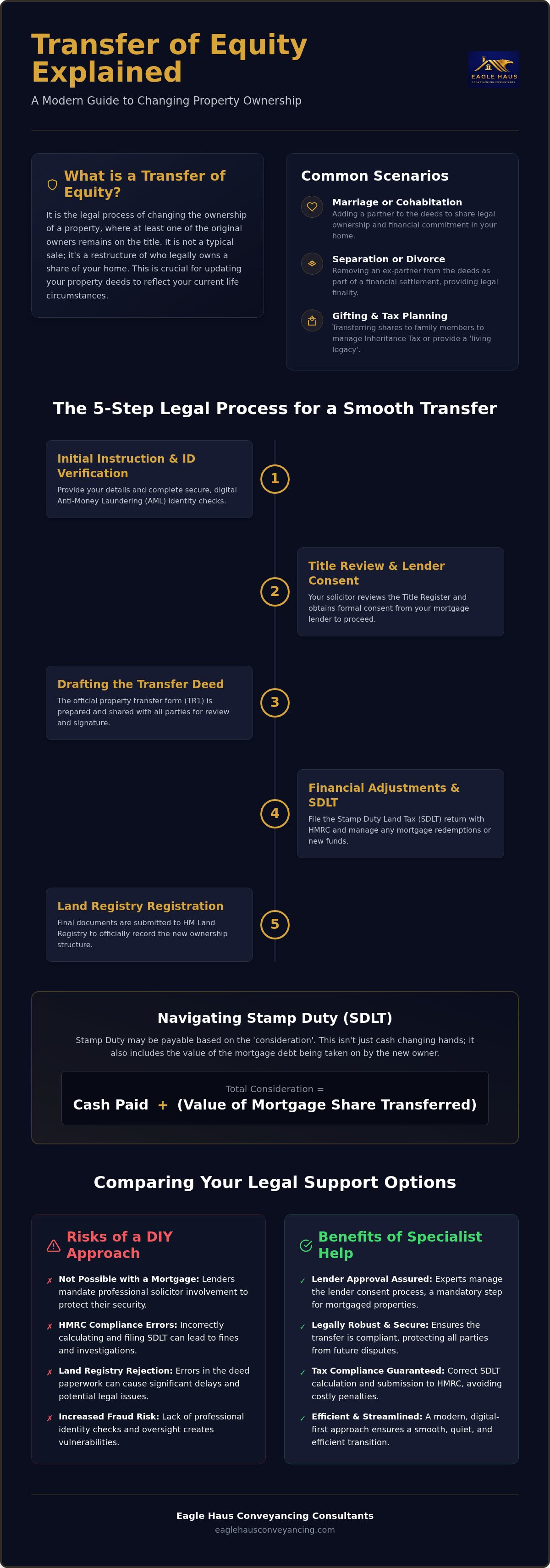
The 2026 property market moves fast. Paper-heavy processes are largely a thing of the past. When you seek transfer of equity legal help today, you should expect a streamlined, digital-first experience. The journey is methodical, ensuring every legal and financial loose end is tied up before the deeds are updated. The process typically follows five key stages:
Step 1: Initial Instruction and ID Verification. You'll provide your details and complete Anti-Money Laundering (AML) checks through secure digital platforms.
Step 2: Title Review and Consent. Your solicitor examines the current Title Register and requests formal consent from your mortgage lender to change the names on the debt.
Step 3: Drafting the Deed. The official property transfer form (TR1) is prepared and shared with all parties for signature.
Step 4: Financial Adjustments. This involves filing Stamp Duty Land Tax (SDLT) returns with HMRC and managing mortgage redemptions or additional borrowing.
Step 5: Land Registry Registration. Final documents are submitted to HM Land Registry to confirm the new ownership structure officially.
Managing Mortgage Lender Consent
Banks have a significant stake in who owns the property they've secured a loan against. If you're adding or removing a name, the lender must be satisfied that the remaining owners can afford the debt. Many homeowners in 2026 find this is the perfect time to explore a "Transfer of Equity and Remortgage" route. By switching lenders at the same time as changing ownership, you can often secure better rates whilst simplifying the legal work into one single transaction. If a lender refuses consent, your solicitor acts as a vital negotiator to find a path forward, whether that's through a different lender or a change in the financial structure.
The TR1 Form and Land Registry Requirements
The TR1 form is the engine of your ownership change. It records vital details about the "transferors" (those currently on the deeds) and "transferees" (those being added). In 2026, the shift towards "e-conveyancing" means most signatures are now handled digitally, removing the need for physical post and reducing the risk of delays. Accessing expert transfer of equity legal help ensures this form is completed accurately to prevent the Land Registry from rejecting the application.
A critical decision on this form is your "Nature of Ownership". You must choose between Joint Tenants, where the property passes automatically to the survivor, or Tenants in Common, where you own specific shares. This choice has massive implications for inheritance and future sales. If you're unsure which path fits your family's needs, our team at Eagle Haus provides modern conveyancing services tailored to your specific situation and long-term goals.
Navigating Stamp Duty and Tax Implications
Tax is often the most confusing part of changing property ownership. Many homeowners assume that if no money changes hands, there's no tax to pay. In 2026, HMRC's definition of "Consideration" remains the primary hurdle for those seeking transfer of equity legal help. This term includes any cash payment made to the person leaving the deeds plus the value of any mortgage debt being taken over. If you take on a larger share of the mortgage, the taxman views that debt as a payment. It is vital to calculate these figures accurately before you commit to the official TR1 transfer form.
Stamp Duty Land Tax (SDLT) Triggers
The "transfer of a mortgage" is a common trigger for Stamp Duty. For example, if you add a partner to your deeds and they take on 50% of a £300,000 mortgage, their consideration is £150,000. Based on current 2026 rates, this triggers a tax bill because it exceeds the £125,000 threshold. However, there are vital exemptions to keep in mind. Transfers following a court order in divorce proceedings are typically exempt from SDLT, regardless of the mortgage value. Getting the calculation right saves you from overpaying or facing HMRC penalties. It's why we emphasize that conveyancing solicitor fees should be transparent and fixed, ensuring you aren't hit with unexpected costs during complex tax filings.
Capital Gains and Inheritance Tax Considerations
Gifting property to family members might feel like a simple act of generosity. HMRC, however, often views this as a transaction at "market value". If the property isn't your primary residence, you may face Capital Gains Tax (CGT). For the 2026/27 tax year, the annual exempt amount is £3,000. Any profit above this is taxed at 18% for basic rate taxpayers or 24% for those in higher brackets. You must report and pay any CGT due within 60 days of the transfer's completion to avoid fines.
Estate planning also plays a significant role. The "7-year rule" for Inheritance Tax means that if you gift a share of equity and pass away within seven years, the gift could still be counted as part of your estate for tax purposes. Whilst your conveyancer manages the legal transfer, you should always consult a tax advisor for complex scenarios. Our role in providing transfer of equity legal help is to ensure the legal paperwork aligns perfectly with your broader financial strategy, keeping your transition compliant and stress-free.
Comparing Legal Support: DIY vs. Specialist Conveyancing Solicitors
Many homeowners view changing a name on a title deed as a minor administrative chore. They see it as "just paperwork" that can be handled with a quick form from the Land Registry. However, this is a dangerous misconception. Property ownership is governed by complex land law, and errors made during a DIY transfer can lead to expensive disputes years down the line. Choosing professional conveyancing solicitors provides a layer of security that a DIY approach simply cannot match. Beyond the expertise, professional firms carry indemnity insurance. This protects you if something goes wrong in a complex transfer, ensuring your investment is always secure. In 2026, finding reliable transfer of equity legal help is about more than just filling in forms; it's about protecting your home's future.
The Risks of DIY Transfers
If you choose to handle the transfer yourself, you risk misinterpreting your "Joint Ownership" status. Choosing the wrong category can lead to bitter inheritance disputes or unintended tax liabilities for your loved ones. Land Registry rejections are also common for laypeople. A small error on the TR1 form can cause months of delays, potentially jeopardising a future sale or a sensitive divorce settlement. Most importantly, it's impossible to DIY when a mortgage lender is involved. Banks require the oversight of a regulated solicitor to ensure their interest in the property remains protected. When you need transfer of equity legal help, trying to save a few pounds on fees often ends up costing thousands in legal repairs later.
Why Local Expertise Matters in the West Midlands
Searching for conveyancing solicitors near me in areas like Wolverhampton or Birmingham offers a distinct advantage. Local solicitors understand the specific housing market trends in Staffordshire, Telford, and Walsall. They are familiar with regional property values and local authority quirks that national "conveyancing factories" often overlook. In 2026, the West Midlands property market has its own unique rhythm. A local expert can anticipate issues before they arise, providing a smoother experience.
Eagle Haus offers a modern, boutique alternative to faceless national firms. We combine traditional reliability with a tech-forward approach, ensuring you get individual attention rather than being just another file number. We specialise in making the complex feel simple, guiding you through each step with clarity and speed. If you're ready to update your deeds with confidence, contact our West Midlands team today to start your transfer.
Secure Your Smooth Ownership Transition with Eagle Haus
Eagle Haus is built on the belief that legal services should be transparent, proactive, and accessible. We operate as a trading name of TRW Legal Consulting Ltd, delivering regulated, high-quality legal services through our strategic partnership with Taylor Rose. This collaboration offers you a unique advantage: the personalised, boutique attention of a local West Midlands consultant combined with the robust security and resources of a top-tier national firm. We focus on providing the transfer of equity legal help you need without the traditional friction of a stuffy law firm environment.
We specialise in the synergy between transfers of equity and remortgaging. In the 2026 property market, many homeowners find that an ownership change is the ideal trigger to find a more competitive deal on their mortgage debt. Our team manages both processes simultaneously. We ensure that your updated deeds and your new mortgage offer are perfectly synchronised, saving you time and reducing the overall administrative burden.
A Modern Perspective on Property Law
We've stripped away the archaic barriers that often slow down property transactions. By using modern technology for identity checks and document signing, we significantly reduce the time you spend waiting for the post. You won't find yourself hiding behind gatekeepers or wading through dense legalese here. We prioritise direct, clear communication that keeps you informed at every stage. This focus on smooth transitions ensures that families in Birmingham or investors in Staffordshire can move forward with total confidence in their legal standing.
Next Steps: Starting Your Transfer Today
Starting the process is straightforward and designed around your convenience. To provide an accurate, fixed-fee quote, we'll need basic details about the property, the current mortgage balance, and the names being added or removed from the title. We'll also ask about the "consideration" involved to help you anticipate any tax filings. In 2026, a standard transfer typically takes between four and eight weeks, depending on the speed of lender consent. Our proactive approach aims to keep your case at the shorter end of that scale by anticipating hurdles before they arise.
Ready to secure your home's future with a partner you can trust? Contact Eagle Haus for your transfer of equity legal help today and let us handle the legal complexities whilst you focus on your next chapter.
Take Control of Your Property's Future
Updating your home's ownership structure is a significant milestone that deserves expert care. Whether you're welcoming a partner into your home or navigating the final stages of a separation, the legal details shouldn't stand in your way. By understanding the tax implications and the importance of lender consent, you've already taken the first step toward a secure transition. Expert transfer of equity legal help ensures that your deeds are accurate, your mortgage is aligned, and your interests are protected for years to come.
At Eagle Haus, we blend deep West Midlands property knowledge with a modern, digital-first approach to conveyancing. Our regulated legal services, delivered through our partnership with Taylor Rose, provide the security of a large firm with the boutique feel of a local consultant. We make the complex feel simple, removing the stress of HMRC filings and Land Registry delays. It's time to finalise your ownership changes with confidence and clarity.
Get a fixed-fee quote for your Transfer of Equity today and move forward with peace of mind.
Frequently Asked Questions
How much does a transfer of equity cost in 2026?
Total costs depend on whether a mortgage is involved and the property's value. You'll typically pay professional legal fees alongside disbursements such as Land Registry fees and identity checks. In 2026, Land Registry fees for transfers of value range from £330 for properties up to £500,000 to £1,105 for those over £1 million. At Eagle Haus, we provide transparent, fixed-fee quotes tailored to your specific situation in Birmingham or Wolverhampton.
Do I need my mortgage lender’s permission to add someone to the deeds?
Yes, you must obtain formal consent from your mortgage lender before adding a new name to the title deeds. The bank needs to verify that all parties can afford the mortgage repayments and meet their specific lending criteria. This process often involves a full credit check and an assessment of joint income. If you're based in Staffordshire or Telford, our team manages this communication with your lender to ensure a smooth transition.
How long does the transfer of equity legal process typically take?
The typical timeline for a standard transfer in 2026 is between four and eight weeks. This duration depends heavily on how quickly your mortgage lender provides consent and the current processing speeds at HM Land Registry. Complex cases involving sensitive divorce settlements or a simultaneous remortgage may take slightly longer. We use modern digital verification tools to speed up the initial stages for our clients across Walsall and Cannock.
Can I transfer equity to my spouse for free?
Whilst you can gift a share of your home to a spouse without an exchange of cash, the process isn't entirely "free" of costs. You'll still need to pay for transfer of equity legal help, disbursements, and Land Registry fees. Furthermore, if the property is mortgaged, the "consideration" (the debt being taken over) could trigger a Stamp Duty liability if it exceeds the £125,000 threshold for the 2026/27 tax year.
What is the difference between a transfer of equity and a remortgage?
A transfer of equity is the legal process of changing the ownership structure on the title deeds. In contrast, a remortgage involves switching your current loan to a new lender or a different deal. Many homeowners in Birmingham and Shropshire choose to combine these steps into a single transaction. This integrated approach is often more efficient and cost-effective, allowing you to update your deeds and secure a better interest rate simultaneously.
Do I have to pay Stamp Duty when removing an ex-partner from the deeds?
In most cases, you won't pay Stamp Duty Land Tax (SDLT) when removing an ex-partner as part of a divorce or the dissolution of a civil partnership. HMRC typically grants an exemption if the transfer is made following a court order or a formal separation agreement. However, if you're an unmarried couple separating without a court order, SDLT might be due on the "consideration", which includes any mortgage debt the remaining owner takes over.
Can I perform a transfer of equity myself without a solicitor?
You can only attempt a DIY transfer if there is no mortgage on the property. If a mortgage exists, lenders require a regulated solicitor to protect their financial interests. Even for unmortgaged homes in Wolverhampton or Telford, DIY transfers carry risks of incorrect deed registration or tax errors. Professional transfer of equity legal help provides the necessary indemnity insurance and ensures your ownership status is correctly recorded with HM Land Registry.
What happens to the Title Deeds after the transfer is complete?
Once the transfer is finalised, HM Land Registry updates the digital Title Register for your property. Physical paper deeds are rarely used in 2026; instead, the digital record serves as the definitive proof of ownership. Your solicitor will provide you with an official copy of the updated register once the change is confirmed. This document will show the new names on the title and any updated mortgage details for your home in Staffordshire.



Comments