Legal Requirements for Bridging Finance in Walsall and What It May Cost

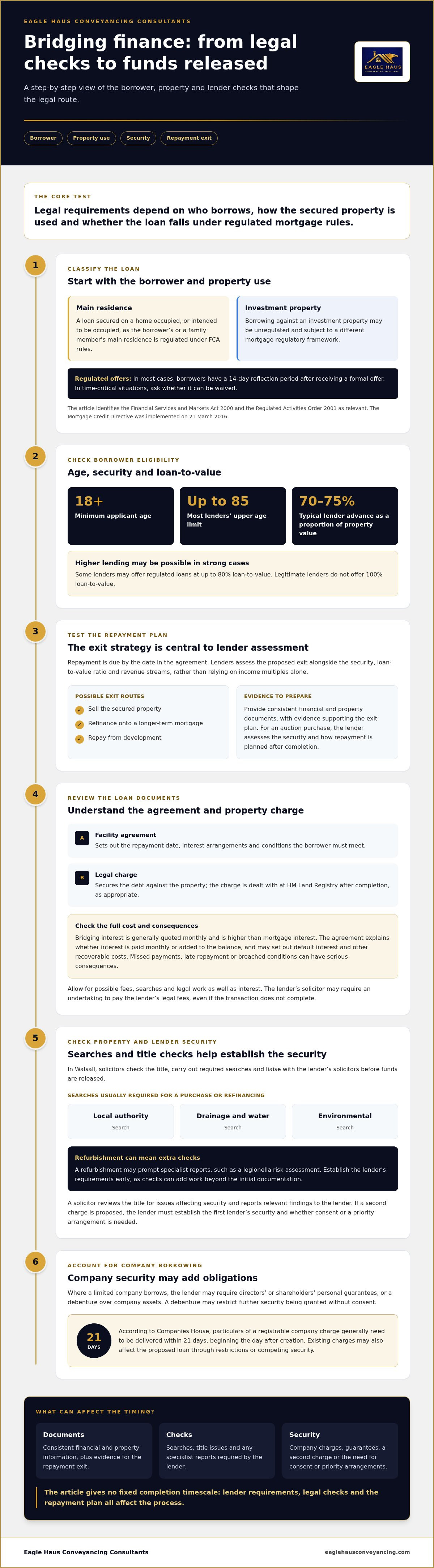
Speed is not the only factor in deciding whether bridging finance is suitable. The legal requirements for bridging finance in Walsall depend on who is borrowing, how the property is used and whether the loan falls under regulated mortgage rules. A loan secured on a property occupied, or intended to be occupied, by you or a family member as a main residence is regulated under FCA rules.
It is understandable to focus on how quickly funds might be released, especially when a purchase or sale is time-sensitive. But legal checks, property documents and your repayment plan all affect the process. This guide explains when residential bridging finance is regulated, what security and legal documents may be involved, how lenders assess an exit strategy and what can affect timescales.
You will also see how the purpose of the borrowing can affect the legal route, why searches and title checks matter, and where delays can arise. Understanding these moving parts can help you assess the timing and obligations alongside the property opportunity.
Table of Contents
Bridging Finance for Property Investment - What are the Legal Considerations?
For investors considering the legal requirements for bridging finance in Walsall, the rules depend on the borrower, the property’s use and any statutory exclusions. In England and Wales, the transaction includes a loan agreement and legal charge. In Walsall, solicitors check the title, carry out required searches and liaise with the lender’s solicitors before funds are released.
Loan Terms and Lender Requirements
Before completion, review the facility agreement, repayment conditions, interest arrangements and security obligations. Missed payments, late repayment or a breach of conditions can have serious consequences. Compare the loan term with your planned exit, and ask your solicitor to explain any unclear wording. The lender’s solicitor may also require your solicitor to undertake to pay the lender’s legal fees, even if the transaction does not complete.
Funding Sources and Lender Security
The lender provides bridging funds in return for agreed repayment terms and security, usually over property or land. For a purchase or refinancing, lenders usually require local authority, drainage and water, and environmental searches. A refurbishment may also prompt specialist reports, such as a legionella risk assessment. These checks can add work beyond the initial documentation, so establish the lender’s requirements as early as possible.
Where a limited company borrows, the lender may also require directors’ or shareholders’ personal guarantees, or a debenture over company assets. A debenture may restrict further security being granted without consent. According to Companies House, particulars of a registrable company charge generally need to be delivered within 21 days, beginning the day after creation. Existing company charges also matter, as restrictions or competing security may affect the proposed loan.
Borrower Eligibility and Affordability
Eligibility depends on the borrower, property security, loan-to-value ratio and repayment plan. UK applicants must be at least 18 years old, and most lenders accept applicants up to 85 years old. Lenders typically advance 70% to 75% of a property’s value; some may offer regulated loans at up to 80% loan-to-value in strong cases. Legitimate lenders don’t offer 100% loan-to-value.
Lenders assess affordability by considering the loan-to-value ratio, revenue streams and proposed exit, rather than relying on income multiples alone. For an auction purchase, for example, the lender will assess the security and how you plan to repay after completion. Provide consistent financial and property documents, including evidence to support your exit plan. If a company is borrowing, explain the business purpose and identify any guarantees or existing charges that could affect the lender’s security. Preparing for the legal requirements for bridging finance in Walsall also means accounting for these checks when assembling the transaction documents.
Conveyancing checks link the lender’s requirements to the property transaction. Your solicitor reviews the title for issues affecting security, handles searches and reports relevant findings to the lender. If a second charge is proposed, the lender must establish the first lender’s security and whether consent or a priority arrangement is needed.
When a residential bridging loan is regulated
A residential bridging loan’s regulatory status depends on the borrower, property use and transaction structure. Repayment is due by the date in the agreement, using an exit such as a sale or remortgage.
Regulated and Unregulated Lending
A bridging loan secured against a home occupied, or intended to be occupied, by the borrower or a family member as their main residence is regulated under FCA rules. The Financial Conduct Authority says these loans fall under its supervision. Borrowing against an investment property may be unregulated and subject to a different mortgage regulatory framework.
UK legislation register identifies the Financial Services and Markets Act 2000 as relevant to whether a bridging loan is a regulated mortgage contract. UK legislation register also identifies the Financial Services and Markets Act 2000 (Regulated Activities) Order 2001 as relevant to that question. The Financial Conduct Authority says the Mortgage Credit Directive was implemented on 21 March 2016, bringing bridging loans secured against owner-occupier residential property under FCA supervision.
In most cases, borrowers have a 14-day reflection period after receiving a formal regulated bridging loan offer, according to the Financial Conduct Authority. This period follows receipt of the formal offer. In time-critical situations, borrowers may wish to ask whether the reflection period can be waived.
Agreements and Legal Charges
The bridging loan agreement records the facility’s terms, including the repayment date, interest arrangements and conditions the borrower must meet. A legal charge secures the debt against the property, with the charge dealt with at HM Land Registry after completion, as appropriate. Reviewing both documents clarifies what the borrower has agreed to and which property secures repayment.
Bridging interest is generally quoted monthly and is higher than mortgage interest. The agreement explains how interest accrues and whether it is paid monthly or added to the balance. It may also set out default interest and other recoverable costs if the borrower breaches conditions or misses the repayment deadline. Read these terms alongside your planned exit, not just the funds available at completion.
For repayment, a borrower may plan to sell the secured property, refinance onto a longer-term mortgage or repay from development proceeds. A regulated bridging loan typically has a 12-month term; unregulated bridging loans generally have standard maximum terms of up to 24 months. The contractual deadline still governs the particular facility, so allow time for a sale, refinance or development to complete.
For a Walsall residential purchase linked to bridging finance, residential purchase conveyancing support can help address the property transaction alongside its legal documents.
Facility agreements and property security documents
A facility agreement sets out the amount advanced, interest, repayment date and conditions attached to bridging finance. The property security documents give the lender rights if the borrower fails to meet those terms. For a Walsall purchase, read the agreement alongside the title and charge documents to understand the loan obligations and which property is secured before completion.
Bridging loans are usually secured against property or land. A legal charge is registered against the property’s title, while a company borrower may also grant a debenture over its assets. A loan can be secured against more than one property, so the paperwork should identify each asset and explain how the lender’s security applies. This is particularly relevant when an investment involves several properties.
First-charge and second-charge loans differ in the order lenders are repaid if the secured property is sold. A second-charge lender ranks behind the first lender, so it must establish the first charge’s extent and whether consent, a deed of priority or an intercreditor arrangement is needed. Costs depend on factors such as the security position and overall risk. The agreement should clearly set out the interest and charges.
The property’s condition and intended use shape the lender’s requirements. A derelict or uninhabitable property may not qualify for a standard mortgage, so bridging finance can fund a purchase or refurbishment before longer-term finance becomes possible. For development work, lenders may require specialist reports, planning documents or construction information. The facility may also set conditions for staged drawdowns before further funds are released.
Residential, buy-to-let and commercial properties can all feature in bridging transactions, but the property’s use affects the lender’s assessment and whether mortgage regulation applies. A main residence, for example, has a different regulatory position from an investment property. Company purchases also raise questions about the borrower’s legal structure and the assets offered as security.
For a property purchase, the lender’s solicitor checks that the documents support the agreed security and that any existing charges are addressed. If another lender already has a charge, the new lender needs to understand its priority before releasing funds. These checks apply to purchases and refinancing, including properties bought for investment or refurbishment.
Confirm the facility agreement identifies the repayment date, interest basis and borrower obligations.
Match each legal charge or debenture to the property or company assets it secures.
For a second charge, establish the first lender’s security and any required consent or priority agreement.
For derelict or development property, account for specialist reports, planning documents and staged funding conditions.
What is an Exit Strategy?
An exit strategy explains how you will repay a bridging loan by its contractual deadline. Lenders assess the plan before advancing funds and may monitor its progress as repayment approaches.
Repayment Routes
Repayment routes are the planned sources of funds for clearing the bridging loan. Common exits include selling the secured property, refinancing onto a longer-term mortgage or using proceeds from a completed development. Each route depends on a different event: a buyer completing, a mortgage being arranged or development work finishing.
For example, a borrower in Walsall buying a property before selling another may plan to repay the loan from the sale proceeds. An investor refurbishing a building might instead rely on a sale or mortgage after the work. If the property is commercial, the proposed sale or refinance still needs to fit the lender’s repayment deadline and the borrower’s documented plan.
Exit Plan Requirements and Assessment
An exit plan sets out the repayment route, the steps needed to achieve it and the expected timing. For regulated bridging loans, lenders must review the borrower’s exit strategy before approval. They assess whether the route is credible and how it fits the loan term. The exit also helps determine whether the borrowing suits the borrower’s plans.
Support your repayment route with evidence. A sale-based plan needs a realistic sale process; a refinance plan needs a property and borrowing proposition that can support longer-term mortgage finance. For development proceeds, explain how completing the work will lead to repayment. Lenders assess the proposal alongside affordability, revenue streams and loan-to-value, rather than relying on income multiples alone.
When planning for the deadline, allow contingency time for steps that could affect completion. A property sale may take longer than anticipated, while mortgage arrangements depend on the property and the borrower’s circumstances. Development exits can be affected by planning, construction documents, drawdowns and the release of further advances. Set out these dependencies clearly so the lender understands what must happen before repayment.
Lenders should establish the intended exit before advancing the loan and monitor progress during the facility, particularly as the contractual repayment date approaches. If progress changes, update the plan and identify a credible repayment route. A lender may consider extending the term if the borrower can show a credible repayment plan, but an extension should not be treated as the original exit.
Compare the planned completion date with the agreement’s repayment deadline, then work backwards through the sale, refinance or development milestones. This can reveal timing pressures early and show how each step supports repayment of the bridging facility.
Bridging finance transaction timescales
Bridging finance can be arranged within days, but funding depends on legal, valuation and lender checks. A typical UK application-to-funds timeline is 7 to 14 days. Straightforward cases may complete within a week, while an initial review typically takes 24 to 48 hours. These are different stages, not a promise that every transaction follows the same timetable.
Timing depends on how quickly the borrower supplies documents, whether the property title is clear and when searches and valuation information arrive. The lender’s solicitor checks the title and security, raises enquiries and coordinates completion requirements with the borrower’s solicitor. Missing documents or title issues can add steps before funds are released. Keep the purchase contract, identification and property information organised from the outset.
An auction purchase brings a fixed deadline into the transaction. Bridging finance can help meet a 28-day auction completion deadline, but the purchase still needs lender approval, legal checks and completion arrangements. Work backwards from the contractual date: allow time for searches, title enquiries and signing the facility and security documents. An auction timetable makes early coordination particularly important.
The properties securing the loan can also affect timing. A purchase or refinance usually involves local authority, drainage and water, and environmental searches. A refurbishment or development may require specialist reports, planning material or construction documents. For a refurbishment, the lender may request a legionella risk assessment and report, even if plumbing replacement is planned after completion. Each additional requirement can create another dependency.
Company borrowing may involve checks on existing charges and additional security documents. If a lender requires a debenture or personal guarantee, those documents need to be prepared and executed before completion. For a second charge, the lender must establish the first lender’s security and whether consent or a priority arrangement is required. These legal details can extend a transaction beyond an otherwise straightforward property purchase.
Be cautious of claims that funds will be released within 24 hours. The lender still needs to complete its checks, and solicitors must satisfy the conditions for release. A credible timetable accounts for the property, documentation, searches and lender requirements, rather than relying on a headline speed claim.
To keep a Walsall transaction moving, respond promptly to solicitor enquiries and flag the completion deadline early. Discuss your bridging finance conveyancing so the legal work can be aligned with the purchase timetable.
Eagle Haus Conveyancing Consultants: Residential Purchases and Sales
Eagle Haus Conveyancing Consultants supports residential purchases and sales where bridging finance forms part of the property transaction. The firm handles legal work for purchases, sales and ownership changes, coordinating it with the related property documentation. For example, a purchase funded temporarily before another property is sold involves conveyancing steps for both transactions.
If your next step is refinancing after the bridge, remortgage support may also be relevant. Eagle Haus also handles Company Purchases and Transfers of Equity. The right support depends on the transaction you are completing and the legal work it involves.
For a clear next step on your property transaction, contact Eagle Haus Conveyancing Consultants.
Plan the property steps that come next
Before committing to bridging finance, map the borrowing against the property transaction that follows. Consider who will own the property, what legal work the next stage involves and how the transition will be handled. For anyone weighing the legal requirements for bridging finance in Walsall, planning ahead can keep the funding decision connected to the wider move.
Eagle Haus Conveyancing Consultants handles Residential Purchases and Sales, Transfers of Equity and Remortgages. These services support different stages of a property change, from buying or selling a home to changing ownership or arranging a new mortgage. Understanding the conveyancing work involved provides a practical starting point for discussing how your property plans fit together.
Get in touch with Eagle Haus Conveyancing Consultants to discuss the property transaction you’re planning. With your next steps clearly in view, you can move forward with greater confidence.
Frequently Asked Questions
Who is eligible for a bridging loan?
Applicants must be at least 18, and most lenders accept borrowers up to 85. Eligibility also depends on the property offered as security, the loan-to-value ratio, the borrower’s finances and a credible repayment plan. For example, a company buying an investment property may face different checks from an individual borrowing against a home. Lenders typically assess the proposed exit and available revenue rather than relying only on income multiples.
How does the application process work?
Typically, the borrower provides information about the property, borrowing purpose, finances and intended repayment route. The lender assesses the proposal, then solicitors review the title, carry out relevant searches and prepare the loan and security documents. For mortgage clients, Eagle Haus requires six months of payslips and bank statements showing the source of funds. Cash purchases require documents covering 12 months, and moved funds need a full evidence trail with supporting statements.
What does FCA regulation mean for you?
FCA regulation means regulated lenders must assess affordability and suitability, including the borrower’s repayment plan, before approving the loan. In most cases, borrowers have a 14-day reflection period after receiving a formal regulated offer, according to the Financial Conduct Authority. This gives time to consider the offer. A borrower’s rights and the lender’s obligations depend on whether the transaction falls within regulated mortgage rules.
When must a bridging loan lender be FCA-authorised or the loan regulated?
A loan secured against a property that the borrower or a family member occupies, or intends to occupy, as their main home is regulated under FCA rules. A lender proposing regulated activities may need appropriate FCA authorisation and permissions before starting them. By contrast, a company borrowing for its business purposes against company property will not ordinarily create a regulated mortgage contract, provided it is not acting as trustee.
What affordability, creditworthiness and disclosure checks are required for regulated bridging loans?
For regulated lending, the lender must assess affordability and suitability, including the proposed exit strategy. The assessment may consider the loan-to-value ratio, revenue streams and the borrower’s financial position. Provide accurate information about income, existing borrowing, property ownership and the intended use of funds, and disclose relevant changes during the application. This helps the lender assess whether the repayments and planned exit fit the borrower’s circumstances.
What legal documents are needed for a bridging loan, including the mortgage deed and personal guarantee?
Core documents usually include the facility agreement and a legal charge, often documented through a mortgage deed, securing the loan against property. A company borrower may also be asked for a debenture over company assets or a personal guarantee from a director or shareholder. The solicitor checks the title and reports issues affecting security. Existing charges may also require consent or a priority agreement before funds are released.
What are typical bridging loan interest rates, arrangement fees and legal costs in Walsall?
Bridging interest is commonly quoted monthly and is higher than mortgage interest. The total cost may include interest, an arrangement fee, an exit fee, valuation costs, searches and legal work for both parties’ solicitors. The amounts depend on factors such as the loan’s risk, security and repayment plan. Request a free, no-obligation quote from Eagle Haus to understand the conveyancing fees for your transaction.
What risks apply if a borrower misses repayments or cannot repay a Walsall bridging loan?
Missing interest payments, failing to repay by the contractual deadline or breaching loan conditions can trigger default. Depending on the agreement, the lender may charge default interest and recover legal, administration, enforcement or receiver costs. If the debt remains unpaid, the lender may seek possession through the courts, appoint receivers or enforcement agents, and sell the secured property. A company guarantee can also expose the guarantor to obligations under its terms.



Comments