Transfer of Equity Costs: A Comprehensive 2026 UK Budgeting Guide

What if the most expensive part of changing your property deeds isn't the solicitor's fee, but a tax trigger you didn't see coming? Many homeowners assume that adding a partner or removing an ex-spouse is a simple administrative task, yet the reality of transfer of equity costs often involves a complex web of Stamp Duty thresholds and Land Registry scales. It is natural to feel anxious about hidden charges or lender requirements whilst you try to organise your financial future. As a trading name of TRW Legal Consulting Ltd, Eagle Haus Conveyancing Consultants provides regulated legal services through Taylor Rose to ensure these transitions are handled with professional care.
We agree that transparency is vital for your peace of mind during major life changes. This 2026 guide helps you master these complexities by providing a detailed breakdown of legal disbursements and tax implications. We will examine the £250,000 Stamp Duty nil-rate threshold, explain the latest Land Registry fee structures, and show you exactly how to navigate lender consent. You will gain a clear roadmap to manage your budget, avoid HMRC penalties, and ensure a seamless ownership change without the stress of the unknown.
Table of Contents
What Are the Total Costs of a Transfer of Equity?
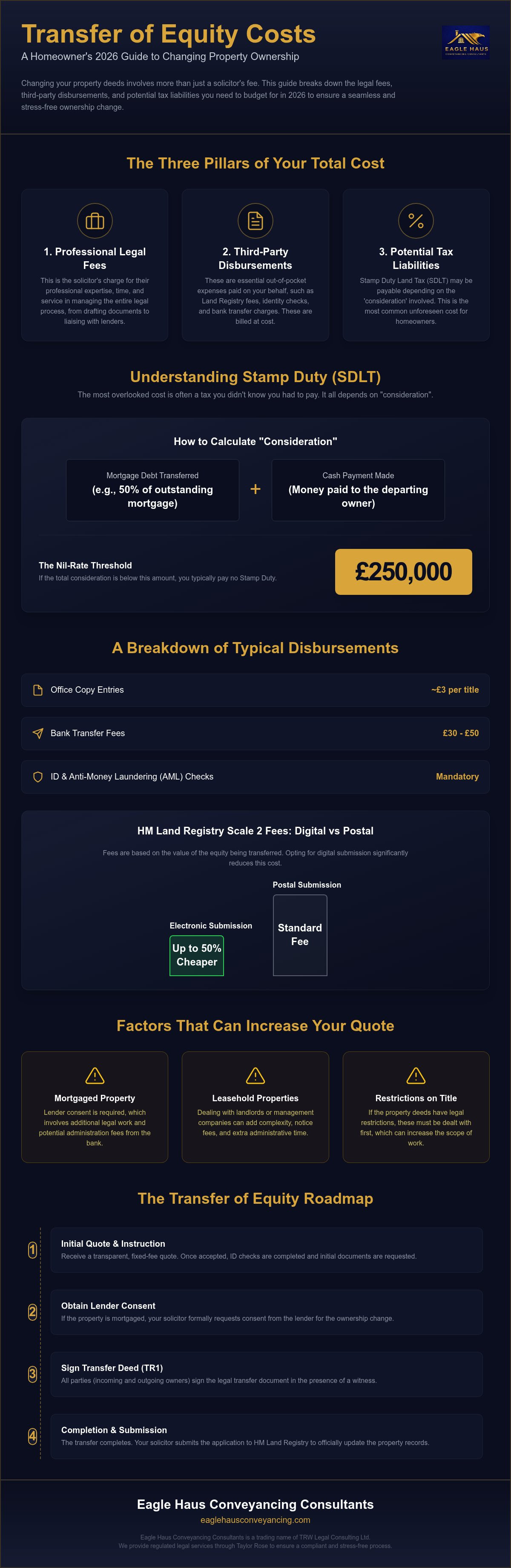
A Transfer of equity is the formal legal process of changing the ownership structure of a property without selling it. This might involve adding a new partner to the deeds or removing a former spouse after a relationship ends. To budget effectively, you must look beyond the initial solicitor quote and consider the three primary cost pillars: professional legal fees, third-party disbursements, and potential tax liabilities. Each of these components contributes to the final transfer of equity costs you'll encounter during the process.
The complexity of your transaction often hinges on whether the property is mortgaged. When a lender is involved, they must formally consent to the change, which often necessitates additional legal work to ensure their security remains protected. It's also vital to distinguish between "gifted" equity, where a share is given freely, and "bought" equity, where the incoming party pays a specific sum. This distinction is a major factor in determining how much you'll ultimately pay in fees and taxes.
The Legal Fee vs. Total Transaction Cost
It's common for homeowners to focus solely on the solicitor's headline fee, but this is only one piece of the financial puzzle. Total transaction costs include essential disbursements like Land Registry fees, identity verification, and anti-money laundering searches. Eagle Haus Conveyancing Consultants prioritises fee transparency to build trust with our clients. By providing regulated legal services through Taylor Rose as part of TRW Legal Consulting Ltd, we ensure you receive a comprehensive, fixed-fee quote that covers all predictable expenses from the outset. This approach prevents the anxiety of unexpected invoices during what is often a stressful life transition.
Why 2026 Market Conditions Matter
The current property market in 2026 has a direct impact on your transfer of equity costs. In areas like Wolverhampton and Telford, rising property values can push transactions into higher Land Registry fee brackets, as these are calculated based on the value of the share being transferred. Additionally, the 2026 interest rate environment means many homeowners choose to combine their ownership change with a remortgage to secure a better deal. For a deeper look at how these market dynamics influence your options, you can read our Transfers of Equity: The 2026 Guide to Changing Property Ownership. This context is essential for anyone looking to make an informed decision in the current climate.
A Breakdown of Conveyancing Fees and Disbursements
Disbursements are the essential "out-of-pocket" expenses your solicitor pays to third parties on your behalf. These are a significant part of your overall transfer of equity costs and are usually billed at cost. To begin the process, your solicitor will obtain "Office Copy Entries" from HM Land Registry. These documents, which usually cost around £3 per title, allow us to verify the current ownership and identify any existing mortgages or legal restrictions. The legal transfer itself is formalised using a TR1 form. This document is the instrument that legally moves the interest from one person to another and must be signed by all parties and witnessed correctly.
Securely moving funds also involves standard administrative charges. Bank transfer fees, typically ranging between £30 and £50, are required when a mortgage is being redeemed or a cash sum is being paid to a departing owner. Additionally, identity and Anti-Money Laundering (AML) checks are mandatory for every person involved in the transaction. These checks protect you from fraud and ensure the process meets strict UK regulatory standards.
Land Registry Scale 2 Fees Explained
Scale 2 fees are the standard for non-sale transfers, such as gifting a share of a property or transferring equity as part of a divorce settlement. These fees are calculated based on the value of the equity share being transferred rather than the full market value of the property. Choosing a solicitor who prioritises digital submissions is a smart way to manage your transfer of equity costs. Electronic applications are significantly cheaper than traditional paper-based postal submissions, often reducing the Land Registry fee by more than half.
Additional Search and Administrative Charges
While a full suite of searches isn't always necessary for an equity transfer, specific scenarios demand extra checks. Bankruptcy searches are mandatory to protect the new title, ensuring that no party involved is currently insolvent. If you are remortgaging as part of the process, your new lender might request updated local authority searches to protect their investment. Complexities also arise if you need to change ownership of your Help to Buy home, as this requires specific administrative fees paid to the scheme administrator. If you have any questions about these requirements, our team can help you calculate your total costs. Finally, if the parties involved use different legal representatives, an ID1 form may be required to verify signatures, which can incur a small additional verification fee.
Stamp Duty Land Tax (SDLT) and Transfer of Equity
One of the most significant variables in your transfer of equity costs is Stamp Duty Land Tax (SDLT). Unlike a standard purchase, the tax isn't calculated on the property's market value. Instead, it's based on "chargeable consideration." This includes any cash payment made to the person leaving the title plus the value of any mortgage debt the remaining or new owner takes on. Understanding this distinction is crucial; you might trigger a tax bill even if no money changes hands during the transition.
Even if no tax is due, you must file an SDLT return with HMRC if the consideration is £40,000 or more. Failing to do so can lead to unexpected penalties, so don't overlook this administrative step whilst focusing on the larger costs. Because these rules are intricate, we always recommend consulting the official government guidance on SDLT to confirm your specific status before proceeding.
Exemptions: Divorce, Separation, and Gifting
In many instances, you can avoid SDLT altogether. Transfers made as part of a formal divorce agreement, civil partnership dissolution, or a court order are typically exempt. This remains true in 2026, provided the transfer is strictly related to the legal ending of the relationship. Similarly, a "Love and Affection" transfer involves gifting equity without any consideration. If there's no mortgage on the property and no cash is exchanged, there's usually no tax to pay. These rules also apply to annulments and formal separations, helping to alleviate financial stress during difficult life transitions.
The "Mortgage Debt" Trap
The most common surprise for homeowners is how mortgage debt impacts their transfer of equity costs. If you add a partner to your deed and they take on 50% of the responsibility for the mortgage, HMRC views that 50% share as consideration. For example, if your property has a £540,000 mortgage, the incoming party is technically taking on £270,000 of debt. Since the 2026 nil-rate threshold for residential properties is £250,000, this transaction would trigger a tax bill on the amount that exceeds the limit.
It's also vital to remember the 3% surcharge for additional properties. If the person receiving the equity already owns another home, this higher rate applies to the entire consideration value, not just the portion above the threshold. Seeking specialist tax advice alongside your legal conveyancing is the best way to ensure your budget is accurate and your ownership transition remains compliant with current laws.
Factors That Can Increase Your Equity Transfer Quote
While many homeowners start with a base estimate, your final transfer of equity costs can fluctuate based on the specific legal "markers" on your property's title. For instance, if you hold the property as tenants in common, a Form A restriction will likely be present. Amending or removing these restrictions requires additional drafting and Land Registry filings. Unlike simple residential changes, transfers involving company-owned properties or bridging loans also require specialist oversight. These complex structures involve corporate verification steps that naturally influence the professional time required for your case.
Lender requirements also play a significant role. If you aren't remortgaging but simply adding a person to the deed, your current bank must grant "Consent to Transfer." Most lenders charge an administration fee for this, which often ranges from £100 to £300. They may also require their own legal representation to ensure their security remains protected; this is a cost that is typically passed on to the homeowner. Even geographic factors matter, as specific council requirements in areas like Birmingham or Staffordshire can occasionally necessitate additional certificates or searches.
Leasehold vs. Freehold Costs
Leasehold properties involve more administrative hours than freeholds. Your conveyancer must communicate with the freeholder or management company to serve a formal "Notice of Transfer." In the West Midlands, management companies often charge specific fees for processing this notice or for providing a "Deed of Covenant." Before the transfer can complete, you must also ensure that all ground rent and service charge arrears are cleared. These extra layers of communication and verification are why leasehold quotes are generally higher than freehold equivalents.
Mortgages and Remortgaging Extras
If you decide to switch lenders whilst changing ownership, the legal workload increases. You are essentially completing a remortgage and a transfer of equity simultaneously. This requires your solicitor to satisfy the requirements of a new lender whilst discharging the old mortgage. You can find more detail on this in our Remortgage and Transfer of Equity: The 2026 Professional Legal Guide. To ensure you aren't caught out by these variables, you should request a bespoke quote that accounts for your specific mortgage and leasehold status. This proactive step helps you manage transfer of equity costs without any late-stage surprises.
Securing a Transparent Quote with Eagle Haus Conveyancing Consultants
Choosing the right partner for your property transition requires more than just a calculator; it requires a team that understands the nuances of the West Midlands market. Eagle Haus Conveyancing Consultants combines modern digital efficiency with a boutique, client-focused approach that prioritises your peace of mind. As a trading name of TRW Legal Consulting Ltd, we deliver regulated services through Taylor Rose, ensuring that your transaction is backed by the highest level of professional oversight. This structure allows us to manage transfer of equity costs with precision whilst maintaining the personal connection that larger, impersonal firms often lack.
Our expertise thrives in complex environments that standard high-street conveyancers might avoid. We specialise in bridging loans and company property purchases, making us an ideal choice for investors or homeowners with intricate financial arrangements. Because we anticipate the specific requirements of these high-stakes transactions, we can provide a smoother journey from instruction to completion. We focus on proactive communication, ensuring you aren't left waiting for updates during critical stages of your ownership transition. This forward-thinking methodology is designed to alleviate the stress typically associated with major life changes.
Why a Personalised Quote Beats an Online Estimate
Whilst instant online estimates provide a rough idea, they often fail to account for the "Restrictions on Title" or specific lender panel requirements discussed earlier in this guide. These "headline prices" usually omit mandatory disbursements, which can lead to a distorted view of your total transfer of equity costs. Eagle Haus Conveyancing Consultants assesses your specific mortgage status and property title before issuing a quote, ensuring total transparency from the outset. We don't believe in hidden fees or late-stage surprises. For further guidance on selecting the right representative for your needs, refer to our guide on Choosing a Transfer of Equity Solicitor.
Expertise Across Staffordshire and the West Midlands
We maintain a strong local presence in Cannock, Walsall, and Birmingham, catering to busy professionals who value both speed and accuracy. Our modern systems are adapted to contemporary lifestyles, allowing for secure digital document handling and faster completion times without the need for endless paperwork. Despite our tech-savvy methodology, we remain a deeply human service provider that treats every client as a partner in the process. We understand that your home is your most valuable asset, and we treat it with the gravity it deserves. If you are ready for a bespoke consultation that clarifies your unique financial position, contact our team today. We are ready to help you navigate the next chapter of your property journey with confidence and ease.
Planning Your 2026 Property Ownership Transition
Changing the legal structure of your property ownership is a significant step that requires careful financial planning. By identifying the specific triggers for Stamp Duty and accounting for lender-specific disbursements early, you can manage your transfer of equity costs without the stress of hidden fees. Whether you're navigating a divorce settlement or simply adding a partner to your deeds, transparency remains the most effective tool for a smooth transition.
As specialists in bridging and investor finance, our team at Eagle Haus provides the expert guidance needed for even the most complex equity changes. We offer transparent, fixed-fee legal support and are regulated by the SRA via Taylor Rose; this ensures your transaction is handled with the highest professional standards. If you're ready to secure your financial future with a partner who prioritises clarity, Request a Transparent Transfer of Equity Quote from Eagle Haus today. We look forward to helping you achieve a seamless and secure ownership transition.
Frequently Asked Questions
How much does a solicitor charge for a transfer of equity in 2026?
Professional legal fees for a straightforward transaction in 2026 typically range from £500 to £750 plus VAT. If your case involves a mortgage or complex leasehold requirements, the fee may sit at the higher end of this scale to reflect the extra administrative work. These costs cover the expertise required to draft the TR1 form and manage Land Registry filings. It's best to request a fixed-fee quote to ensure your transfer of equity costs remain predictable.
Do I have to pay Stamp Duty if I am just adding my partner to the deeds?
You only pay Stamp Duty if the "chargeable consideration" exceeds the 2026 nil-rate threshold of £250,000. Consideration includes any cash payment plus the share of the mortgage debt the new owner takes on. For example, if you add a partner to a property with a £600,000 mortgage, their 50% share of the debt is £300,000. This exceeds the threshold and would trigger a tax bill even if no cash changes hands.
Can I carry out a transfer of equity without a solicitor?
While you can technically manage the process yourself if the property is mortgage-free, it's rarely advisable for most homeowners. If there is an existing mortgage, your lender will almost certainly insist on a regulated solicitor to protect their legal charge. Professional oversight ensures that the transfer deed is correctly executed and the Land Registry's Scale 2 requirements are met. Mistakes in these filings can lead to significant delays or title issues when you eventually sell.
How long does the transfer of equity process typically take?
A standard transfer of equity typically takes between four and six weeks to complete. This timeline depends on how quickly your mortgage lender provides consent and how fast all parties sign the necessary documents. If you're also remortgaging, the process might align with the lender's offer period. Using modern, tech-savvy conveyancers can often speed up the identity verification and communication stages, helping you reach a final resolution much more efficiently.
Will my mortgage lender charge me a fee for a transfer of equity?
Most mortgage lenders charge an administration fee to review and consent to the change in ownership. These fees usually fall between £100 and £300, depending on your specific bank's policies. The lender needs to perform their own due diligence on the incoming party to ensure they meet affordability criteria. You should check your mortgage terms or contact your lender early to factor this specific expense into your overall budget before starting the legal work.
What is the difference between legal fees and disbursements?
Legal fees represent the professional charges for your solicitor's time and expertise in managing the transaction. Disbursements are third-party costs that your solicitor pays on your behalf, such as Land Registry fees and AML search charges. It's important to distinguish between these when reviewing a quote. A transparent breakdown ensures you don't mistake the solicitor's headline rate for the total amount you'll need to pay to finish your transfer of equity costs.
Do I need a new mortgage to transfer equity?
You don't necessarily need a new mortgage, but you must have your current lender's formal permission to change the title. They will assess the new ownership structure to ensure their loan remains secure. Alternatively, many homeowners choose this moment to remortgage with a different lender to secure a better interest rate. Combining these processes can be cost-effective as your solicitor can handle both the new mortgage and the equity transfer simultaneously during the same transaction.
Is a transfer of equity cheaper than a standard property sale?
Yes, a transfer of equity is generally cheaper than a standard property sale or purchase. This is because the legal work is less intensive; there is usually no need for a full contract pack or extensive local authority searches. Land Registry fees are also lower because they're based on Scale 2 rather than the higher Scale 1 rates used for sales. This makes it a more cost-effective way to reorganise property interests between family members or partners whilst maintaining your home.


Comments