Solicitor vs Conveyancer: Which Should You Choose for Your 2026 Home Move?

The cheapest quote on your screen might actually be the most expensive mistake you make during your 2026 home move. When you're looking at a list of legal providers, the choice of solicitor vs conveyancer often feels like a toss-up between two identical services with different price tags. You want a smooth, stress-free completion, yet the fear of hidden delays or confusing jargon can make the decision feel overwhelming. It's completely normal to feel uncertain about who is truly qualified to protect your investment, especially if your move involves specialist finance like bridging loans.
We believe that your peace of mind is just as important as the legal paperwork. This guide will help you understand the essential differences between solicitors and licensed conveyancers so you can choose the right level of expertise for your specific situation. We'll explore the impact of the mandatory 2026 TA6 property forms, explain why certain transactions require a broader legal scope, and provide the clarity you need to ensure your new home is fully protected from day one.
Table of Contents
Solicitor vs Conveyancer: Defining the Legal Professionals
Picking the right expert to manage your property move usually starts with the solicitor vs conveyancer debate. It's a common misconception that one is inherently better than the other; in reality, both are fully qualified and regulated to practise property law in England and Wales. The right choice depends on the specific details of your transaction, the length of your chain, and the level of legal protection you feel you need. Understanding What is Conveyancing? helps demystify the process. It's the essential administrative and legal work required to ensure a property's title passes securely from seller to buyer.
What is a Licensed Conveyancer?
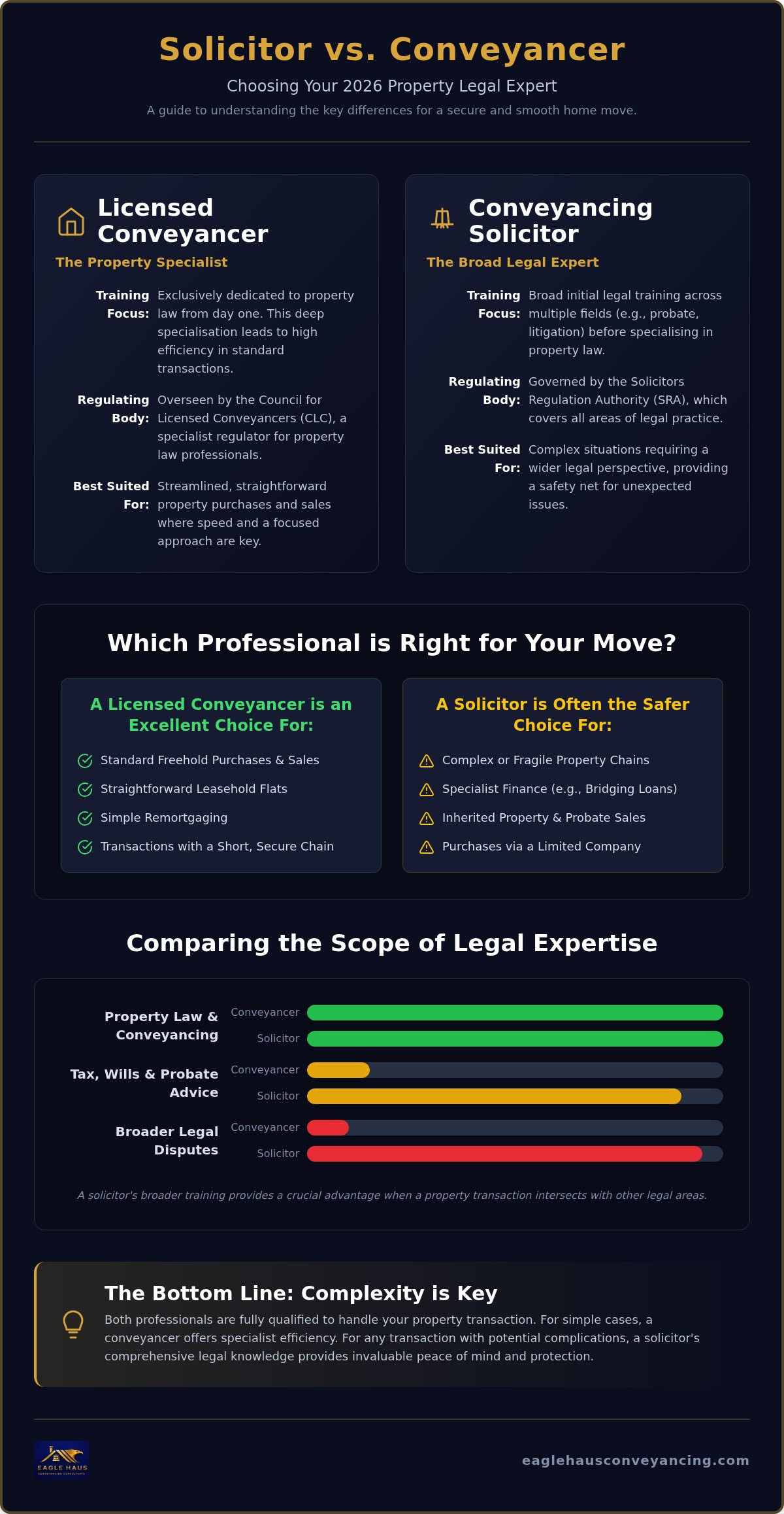
A Licensed Conveyancer is a specialist professional regulated by the Council for Licensed Conveyancers (CLC). Unlike general lawyers, their entire training and professional life revolve exclusively around property law. This single-minded focus means they are often incredibly efficient at processing standard transactions. You'll frequently find them working in high-volume firms, often referred to as conveyancing factories, where digital systems and speed are the top priorities. However, many also operate in boutique specialist firms where they provide dedicated, expert attention to complex residential cases. They are a great fit if your move is straightforward and you want a professional who knows the ins and outs of property transfers without the distraction of other legal fields.
What is a Conveyancing Solicitor?
A solicitor is a lawyer regulated by the Solicitors Regulation Authority (SRA). Their training is naturally broader, covering multiple disciplines such as probate, litigation, and contract law before they choose to specialise in property. This wider background provides a vital safety net if your move hits a legal snag that falls outside the standard property remit. Whilst managing residential purchases and sales, a solicitor can offer a comprehensive perspective. This is particularly useful if the sale involves an inherited estate or complex tax implications. They bring a level of legal authority that is reassuring when dealing with high-value assets or contentious situations.
Ultimately, the solicitor vs conveyancer decision often hinges on complexity. If you're buying a standard freehold house with no complications, a conveyancer's streamlined approach is often perfect. If your move is part of a fragile chain or involves non-standard property types, a solicitor's broad legal toolkit might offer the extra security you're looking for in 2026. The rise of digital-first platforms means both roles are more accessible than ever, but the depth of legal knowledge behind the screen remains the deciding factor for a smooth completion.
The Critical Differences in Training and Regulation
While the day-to-day process of moving house looks remarkably similar regardless of who you hire, the foundations of their expertise are built differently. A Licensed Conveyancer is a specialist from day one. Their training focuses exclusively on property law, making them highly streamlined for efficient, standard transactions. On the other hand, a solicitor follows a generalist path first, studying a wide range of legal fields before specialising. This distinction is the core of the solicitor vs conveyancer choice for many buyers in 2026. It's the difference between a specialist surgeon and a highly skilled GP who also performs surgery; both can get the job done, but their background influences how they view complications.
Breadth of Legal Knowledge
The solicitor’s advantage lies in multi-faceted legal scenarios where property isn't the only concern. For instance, a solicitor can advise on how a property purchase affects your Will or potential inheritance tax liabilities. They see the bigger picture of your legal life. Conversely, conveyancers are experts in the highly efficient models where speed and volume are often prioritised for standard sales. They don't usually deviate into other legal areas, which keeps their process lean. If you're looking for a partner who can manage more than just the deeds, consulting with a modern legal guide can help you decide which path fits your long-term goals.
Regulatory Safeguards
Both professions must adhere to strict codes of conduct to ensure your funds remain safe. Solicitors are regulated by the Solicitors Regulation Authority (SRA), which provides a broad safety net across all legal services they offer. Licensed conveyancers are overseen by the Council for Licensed Conveyancers (CLC), a body that focuses specifically on protecting property buyers and sellers. Crucially, both are required to carry Professional Indemnity Insurance. This insurance is a non-negotiable requirement that protects you if a mistake is made during the transaction. Whether you choose an SRA-regulated firm or a CLC-specialist, the high level of consumer protection in 2026 ensures your investment is legally secure.
Ultimately, the choice between these two professionals shouldn't be based on a fear of poor regulation. Both paths offer robust protection and deep expertise. Instead, your decision should focus on the level of bespoke legal support your specific move requires. For a standard freehold sale, a conveyancer’s focused approach is excellent. For a move tied up in complex estate planning or litigation, the broader reach of a solicitor provides the necessary legal weight to keep your transaction on track.
When Complexity Dictates Your Choice
While a standard freehold sale is relatively linear, some transactions carry inherent legal risks that require a broader perspective. This is often where the solicitor vs conveyancer choice becomes critical. If you're dealing with a property that has unusual title deed restrictions or a brewing boundary dispute, a solicitor’s background in litigation provides a distinct advantage. They can interpret complex covenants and advise on potential court outcomes in a way that a specialist conveyancer might not be trained to do. This proactive approach identifies problems before they become expensive delays during your 2026 move.
Company Purchases and Investment Portfolios
Purchasing property through a limited company is a growing trend for 2026 investors looking to optimise their tax positions. These company purchases require more than just property knowledge; they demand a firm understanding of corporate law and director responsibilities. Your legal partner must ensure the transaction complies with strict lender requirements for specialist finance whilst protecting the long-term interests of the investment firm. A solicitor’s ability to navigate both corporate structures and land law ensures your portfolio remains legally robust. Having a partner who understands the intersection of business and property law is vital for professional security.
Specialist Finance and Bridging Loans
Investors moving quickly amongst the West Midlands property market often rely on bridging loans to secure high-potential deals before they disappear. These high-stakes transactions require a delicate balance of extreme speed and rigorous legal diligence. Because bridging finance is expensive, any delay in the legal process can cost thousands in interest payments. Many investors prefer the professional reassurance of a solicitor who can handle the intense scrutiny required by specialist lenders. This oversight ensures that whilst the clock is ticking, every legal safeguard is firmly in place. It's about combining the efficiency of a modern move with the depth of traditional legal expertise.
Ultimately, if your transaction involves more than just a simple exchange of keys, the solicitor vs conveyancer decision should lean towards the professional with the widest legal toolkit. Complexity shouldn't be a source of stress; it's simply a sign that you need a partner equipped to handle the nuances of modern property law. Choosing a professional who can manage complex finance and corporate issues alongside the standard conveyancing process ensures a smoother path to completion and legally protected ownership.
Choosing the Right Partner in the West Midlands
Choosing a partner for your 2026 move involves more than just a simple price comparison. The solicitor vs conveyancer debate often overlooks the immense value of regional knowledge. For transactions in Staffordshire, Wolverhampton, or Birmingham, local expertise is often the deciding factor between a smooth completion and a frustrated chain. If you're currently browsing for property solicitors near me, it's vital to find a team that understands the specific requirements and nuances of the West Midlands property market.
The Importance of Local Market Insight
Navigating regional property trends in areas such as Cannock, Walsall, and Telford requires an eye for detail that national firms often lack. Local partners often maintain established relationships with regional estate agents and surveyors, which streamlines the flow of information and speeds up the exchange of contracts. Proximity to your legal partner can alleviate much of the stress associated with completion week. They are often already familiar with specific Land Registry quirks or common regional search requirements, such as historic coal mining reports, that might surprise a national high-volume firm. This local insight ensures your searches are accurate and returned promptly, preventing the common bottlenecks that delay exchange.
Evaluating Fees and Service Levels
Understanding the difference between fixed-fee conveyancing and hourly rates is crucial for your 2026 budget. Whilst a low headline quote might seem attractive at first glance, the cheapest option often leads to hidden disbursement surprises later in the process. There is immense value in choosing a proactive professional guide over an impersonal, high-volume call centre. A boutique service prioritises individual attention, ensuring you aren't left chasing updates from someone who doesn't know your file. In a high-volume environment, communication often breaks down, leading to the very delays you are trying to avoid. A modern, tech-savvy firm uses digital tools to speed up the process, not to hide from their clients.
We aim to provide a modern service that doesn't lose the human touch. By balancing online efficiency with deep local insight, we ensure your transaction is handled with the highest level of care and professional authority. It is about creating a sense of security through every step of your journey. To start your move with a partner who truly knows the local area, speak to our West Midlands experts for a transparent and supportive quote that puts your needs first.
The Eagle Haus Advantage: Expert Conveyancing Simplified
Choosing between a solicitor vs conveyancer shouldn't feel like a compromise between speed and security. At Eagle Haus, we've designed a modern consultancy model that removes the stress from your 2026 home move. As a trading name of TRW Legal Consulting Ltd, we provide regulated legal services through our partnership with Taylor Rose. This structure allows us to offer the personalised, boutique experience of a dedicated consultant whilst providing the robust legal backing and resources of a top-tier national firm. It's a proactive approach that ensures your transaction remains on track without the frustration of high-volume call centres.
Boutique Service with Regulated Backing
The collaboration between Eagle Haus and Taylor Rose is built to protect your interests at every stage. When you work with us, you aren't just another file in a cabinet; you have a dedicated professional who understands the specific nuances of your move. We prioritise transparency and clear communication, ensuring you're never left wondering about the status of your exchange. This partnership means you benefit from modern digital systems that speed up the administrative side of conveyancing, all whilst your funds and legal documents are protected by a fully regulated, secure framework. We believe that professional authority should always be paired with a warm, human touch.
Expertise in Complex Transfers and Finance
Our team specialises in the areas of property law where precision is non-negotiable. Whether you're managing transfers of equity or navigating the complexities of company-based acquisitions, we provide the expert oversight required for a successful completion. We understand that modern investors and homeowners often require more than just a standard service. We offer tailored support for:
Specialist finance and bridging loan requirements.
Complex residential purchases and sales across the West Midlands.
Limited company property purchases for portfolio growth.
Detailed remortgage support for buy-to-let investors.
We pride ourselves on closing property deals fast whilst ensuring every legal detail is colour-perfect. If you're planning a remortgage or a new purchase in 2026, you need a partner who can balance technical expertise with a commitment to your individual goals. Our methodology is designed to alleviate the pressure of major life transitions, giving you the confidence that your ownership is legally protected. Take the first step towards a smoother completion by contacting our team today for a consultation that puts your needs at the centre of the process.
Secure Your 2026 Move with the Right Legal Expertise
The choice in the solicitor vs conveyancer debate ultimately comes down to the unique requirements of your property journey. For a standard residential sale, a specialist conveyancer offers incredible efficiency; however, if your move involves complex bridging loans or company-based acquisitions, the broader legal weight of a solicitor is often the safer path. By prioritising local expertise in the West Midlands and Staffordshire, you ensure that regional search nuances and Land Registry quirks don't stand in the way of your completion date. It's about matching the level of professional oversight to the complexity of your specific transaction.
At Eagle Haus, we provide regulated legal services through our partnership with Taylor Rose, combining national resources with the personal touch of a boutique consultancy. Our team specialises in company purchases and specialist finance, ensuring every legal detail is handled with precision and transparency. We're here to act as your modern professional guide, turning a potentially stressful transition into a smooth, successful reality. You deserve a partner who is as committed to your new beginning as you are.
Get a professional conveyancing quote from Eagle Haus today and move forward with total confidence.
Frequently Asked Questions
Is a conveyancer cheaper than a solicitor for a standard house sale?
Conveyancers are frequently more cost-effective for standard sales because they specialise solely in property law. However, the price gap has narrowed in 2026 as more solicitors adopt fixed-fee models. You should always compare the total quote, including disbursements and VAT, rather than just the headline fee. A cheaper quote from a high-volume firm might lack the personal attention your move in Staffordshire or Wolverhampton requires.
Can a conveyancer handle a complex leasehold property purchase?
Licensed conveyancers are fully qualified to handle complex leasehold purchases, as their entire training is dedicated to property law. They are experts in navigating the nuances of ground rents, service charges, and lease extensions. Whilst they are highly capable, if a leasehold issue turns into a broader legal dispute, a solicitor's litigation background might offer an extra layer of protection for your investment during the transaction.
Do I need a solicitor if I am buying a property through a limited company?
You don't strictly need a solicitor for a company purchase, but you do need a professional who understands corporate law. Buying through a limited company involves specific lender requirements and director responsibilities that go beyond a standard sale. At Eagle Haus, we specialise in these transactions, providing the regulated legal support needed to ensure your property investment firm remains compliant and legally secure throughout the process.
What happens if a legal dispute arises during the conveyancing process?
If a minor disagreement occurs, your legal representative will attempt to resolve it through negotiation. However, if a formal legal dispute arises that requires court intervention, a solicitor is generally better equipped to handle the litigation. In the solicitor vs conveyancer debate, this is a key distinction. Most property moves complete without such issues, but a solicitor provides a broader safety net for contentious situations.
Are licensed conveyancers as well-regulated as solicitors in 2026?
Yes, licensed conveyancers are subject to rigorous regulation by the Council for Licensed Conveyancers (CLC), whilst solicitors are overseen by the Solicitors Regulation Authority (SRA). Both bodies ensure that client funds are protected and that professionals maintain high ethical standards. In 2026, both paths offer robust consumer protection, including mandatory professional indemnity insurance, so you can feel secure regardless of which professional you choose for your move.
Can a solicitor help with my Will whilst handling my property purchase?
A solicitor can assist with your Will, but a licensed conveyancer is restricted to property-related legal work. If you want to update your estate planning whilst buying a house in Birmingham or Cannock, a solicitor offers a more comprehensive service. This approach is often convenient for buyers who want to ensure their new asset is properly accounted for in their long-term legal plans without hiring multiple firms.
How do I know if my conveyancer is properly regulated?
You can verify a professional's credentials by checking the official registers for the SRA or the CLC. Every regulated firm must display their regulatory information on their website and letterheads. For example, Eagle Haus is a trading name of TRW Legal Consulting Ltd, and we provide our regulated services through our partnership with Taylor Rose. This transparency ensures you're working with a legitimate, insured professional for your transaction.
Should I choose a local solicitor in Wolverhampton or a national online firm?
Choosing a local partner in Wolverhampton or Staffordshire often provides better market insight than a national online firm. Local experts understand regional Land Registry issues and have established relationships with West Midlands estate agents. A modern firm that combines online efficiency with a local touch offers the best of both worlds. You get the speed of digital communication without losing the personal connection and vital regional knowledge.


Comments