Shared Ownership Part Buy Part Rent: The Complete 2026 Guide

Updated: Sep 23
What if your path to the property ladder didn't require a massive deposit or a soul-crushing mortgage from day one? It's a common frustration that while the dream of owning a home is clear, the financial reality often feels out of reach. You might already know that shared ownership part buy part rent schemes exist to bridge this gap, but the complex leasehold structures and fear of hidden costs can make the process feel more daunting than it should.
We believe you deserve a clear, stress-free path to property ownership without the anxiety of expensive staircasing or confusing legal transfers. This complete 2026 guide provides that certainty. We will explore how the latest 1% staircasing rules work, explain your maintenance rights under the Affordable Homes Programme, and simplify the legal steps required to secure your future. You'll find a structured journey that turns professional jargon into a practical plan, helping you move into your new home with total confidence and lower monthly outgoings.
Table of Contents
What is Shared Ownership Part Buy Part Rent?
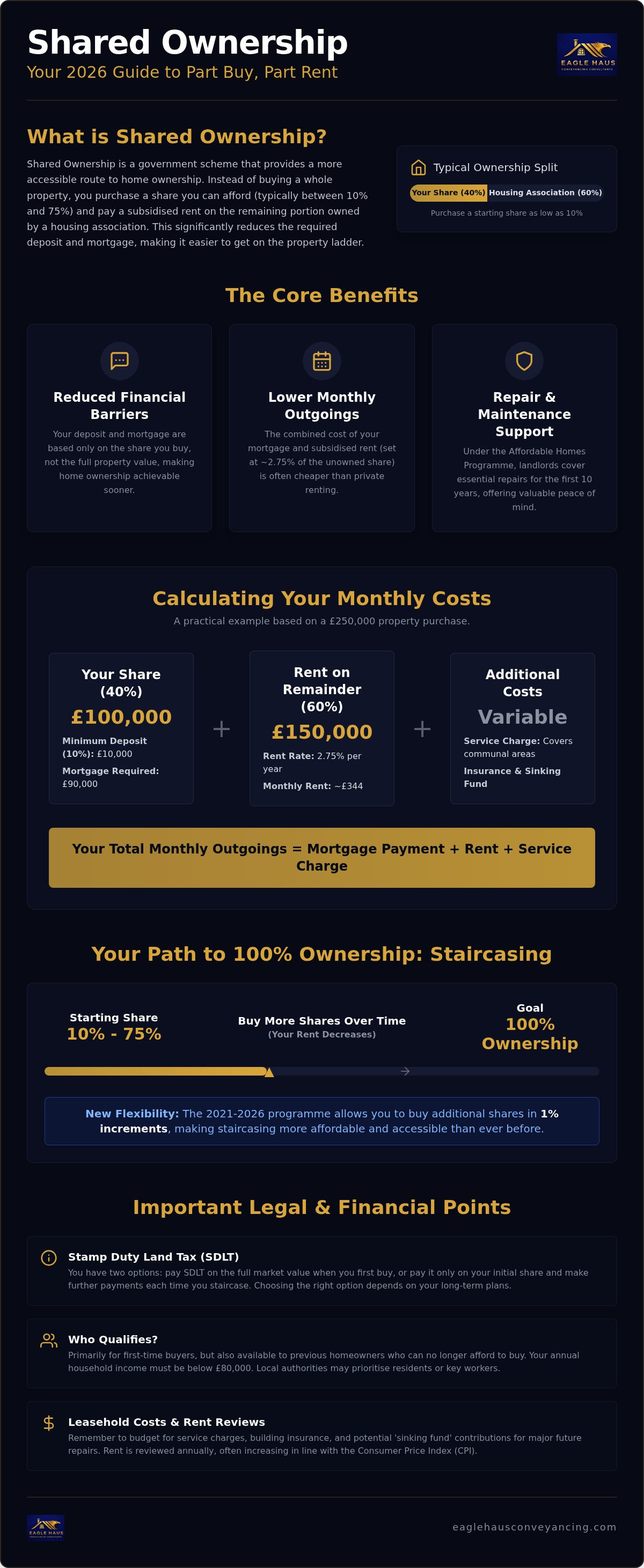
The concept of shared ownership part buy part rent is a practical solution for those who find the traditional housing market out of reach. In 2026, this scheme has evolved into a sophisticated legal partnership between you and a housing association. Essentially, you purchase a share of a property, usually between 10% and 75% of its market value, and pay a subsidised rent on the remaining portion. This model allows you to secure a home with a significantly smaller deposit than a standard purchase, as your deposit is based only on the share you're buying, not the full property value.
The housing association acts as your landlord and co-owner, holding the remaining equity whilst you live in the property as a leaseholder. It's helpful to understand what shared ownership is in a legal sense; it's a long-term leasehold arrangement that grants you the security of a homeowner without the immediate burden of a massive mortgage. In Staffordshire and the West Midlands, this has become a favourite route for buyers who want to stay local but need a more flexible entry point.
The Core Benefits of the Scheme
Choosing a part buy part rent model offers several distinct advantages for modern buyers:
Reduced Financial Barriers: Because you only need a mortgage for your share, the required deposit is much lower. This is often the difference between waiting years to save or moving in now.
Predictable Costs: Rent on the unowned share is typically set at 2.75% per year. Even with recent interest rate fluctuations in 2026, the combined cost of a mortgage and rent is often lower than private renting or a full mortgage.
Repair Support: Under the 2021-2026 Affordable Homes Programme, the landlord is responsible for essential repairs and maintenance for the first 10 years, offering peace of mind to new owners.
Who is Shared Ownership for?
This scheme isn't just for first-time buyers; it's a versatile tool for various life stages. To qualify, your annual household income must be less than £80,000. In areas like Wolverhampton, Telford, and Walsall, local authorities often prioritise residents or key workers who already have a connection to the community.
It's also an excellent option for "second-steppers" or those who've previously owned a home but can no longer afford to buy at full market value, perhaps following a divorce or a change in financial circumstances. By providing a clear path to ownership, shared ownership part buy part rent ensures that local families can find long-term security in the areas they love. Whether you're looking for a modern apartment in Birmingham or a family home in Staffordshire, the eligibility criteria are designed to support those with a genuine need for affordable housing.
Calculating the Financials: Rent, Mortgages, and Costs
Managing the financials of a shared ownership part buy part rent property requires a clear understanding of three distinct monthly outgoings: your mortgage payment, your subsidised rent, and your service charge. While rent is paid to the housing association, service charges fund the day-to-day upkeep of shared areas and apartment blocks; to see how residential schemes manage these communal spaces and budgets, you can learn more about Winfields Block Management. This tripartite structure is what makes the scheme affordable, but it also demands careful budgeting. Your mortgage is only for the portion you own, whilst the rent is paid to the housing association for the remaining share.
Understanding the Rent Component
The rent you pay is typically calculated at 2.75% of the value of the unowned share per year. According to the official government Shared Ownership scheme rules, these payments are kept below market rates to ensure the property remains affordable. It's vital to remember that rent is usually reviewed annually; increases are often linked to the Consumer Price Index (CPI). For the 2026-2027 period, many associations are applying a 4.8% increase, which reflects a CPI of 3.8% plus a 1% buffer. As you buy more shares through staircasing, your rent payments will decrease proportionally, eventually reaching zero if you achieve 100% ownership.
Hidden Costs to Budget For
Beyond the headline figures, you must account for service charges and building insurance. These fees cover the maintenance of communal areas, such as hallways or shared gardens, and are mandatory for leaseholders. You should also check your lease for a 'sinking fund' clause. This is a pot of money collected from all residents to cover major future repairs, like a new roof or lift maintenance. These costs can vary significantly depending on the age and type of the building. To get a better handle on your upfront expenses, you might want to read our First Time Buyer Conveyancing Fees: A Complete 2026 Guide to ensure your legal budget is accurate.
When planning your initial purchase, remember to factor in mortgage valuation fees, broker fees, and your legal disbursements. For a typical £280,000 property in the West Midlands where you purchase a 25% share, a 5% deposit on that share would average approximately £3,500 in 2026. This lower entry point is why shared ownership part buy part rent remains so popular. If you're feeling overwhelmed by the numbers, our team at Eagle Haus Conveyancing Consultants can help clarify the financial implications of your specific lease, ensuring you move forward with total transparency.
The Shared Ownership Conveyancing Process
Navigating a shared ownership part buy part rent purchase requires more than just standard legal checks. It's a tripartite agreement where your solicitor must satisfy the requirements of both your mortgage lender and the housing association. The process officially begins when we receive the Memorandum of Sale. This document is the starting gun for the transaction, outlining the agreed purchase price, the percentage share you're acquiring, and the specific administrative requirements of the housing provider. Unlike a traditional purchase, the timelines here are often dictated by the housing association's internal approval windows, making proactive legal management essential.
The Legal Due Diligence Phase
During the due diligence phase, your conveyancer's primary task is to dissect the Shared Ownership Lease. These documents are significantly more complex than standard leases, often containing restrictive covenants regarding sub-letting, home improvements, or even pet ownership. We meticulously review these terms to ensure they align with your mortgage lender’s specific handbook requirements. If the lease doesn't meet these standards, it can stall your application. For a broader look at how we manage these milestones, you can explore our guide on Residential Purchases and Sales: A Modern Guide to Conveyancing in 2026.
Stamp Duty Decisions
One of the most critical financial decisions you'll make during the legal process involves Stamp Duty Land Tax (SDLT). You generally have two options: a "Market Value Election" or "Staged Payments". A Market Value Election involves paying SDLT on the full market value of the property upfront. Whilst this requires more capital initially, it means you'll never pay SDLT again, even if you staircase to 100% ownership later. This is often a savvy move in the West Midlands property market if you expect prices to rise over the coming decade.
According to official government guidance on shared ownership, as of April 2025, first-time buyers pay 0% stamp duty on the first £300,000 of a property's value. This makes the Market Value Election particularly attractive for many 2026 buyers, as it often results in a zero-tax bill now and total protection from future tax hikes. We strongly advise clients to seek early legal advice on SDLT to avoid overpayment or unexpected costs when purchasing additional shares. Choosing the wrong method can lead to significant unnecessary expenses during the staircasing process, so getting this right at the point of shared ownership part buy part rent entry is vital for your long-term equity.
Future Planning: Staircasing and Selling
One of the most empowering features of the shared ownership part buy part rent model is the ability to increase your stake in the property over time. This process, known as staircasing, allows you to buy additional shares in increments as small as 1% under the latest 2021-2026 Affordable Homes Programme. To begin, you must instruct a RICS-qualified surveyor to provide an independent valuation. This is a non-negotiable step because the price of the additional share is determined by the current market value of your home at that specific time, not what you originally paid for it.
Once the valuation is set, your conveyancer manages the legal transition. This usually involves a Transfer of Equity to ensure that the amendment to your lease or the creation of a new deed is legally sound and correctly registered with the Land Registry. We also coordinate with your mortgage lender if you are borrowing additional funds to cover the cost of the new share, ensuring all financial charges are correctly recorded.
The Legal Steps to Staircasing
Staircasing requires a methodical approach to ensure your investment is protected. Your solicitor will review the existing lease to confirm the specific staircasing provisions and any associated administrative fees charged by the housing association. If you decide to staircase to 100%, the process becomes even more significant; it often involves acquiring the freehold of the property, which effectively ends your relationship with the landlord. This transition requires a specialist who can handle the nuances of leasehold enfranchisement alongside your mortgage provider’s requirements.
Selling Your Share
When the time comes to move on, the selling process differs from a standard market sale. Your housing association usually has a "nomination period", often lasting four to eight weeks. During this time, they have the right of first refusal to find a buyer who meets the scheme's eligibility criteria. This mechanism ensures the property remains affordable for the local community in Staffordshire or the West Midlands. If they cannot find a buyer within this window, you can typically sell your share on the open market through a specialist estate agent.
In certain scenarios, you might choose "back-to-back" staircasing. This is where you buy the remaining shares and sell the property at 100% ownership simultaneously. It is a complex legal manoeuvre that requires precise timing and expert coordination between multiple parties. Whether you are looking to buy more shares or move to your next home, our team at Eagle Haus provides the proactive support needed to manage these transitions without the stress.
Expert Conveyancing in Staffordshire and the West Midlands
Success in a shared ownership part buy part rent transaction often hinges on the strength of the relationships between legal teams and housing associations. In the West Midlands, regional providers have specific administrative workflows that can cause delays if your solicitor isn't familiar with their requirements. We've built our reputation on understanding these local nuances, ensuring that buyers in Birmingham, Telford, and beyond experience a smooth, methodical path to completion. We don't see ourselves as distant service providers; we act as your proactive partner throughout the entire journey.
Serving Our Local Communities
Our expertise extends across the heart of Staffordshire, providing bespoke advice for families in Cannock, Walsall, and Wolverhampton. Local knowledge is particularly vital when reviewing the specific lease terms of regional housing providers, as their maintenance obligations and staircasing rules can vary significantly. By choosing a partner with deep roots in the local market, you avoid the "one-size-fits-all" approach of national conveyancing factories. If you're currently searching for a legal team that understands your specific area, our guide on Property Solicitors Near Me: A 2026 Guide to Choosing the Right Conveyancing Partner explains how local presence translates into faster completions.
Start Your Journey with Eagle Haus
We've modernised the conveyancing experience to alleviate the stress typically associated with shared ownership part buy part rent purchases. This begins with transparent, fixed-fee quotes that ensure there are no hidden surprises on completion day. We use direct, functional communication to keep you informed at every milestone, from the initial review of the Memorandum of Sale to the final registration of your title deeds. You won't be passed between junior clerks; you'll have direct access to experienced conveyancing consultants who speak your language and understand your goals.
Moving house is a major life transition, and our supportive approach is designed to build a sense of security and trust. We anticipate procedural questions before they become concerns, creating a rhythmic flow that maintains momentum without feeling rushed. Whether you're a first-time buyer in Staffordshire or looking to remortgage a shared ownership property in the West Midlands, our commitment to professional, modern legal support ensures your transaction is handled with the care it deserves.
Secure Your Future on the Property Ladder
Choosing a shared ownership part buy part rent property is a strategic move that makes homeownership accessible in today's market. By understanding the balance between your mortgage and subsidised rent, you can manage your monthly outgoings with confidence. The key to a successful move lies in navigating the unique legal milestones of the scheme, from choosing the right Stamp Duty election to planning for future staircasing. With the right preparation, what once felt like a complex hurdle becomes a clear, structured path to owning your home.
Our specialist shared ownership legal team is here to provide the proactive, modern support you need. We are local experts serving Staffordshire and the West Midlands, regulated by the SRA through Taylor Rose. We focus on transparency and ease, ensuring your transition is as stress-free as possible. Get a transparent conveyancing quote for your shared ownership purchase today and take the next step toward your new front door. You've done the hard work of finding your home; now let us handle the legal journey with the care and expertise you deserve.
Frequently Asked Questions
Can I buy 100% of my shared ownership home straight away?
No, the scheme is intended to help buyers who cannot afford a full market purchase. You typically buy an initial share between 10% and 75%. Once you've moved in, you can increase your ownership through staircasing. While most leases allow you to reach 100% ownership eventually, doing so at the very start isn't how the scheme operates. We can help you review the specific lease terms to see if any restrictions apply.
Do I need a special mortgage for shared ownership part buy part rent?
Yes, you'll need a specific shared ownership part buy part rent mortgage. Not every lender provides these products, but many major high-street banks and building societies have dedicated ranges for the scheme. These mortgages are tailored to account for the fact that you're only borrowing for a portion of the property's value whilst paying rent on the rest. It's usually best to speak with a specialist broker who understands the criteria for housing associations in the West Midlands.
What happens if I want to renovate my shared ownership property?
You can carry out general decorating and minor repairs without asking, but major structural renovations usually require written permission from your housing association. Because they still own a share of the property, they need to ensure any work is safe and won't negatively impact the home's value. If you improve the property, it's vital to keep records, as some improvements can be disregarded during future valuations when you decide to staircase or sell your share.
Is shared ownership more expensive than buying on the open market?
Monthly outgoings for shared ownership are often lower than a full mortgage because the rent on the unowned share is subsidised. However, you must factor in service charges and the potential for rent increases linked to inflation. In areas like Birmingham and Telford, it provides a much more affordable entry point for those with smaller deposits. Over the long term, the total cost depends on how quickly you staircase and the property's value growth compared to standard homes.
Can I sub-let my shared ownership house if I move away?
Most shared ownership leases strictly prohibit sub-letting the entire property. The scheme is designed to help people who need a home to live in, not for investment purposes. However, some housing associations grant permission in exceptional circumstances, such as a temporary work relocation. Under the Renter's Rights Act 2025, new rules apply to shared owners who sub-let, including providing tenants with specific information about their rights and the lease structure.
What are the legal fees for a shared ownership purchase in 2026?
Legal fees for a shared ownership purchase are typically slightly higher than a standard residential sale because the conveyancing process is more complex. Your solicitor must review the unique lease terms and satisfy the requirements of both your lender and the housing association. At Eagle Haus, we provide transparent, fixed-fee quotes so you know exactly what your professional fees and disbursements will be. This clarity helps you budget effectively for your move in Staffordshire or the West Midlands.
How long does the conveyancing process take for shared ownership?
The process usually takes between 8 and 12 weeks, though this can vary depending on the efficiency of the housing association and the complexity of the chain. Because there is a third party involved, the legal checks often take longer than a standard freehold purchase. We work proactively to manage these timelines, coordinating closely with providers in Wolverhampton and Walsall to avoid common bottlenecks. Keeping your mortgage offer and deposit ready can help speed up the final stages.
What is a "Memorandum of Sale" in shared ownership?
A Memorandum of Sale is a formal document issued by the housing association or estate agent that confirms the details of the agreed purchase. It lists the buyer, seller, solicitors, and the agreed price for the specific share being bought. This document is essential because it triggers the start of the legal process, allowing us to request the contract pack and begin our due diligence on the shared ownership part buy part rent lease and property searches.


Comments