Shared Ownership Conveyancing Fees: A Comprehensive 2026 Guide

Why does a 25% share of a home often come with a legal bill that feels like you're buying the whole street? It's a common frustration for many first-time buyers when they first receive a quote for shared ownership conveyancing fees. You've likely spent months carefully saving for your deposit, only to find yourself staring at a breakdown of leasehold requirements and housing association clauses that seem designed to confuse. We understand that this transition is a massive life milestone. The last thing you need is the anxiety of "fee creep" or unexpected costs surfacing whilst you are trying to finalise your move.
This 2026 guide is here to provide clarity and hand back control, offering a transparent look at the legal costs involved in securing your new property. We'll explore exactly what you're paying for, from Land Registry fees to specialist lease reviews, ensuring you can budget with total confidence. You'll learn how to identify a fair contract and how to handle the complexities of housing association agreements without the stress of last-minute financial surprises. This is about making your purchase as smooth and predictable as possible.
Table of Contents
What Does Shared Ownership Mean for Your Conveyancing Budget?
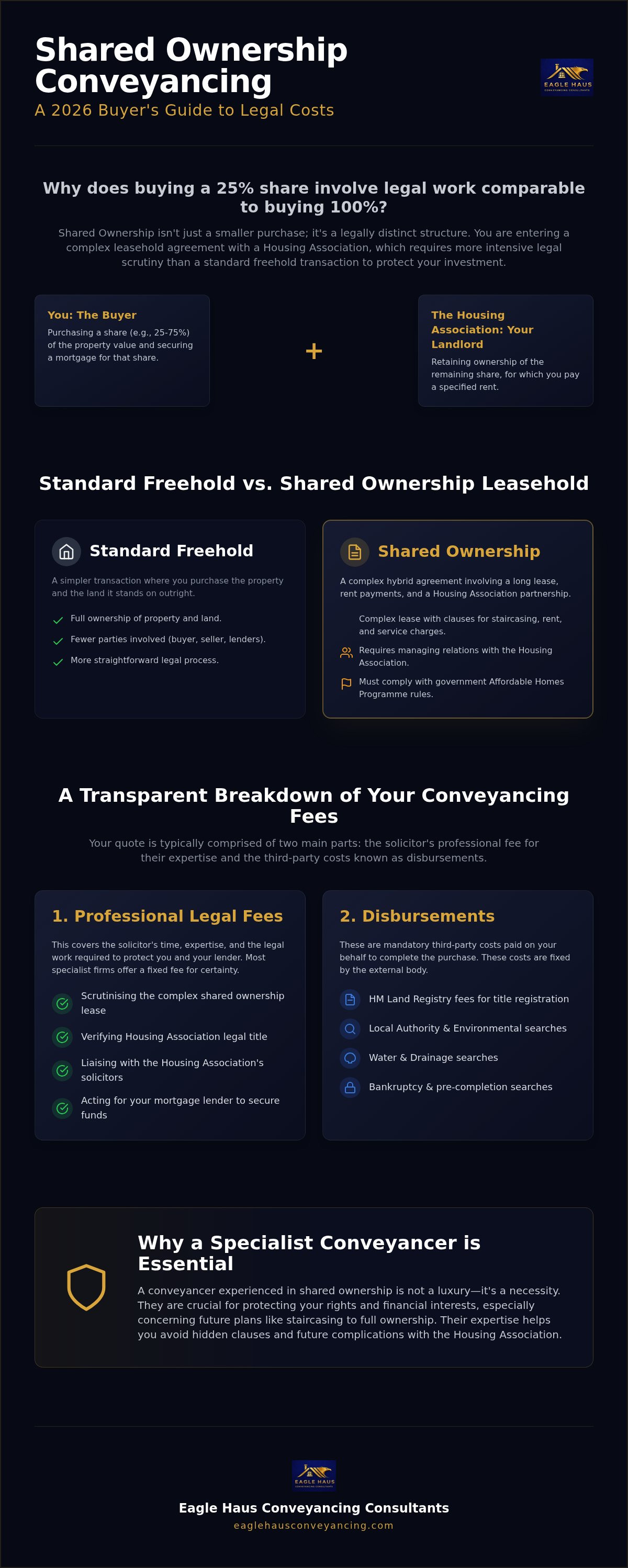
Shared ownership is often described as "part-buy, part-rent", but this simplified label masks a complex legal framework. For your budget, it means you aren't just buying a portion of a building; you are entering into a sophisticated hybrid of leasehold law and affordable housing regulations. Because you are only purchasing a percentage of the property's value, the Housing Association remains a permanent fixture in your legal contract. They act as your landlord and a partner in the transaction, which naturally increases the volume of paperwork and the depth of the legal review required.
The Legal Reality of Fractional Ownership
When you step into this scheme, you are purchasing a long leasehold interest rather than a freehold title. This distinction is vital for understanding shared ownership and how it impacts your initial costs. Since December 2025, these leases are strictly classified as long leases rather than assured tenancies, providing you with stronger legal protections. The Housing Association's requirements add significant layers to the conveyancing process, as your solicitor must ensure the lease complies with government standards set out in the Affordable Homes Programme 2021-2026. These leases include clauses regarding "staircasing", rent increases, and specific maintenance obligations that don't exist in standard residential deals. Shared ownership conveyancing is a specialist legal process for 2026 buyers.
Why Standard Quotes Often Fall Short
A common misconception amongst first-time buyers is that buying 25% of a home should result in a lower legal bill. In reality, the work involved for your solicitor is often more intensive than a full-market purchase. They must vet the Housing Association’s solicitor, review complex service charge structures, and ensure the mortgage lender's specific requirements for shared equity are met. This is why shared ownership conveyancing fees are typically higher than those for a standard freehold house.
If you are comparing costs, you might find that general first time buyer conveyancing fees don't always account for these specialist lease requirements. Specialist solicitors must dedicate more professional time to verifying that your fractional equity is legally protected against future changes in the housing market. By acknowledging these complexities early, you can build a realistic budget that covers the necessary expertise without facing financial shocks just before you get your keys.
A Transparent Breakdown of Shared Ownership Conveyancing Fees in 2026
Understanding the cost of your move starts with separating professional expertise from third-party expenses. When you review a quote for shared ownership conveyancing fees, the primary figure represents the time and skill your solicitor invests. For 2026 buyers, it's vital to check official government guidance on costs to see how these fit into your wider purchase. Most modern firms prefer fixed-fee quotes over hourly rates. Fixed fees provide the certainty you need to budget for completion day without fearing a ticking clock every time you send an email. Transparency at the quote stage is the best way to prevent "bill shock" later in the transaction.
Professional Fees vs. Administrative Costs
Your solicitor's professional fee covers a rigorous checklist of legal safeguards. They don't just fill in forms; they scrutinise the lease for restrictive covenants and verify the Housing Association’s title. A significant portion of this work involves "acting for the lender". Since your mortgage provider has a stake in the property, your solicitor must ensure the lender's interests are fully protected. This is often listed as a separate professional charge on your quote. At Eagle Haus, we prioritise clear communication to ensure Staffordshire clients see exactly where every penny goes, removing the mystery that often surrounds traditional legal services.
The Impact of New Build Shared Ownership
If you are buying a brand-new property in the West Midlands, be prepared for slightly higher legal costs. New build shared ownership involves reviewing complex site titles and developer-specific contracts which require more professional hours. You might also encounter supplemental fees for administrative tasks like handling a Lifetime ISA or a Help to Buy ISA. These schemes require additional reporting to the government, and firms usually charge a modest fee to manage the paperwork correctly. Whether you are looking at a new development in Birmingham or a boutique site in Staffordshire, getting a tailored conveyancing quote early helps you account for these extras. Finally, always remember that VAT at 20% applies to all professional fees. This will be clearly marked on your 2026 completion statement, ensuring you have a complete picture of your financial obligations before you commit.
Understanding Disbursements: The "Other" Costs of Buying
Disbursements are the essential third-party costs your solicitor pays on your behalf to keep the transaction moving. Unlike the professional fee for their expertise, these charges go directly to external organisations like local councils or the Land Registry. When calculating your total shared ownership conveyancing fees, these costs are usually grouped together on your initial quote. In 2026, most firms use digital platforms to conduct electronic ID checks and secure search portals. These digital fees are now a standard part of modern transactions, ensuring your identity is verified quickly and securely without the need for multiple office visits.
The price of a Local Authority search can vary significantly depending on where you are buying. For instance, a search through Birmingham City Council may have a different price point compared to one in Staffordshire. This isn't a fee your solicitor controls; it's set by the specific council to cover the cost of checking planning permissions, highway status, and local infrastructure projects near your new home. Because these prices are determined by local government, your disbursement total might look slightly different from a friend buying in a neighbouring county.
Land Registry fees also play a major role in your final statement. As of August 2026, these are based on the property's value. For a home valued between £200,001 and £500,000, you will typically pay £330 for the registration. It's vital to remember that this fee is paid at completion to ensure your ownership is officially recorded on the national database.
Essential Searches for Shared Ownership
Beyond the standard local search, your solicitor will organise environmental, drainage, and chancel repair searches to protect your investment. Shared ownership involves specific administrative hurdles, such as the "Notice of Charge" fee. This is a payment made to the Housing Association to formally notify them that a mortgage lender has a legal interest in the property. You may also encounter a "Certificate of Compliance" fee. This confirms you've met all the requirements of the leasehold agreement, which is a critical step for your lender. You can find more official shared ownership scheme details on the government website to see how these administrative steps fit into the wider process.
Stamp Duty Land Tax (SDLT) Considerations
One of the biggest decisions you'll face is how to handle Stamp Duty. You generally have two choices: a "Market Value Election", where you pay SDLT on the full value of the property upfront, or "Paying in Stages", where you pay based on the share you're actually buying. Choosing to pay in stages might save you money now, but it could lead to higher costs if you decide to staircase later. SDLT for shared ownership requires a specialist tax calculation to ensure you aren't overpaying or missing out on first-time buyer reliefs. Your solicitor will guide you through this choice, but it's worth discussing with your financial advisor to see which path suits your long-term goals.
Why Specialist Conveyancers are Essential for Shared Ownership
Selecting a solicitor who views shared ownership as just another administrative task is a significant risk. These transactions are unique because they involve a three-way legal relationship between you, your mortgage lender, and the Housing Association. A generalist firm might offer lower shared ownership conveyancing fees initially, but they often lack the technical depth to handle the specific requirements of the Affordable Homes Programme 2021-2026. If your solicitor doesn't understand the nuances of the "Notice of Charge" or the Housing Association’s specific insurance requirements, your move could stall at the final hurdle.
Avoiding Delays in the Chain
Shared ownership chains are notoriously fragile because they rely on the responsiveness of third-party legal teams. Your solicitor must maintain constant, proactive communication with the Housing Association’s representatives to ensure all certificates of compliance are issued on time. At Eagle Haus, we organise complex files with a methodical rhythm, anticipating potential bottlenecks before they cause a delay. This specialist focus is what separates a smooth completion from a stressful collapse. For a broader look at how we manage these timelines, see our guide to residential purchases and sales.
Future-Proofing Your Investment
The work your solicitor does today protects your ability to sell or "staircase" in the future. Staircasing allows you to buy more shares in your home, eventually reaching 100% ownership in most cases. However, some leases contain restrictive covenants that could limit this or affect the resale value of homes across the West Midlands and Staffordshire. An expert eye will verify that your lease is fair and that there are no hidden administration charges for future alterations. This reassurance factor is priceless when you're committing to a long-term investment. We pride ourselves on being a boutique partner in this journey, offering the individual attention that high-volume call centres simply cannot match. If you want to ensure your legal interests are fully protected, you can get a tailored quote from our specialist team to get started.
Securing Professional Legal Support in the West Midlands and Staffordshire
When you're buying a home in the West Midlands, the local property landscape is just as important as the national regulations. Getting a clear handle on shared ownership conveyancing fees is easier when you work with a team that understands the specific requirements of Birmingham City Council or Wolverhampton City Council. Local knowledge isn't just a "nice to have"; it's a tool for speed. Knowing how these specific local authorities handle search requests or planning enquiries can shave days off your timeline, helping you move into your new home sooner. It's about precision. Our modern, tech-enabled approach means you can track your progress from your smartphone whilst receiving the care that only a dedicated consultant can provide.
Operating through Taylor Rose for regulated services, Eagle Haus combines the personalised touch of a boutique consultancy with the robust security of a national firm. This partnership ensures your transaction is handled with the highest level of professional oversight whilst you enjoy a direct, human connection with your legal guide. We don't believe in high-volume call centres where you're just a file number. Instead, we focus on building a sense of security through clear communication and a proactive attitude that anticipates the needs of housing associations and lenders alike.
Local Expertise for Local Buyers
Navigating the specific housing associations active in Staffordshire and Cannock requires a nuanced touch. By choosing a consultant with deep roots in the West Midlands, you gain an advocate who knows which local providers are the most responsive. Whether you are looking at a modern development in Walsall or a more rural property in Shropshire or Telford, we understand the regional titles and site-specific covenants that often appear. This local insight allows us to provide an accurate, no-obligation quote for your shared ownership conveyancing fees that reflects the reality of your specific location.
Your Next Steps to Completion
Instructing a specialist team for your shared ownership journey is a straightforward process. To save time during your initial consultation, it's helpful to have your mortgage in principle, your proof of deposit, and your ID documents ready to go. Starting early allows us to vet the Housing Association lease before you're too far into the process, ensuring there are no hidden surprises. To help you stay organised, use this final checklist for budgeting your 2026 conveyancing costs:
Professional legal fees (ensure these include the cost of acting for your lender).
VAT at the current rate of 20% on all professional services.
Search fees specific to your local council in Birmingham or Staffordshire.
Land Registry fees based on your property's 2026 value bracket.
Notice of Charge and Certificate of Compliance fees required by the Housing Association.
Electronic ID and secure digital transfer fees for a modern, safe transaction.
By preparing these details now, you can approach your purchase with total transparency and the confidence that your fractional equity is fully protected.
Moving Forward with Confidence
You now have the tools to navigate the unique legal landscape of shared equity. By choosing a specialist who understands the 2026 regulatory environment, you ensure your initial investment is legally sound and ready for future staircasing. Transparency is the foundation of a stress-free move. Understanding how shared ownership conveyancing fees are structured allows you to budget with precision from the very start. This clarity eliminates the anxiety of hidden costs and keeps your focus on the excitement of your new home.
At Eagle Haus, we combine deep local expertise in the West Midlands and Staffordshire with the regulated security of Taylor Rose. Our boutique approach prioritises your individual needs over high-volume transactions, providing a clear, fixed-fee path to completion. We are dedicated to making your transition into homeownership as smooth and rewarding as possible. Get a transparent shared ownership conveyancing quote from Eagle Haus today and secure your future with a partner you can trust.
Frequently Asked Questions
How much are shared ownership conveyancing fees on average in 2026?
Your total costs depend on the property's value and the specific requirements of the housing association lease. Professional fees for shared ownership are typically higher than standard purchases because of the increased legal scrutiny required. In 2026, you must also budget for disbursements like Land Registry fees, which are £330 for properties valued between £200,001 and £500,000. Getting a tailored quote is the only way to see an accurate breakdown for your move.
Do I have to pay Stamp Duty on a shared ownership property?
You will likely pay Stamp Duty, but your status as a buyer affects the total. First-time buyers in 2026 benefit from 0% tax on the first £300,000 of a property's price, provided the total value is under £500,000. You can choose to pay tax on the full market value immediately or pay in stages as you buy more shares. Your solicitor will help you decide which option is most cost-effective.
Why is shared ownership conveyancing more expensive than standard conveyancing?
The higher cost reflects the additional legal work required to protect your fractional interest. Your solicitor must vet the housing association’s lease, ensure it meets lender requirements, and handle specific administrative tasks like the Notice of Charge. These extra layers of scrutiny ensure your shared ownership conveyancing fees cover the expertise needed to manage the three-way relationship between you, your mortgage lender, and the housing association.
Can I use any solicitor for a shared ownership purchase?
You can use any solicitor, but choosing a specialist is highly recommended. Many generalist firms aren't familiar with the specific clauses in affordable housing leases or the requirements of the Affordable Homes Programme 2021-2026. A specialist ensures the lease allows for future staircasing and that all housing association requirements are met. This prevents the common delays that occur when using a solicitor who does not understand the nuances of the scheme.
What are "Notice of Transfer" fees in shared ownership?
A Notice of Transfer fee is a disbursement paid to the housing association to formally record the change of ownership. When you buy a share in a property, the association must update their records to recognise you as the new leaseholder. This fee is separate from your solicitor's professional charges. It's a standard requirement for almost all shared ownership transactions to ensure the legal title is correctly managed and your rights are protected.
How long does the shared ownership conveyancing process take in Staffordshire?
The process typically takes between 8 and 12 weeks to reach completion. Local factors in Staffordshire, such as the responsiveness of the housing association and the speed of local authority searches, play a significant role in the timeline. Because shared ownership involves a third party, the journey is often slightly longer than a standard freehold purchase. A proactive solicitor with deep local knowledge can help keep the momentum steady and avoid unnecessary bottlenecks.
What happens to my legal fees if the purchase falls through?
Your liability depends on the specific agreement you have with your legal firm. Many modern conveyancers offer no sale, no fee arrangements for their professional charges, meaning you won't pay the main legal fee if the transaction fails. However, you will usually still be responsible for any disbursements already paid to third parties. This includes costs for local searches or electronic ID checks, which are non-refundable once the work has been completed.
Are there extra fees for staircasing later on?
Increasing your share in the property is treated as a separate legal transaction. When you decide to staircase, you will need to pay further shared ownership conveyancing fees for the legal work involved in amending your lease and updating the Land Registry. You should also budget for a RICS valuation fee and potential Stamp Duty costs if your total share exceeds certain thresholds. Planning for these future costs early helps you manage your long-term budget effectively.


Comments