Secure Your Share: Tenants in Common Guide

If you're buying a home with a partner or friend, you might assume that "owning it together" is a straightforward, one-size-fits-all arrangement. But what if the default legal structure actually leaves your hard-earned deposit vulnerable? When you choose to become tenants in common, you're opting for a setup that acknowledges your individual contribution rather than blending everything into one. It's completely normal to feel a sense of unease amongst the complexities of property law, especially whilst you're trying to balance a major life transition with the need to protect your financial future. You want to know that your investment is secure and that your share of the property will go exactly where you intend it to.
This guide will help you understand the legal nuances of this ownership type, from ensuring your inheritance wishes are met to using a deed of trust to ring-fence your initial contribution. We'll strip away the confusing conveyancing jargon to give you a clear, step-by-step path toward a smooth and secure transaction. By the end, you'll see why this modern approach to property ownership is often the smartest way to treat your home as a flexible, protected asset.
Table of Contents
Understanding Tenants in Common: How Joint Ownership Works in England & Wales
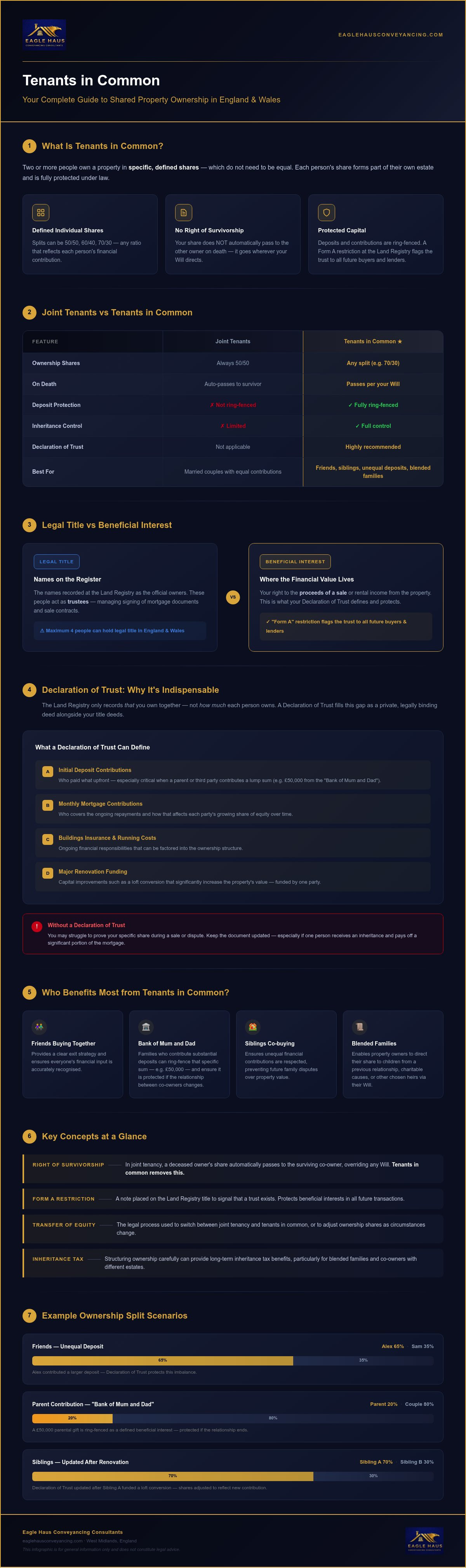
Buying a home with a partner, friend, or family member is an exciting milestone, but it requires a clear-headed approach to financial protection. Opting to be tenants in common is the modern standard for co-owners who want clear boundaries and financial transparency. This arrangement allows two or more people to own a property in specific, defined shares. Unlike the more traditional joint tenancy, your shares don't have to be equal. You might decide on a 60/40 or 70/30 split to reflect the fact that one person paid a larger portion of the deposit or contributes more to the monthly mortgage payments.
Crucially, this setup removes what lawyers call the "Right of Survivorship." In a standard joint tenancy, if one owner passes away, their share automatically transfers to the surviving owner regardless of what their Will says. By choosing this more flexible route, your share forms part of your own estate. It ensures your inheritance wishes are respected, allowing you to leave your portion of the property to children, family members, or a charity of your choice. It's a proactive way to maintain control over your most significant asset.
The Legal Title vs Beneficial Interest
Understanding the difference between legal title and beneficial interest is vital for any modern homeowner. The legal title refers to the names recorded at the Land Registry as the official owners. By law, a maximum of four people can hold the legal title to a property in England and Wales. These individuals act as trustees, managing the administrative side of ownership, such as signing mortgage documents or sale contracts.
Beneficial interest is where the actual financial value lies. It represents your right to the proceeds of a sale or the income generated by the property. When you choose to be tenants in common, a "Form A" restriction is usually placed on the title register. This acts as a signal to future buyers and lenders that a trust exists. It's a simple but effective mechanism that ensures individual capital is protected and cannot be ignored during a transaction, providing a sense of security for everyone involved.
Why 2026 Buyers are Choosing Tenants in Common
The property market in 2026 is increasingly defined by collaborative buying and complex financial arrangements. With the "Bank of Mum and Dad" frequently providing substantial deposits, many families now require a legally binding way to ring-fence those contributions. If a parent provides £50,000 towards a purchase, they often want the peace of mind that comes with knowing that specific sum is protected if the relationship between the co-owners changes or the property is sold.
This ownership style is also the default choice for friends or siblings buying together. It provides a clear exit strategy and ensures that everyone’s financial input is accurately recognised. Whether you are embarking on residential purchases and sales or simply looking to formalise an existing arrangement, this method offers the flexibility that modern lives demand. It transforms the property from a rigid joint venture into a versatile asset that works for your specific circumstances.
The Role of Shares and Declarations of Trust in Co-ownership
The Land Registry is efficient at recording that you hold a property as tenants in common, but its public records are relatively basic. It won't specify exactly how much each person owns or what should happen if your circumstances change. This is where a Declaration of Trust becomes indispensable. It’s a private deed that sits alongside your title deeds, acting as a clear, legally binding agreement that defines your beneficial interest. Without it, you might find yourself in a difficult position if you ever need to prove your specific share of the property's value during a sale or dispute.
Calculating these shares requires a proactive conversation about your finances. You might choose to split the equity based on your initial deposit contributions, but modern buyers often look deeper. You can factor in who pays the monthly mortgage, who covers the buildings insurance, or even who funds a major renovation like a loft conversion. By documenting these details early on, you create a transparent framework that prevents resentment later. It’s also vital to keep this document updated. If one person receives an inheritance and pays off a significant chunk of the mortgage, your shares should be adjusted to reflect that new reality.
A well-drafted deed also provides an essential "exit strategy." It outlines exactly what happens if one owner wants to move on whilst the other wants to stay. This might include a "right of first refusal," giving the remaining owner a set period to buy out the other’s share at a fair market value. Having these rules in place from the start makes the process predictable and far less emotional. If you're currently planning a purchase, seeking expert conveyancing support can ensure your trust is tailored to your specific needs.
What is Included in a Declaration of Trust?
This document is highly customisable, but several key elements are standard for most co-owners who want to maintain financial clarity:
Ownership percentages: This can be a fixed split (such as 65/35) or a floating formula that changes based on ongoing contributions.
Ongoing responsibilities: Clear instructions on who pays the mortgage, utility bills, and structural maintenance costs.
Dispute resolution: A pre-agreed method for valuing and selling the property if you can't agree on a buy-out price later.
Protecting Unmarried Couples and Friends
For unmarried couples and friends buying together, this legal protection is even more critical. English law doesn't recognise "common law" marriage. This means that without a formal agreement, the courts might assume you intended to share everything equally, regardless of your actual financial input. This often leads to costly, stressful litigation if the relationship ends. A Declaration of Trust is the essential rulebook for shared property ownership, ensuring that everyone’s investment is ring-fenced from day one. It replaces uncertainty with clarity, allowing you to focus on enjoying your new home together.
Joint Tenants vs Tenants in Common: Choosing the Right Path
Deciding how to hold your property is one of the most important choices you'll make during the conveyancing process. While joint tenancy is often seen as the traditional route for married couples, becoming tenants in common is increasingly the preferred choice for those with more complex financial lives. The right path depends entirely on whether you view your home as a shared, indivisible whole or as a modular asset with distinct, individual shares. This choice has significant implications for your tax planning and your long-term legacy.
For property investors, the distinction is even more critical. If you are managing a portfolio, you might work with buy to let remortgage solicitors to optimise your holdings. Investors and limited companies often favour the tenants in common model because it allows for multi-party deals where each person’s capital is clearly demarcated. It also facilitates easier Inheritance Tax planning, as owning a specific share can help you stay within tax thresholds whilst still maintaining a stake in a high-value asset.
Scenario Analysis: Families vs Investors
Many married couples choose joint tenancy for its "set and forget" simplicity. It ensures the family home passes automatically to the surviving spouse without the need for complex probate. Business partners and friends, however, require the granular control that individual shares provide. If you're using bridging loans to acquire a property quickly during a fast-paced auction or commercial residential deal, this structure allows you to define exactly who owns what from the moment the funds are released. It’s about matching your legal setup to your specific financial reality.
The Impact on Your Will and Estate
Because there is no right of survivorship, your share in the property will not automatically go to the other owners when you pass away. It's a crucial point: your share must be explicitly mentioned in your Will. If you die without a Will, your portion of the home will be distributed according to the rules of intestacy. This could mean your share goes to a distant relative rather than your co-owner or partner. We always recommend reviewing or drafting your Will alongside the conveyancing process to ensure your property wishes are fully protected and legally binding.
Changing Your Ownership Type: The Transfer of Equity Process
Life changes, and your property ownership should reflect your current reality. Whether you’re separating or simply want more financial protection, you can transition from joint tenants to tenants in common through a process known as severing the joint tenancy. This isn't a complex ordeal, but it does require methodical legal steps to ensure your new status is correctly recorded and your interests are fully protected. It’s a proactive way to adapt your home ownership to suit your evolving lifestyle.
A specialist solicitor manages this transition, ensuring that the legal paperwork aligns with your financial intentions. One of the most overlooked aspects of this process is lender consent. If you have an existing mortgage, your bank needs to be notified of the change. Whilst they generally don't object to you becoming tenants in common, failing to follow their specific requirements could lead to complications later. Your solicitor will handle this communication, ensuring a seamless update to your Land Registry title deeds whilst maintaining your mortgage compliance.
Step-by-Step: From Joint Tenants to Tenants in Common
The transition follows a logical three-step path designed for clarity and security:
Step 1: Serving a Notice of Severance. You must serve a formal written notice to the other joint owners. You don't actually need their consent to do this, but you must be able to prove the notice was delivered to their last known address.
Step 2: Drafting the Declaration of Trust. As we explored earlier, this is your financial rulebook. It defines your new shares and outlines what happens to the equity if the property is sold.
Step 3: Land Registry Application. Your solicitor will submit Form SEV or RX1 to the Land Registry. This places a restriction on the title, officially recording your status and alerting future buyers to your specific ownership shares.
When to Consider a Transfer of Equity
Divorce or separation is the most common trigger for this change. It allows both parties to ringfence their respective shares whilst the long-term future of the property is decided. It’s also an excellent tool when adding a new partner to the title deeds. By choosing this setup, the original owner can protect the equity they've already built up, ensuring a fair starting point for the new joint venture. Many homeowners choose to combine this process with a remortgage to save time and reduce overall legal costs. If you're ready to update your ownership, you can start your transfer of equity here with our expert team.
Expert Legal Support for Co-owners in the West Midlands
Eagle Haus Conveyancing Consultants provides a bridge between complex legal requirements and the personal needs of modern homeowners. Whilst we operate as a specialist in residential property transactions across the whole of England and Wales, our roots and heart remain firmly in the West Midlands. We understand that choosing to be tenants in common is often about more than just legal paperwork. It's about protecting your family, your investment, and your peace of mind. Our team offers the reassuring, professional guidance you need to navigate these decisions with confidence, ensuring every share is accurately recorded and legally secure.
In 2026, conveyancing shouldn't feel like a relic of the past. We've embraced a tech-savvy approach that prioritises speed and transparency without losing the human touch. By using modern communication channels and efficient digital workflows, we keep you updated at every stage of your transaction. This proactive methodology is designed to alleviate the stress typically associated with buying a home or changing ownership types. You get the security of a regulated legal service, provided through Taylor Rose, with the ease of a forward-thinking boutique firm that values your time and individual circumstances.
Why Local Expertise Matters for Your Purchase
Having a team that understands the regional property trends in Staffordshire, Wolverhampton, and Telford makes a tangible difference to your experience. We're familiar with the specific Land Registry nuances across Birmingham and Shropshire, ensuring your application is handled correctly the first time. Unlike high-volume, impersonal national firms, we prioritise individual attention for every client. We take the time to demystify the process, whether you're a first-time buyer navigating your first mortgage or a seasoned investor looking to ring-fence a new acquisition through a transfer of equity or a remortgage.
Next Steps: Securing Your Property Interests
Taking the first step toward securing your share is simpler than you might think. Whether you're looking for a transparent quote for a transfer of equity or need support with a complex residential purchase, we're here to help. Starting the process is easy through our modern communication channels, where you can get the clarity you need without the usual delays. Our commitment to building security and trust means you’ll always have a partner in your corner. We focus on a smooth conveyancing process that ensures your property interests as tenants in common are protected for years to come, giving you total peace of mind as you move into your new home.
Secure Your Financial Future and Property Shares
Choosing the right ownership structure is the most effective way to ensure your property remains a secure asset rather than a source of future stress. By opting for tenants in common, you've taken a proactive step toward protecting your individual deposit and honouring your inheritance wishes. We've explored how a Declaration of Trust serves as your essential financial rulebook, whilst a transfer of equity can help your legal setup adapt as your life evolves. Whether you're a first-time buyer in Staffordshire or a seasoned investor in Birmingham, clarity is always your best protection.
Eagle Haus combines modern, tech-savvy conveyancing with the professional authority of regulated legal services via Taylor Rose. Our specialists in West Midlands residential property understand the nuances of complex bridging and company purchases, providing the individual attention your transaction deserves. Protect your property investment with Eagle Haus today. You don't have to navigate these legal complexities alone. With the right support, you can move forward with total confidence in your shared ownership journey.
Frequently Asked Questions
Can one tenant in common force a sale of the property?
Yes, a co-owner can apply to the court for an "Order for Sale" under the Trust of Land and Appointment of Trustees Act 1996. Whilst the court considers factors like the original purpose of the trust and the welfare of any children living there, they generally lean towards allowing a sale if one party wants to realise their investment. Having a clear Declaration of Trust in place often simplifies this by pre-agreeing the sale process.
Do I need a new Will if I become a tenant in common?
You should definitely review or update your Will when you choose to be tenants in common. Since your share doesn't automatically pass to the other owners, your Will is the only legal way to ensure your portion of the property goes to your intended beneficiaries. Without a Will, your share will be distributed according to the strict rules of intestacy, which might not reflect your personal wishes or family situation.
What happens to my share if I die without a Will?
If you pass away without a valid Will, your share of the property is distributed according to the rules of intestacy. This means your beneficial interest will go to your next of kin, such as a spouse, civil partner, or children, rather than automatically passing to your co-owner. This can create significant legal and financial complications for the surviving owner, who may find themselves owning a home with your relatives rather than you.
Can we have unequal shares as tenants in common?
Yes, owning unequal shares is one of the primary reasons people choose this ownership type. You can define your shares based on initial deposit contributions, mortgage payments, or even the cost of renovations. For example, one person could own 75% whilst the other owns 25%. This flexibility is particularly useful amongst friends or family members who are contributing different amounts of capital to the purchase and want their investment protected.
Does the mortgage lender need to know if we are tenants in common?
Yes, your mortgage lender must be informed and give their consent if you are changing your ownership status. Lenders generally don't object to this setup because all owners remain "jointly and severally liable" for the full mortgage debt. However, the Land Registry requires confirmation that the lender is aware of the change, and your solicitor will manage this formal communication as part of the legal transfer of equity process.
Is it expensive to change from joint tenants to tenants in common?
The Land Registry doesn't typically charge a fee to register a "Form A" restriction when you sever a joint tenancy. However, you'll need to account for professional legal fees for drafting the Declaration of Trust and managing the paperwork. This is a vital investment to ensure your shares are correctly defined and legally protected, preventing much higher costs that could arise from future ownership disputes or complex probate issues.
Can a limited company be a tenant in common with an individual?
Yes, a limited company can hold a property as a tenant in common alongside an individual. This is a frequent arrangement in commercial residential deals or when investors are pooling resources. The company's share is treated as a business asset, whilst the individual's share is a personal one. It allows for clear separation of corporate and personal tax liabilities whilst facilitating a joint property venture between different types of legal entities.
What is a "Notice of Severance" and how is it served?
A Notice of Severance is a formal written document used to end a joint tenancy and create a tenancy in common. To be legally effective, it must be served on all other joint owners at their last known address. You don't need the other owners' agreement to sever the tenancy, but you must be able to prove that the notice was delivered, often via recorded post or professional hand delivery.


Comments