Right to Buy Guide: Owning Your Council Home in 2026

If you think the hardest part of buying your council home is the years of waiting, you might be surprised to find that the real challenge is the strict 2026 legal clock. Once you submit your application, the process becomes a high-stakes race against statutory deadlines and complex paperwork. It's completely natural to feel anxious about missing a cutoff or being confused by the difference between leasehold and freehold responsibilities in older council stock.
We understand that this is more than just a transaction; it's about securing your family's future. Our expert guide to right to buy conveyancing is designed to help you master the legal journey of purchasing your property. You'll learn how to maximise your available discount, which now ranges between £16,000 and £38,000 depending on your region, and how to navigate the "repayment of discount" rules if you decide to move later. We provide a clear, step-by-step roadmap to ensure your transition from tenant to homeowner is smooth, transparent, and successful.
Table of Contents
Understanding the Right to Buy Scheme in 2026
The Right to Buy scheme remains a cornerstone of British homeownership, offering secure tenants the legal opportunity to purchase their council property at a significant discount. Since its inception, the policy has evolved to meet changing economic needs. Understanding the history of the Right to Buy scheme helps clarify why these rules exist and how they protect your right to own your home. In 2026, despite recent legislative shifts, the scheme continues to provide a stable route for first-time buyers to enter the property market, especially across Staffordshire and the West Midlands.
It's vital to distinguish between the two main types of purchase schemes. Right to Buy typically applies to council tenants with a secure tenancy. If you rent from a housing association, you might instead fall under the Right to Acquire scheme. While the principles are similar, the discount levels and specific rules can vary. Identifying your landlord's status is a priority before you begin the legal process. Expert right to buy conveyancing ensures that these initial checks are handled correctly, preventing delays later in the transaction.
Are You Eligible for the 2026 Discount?
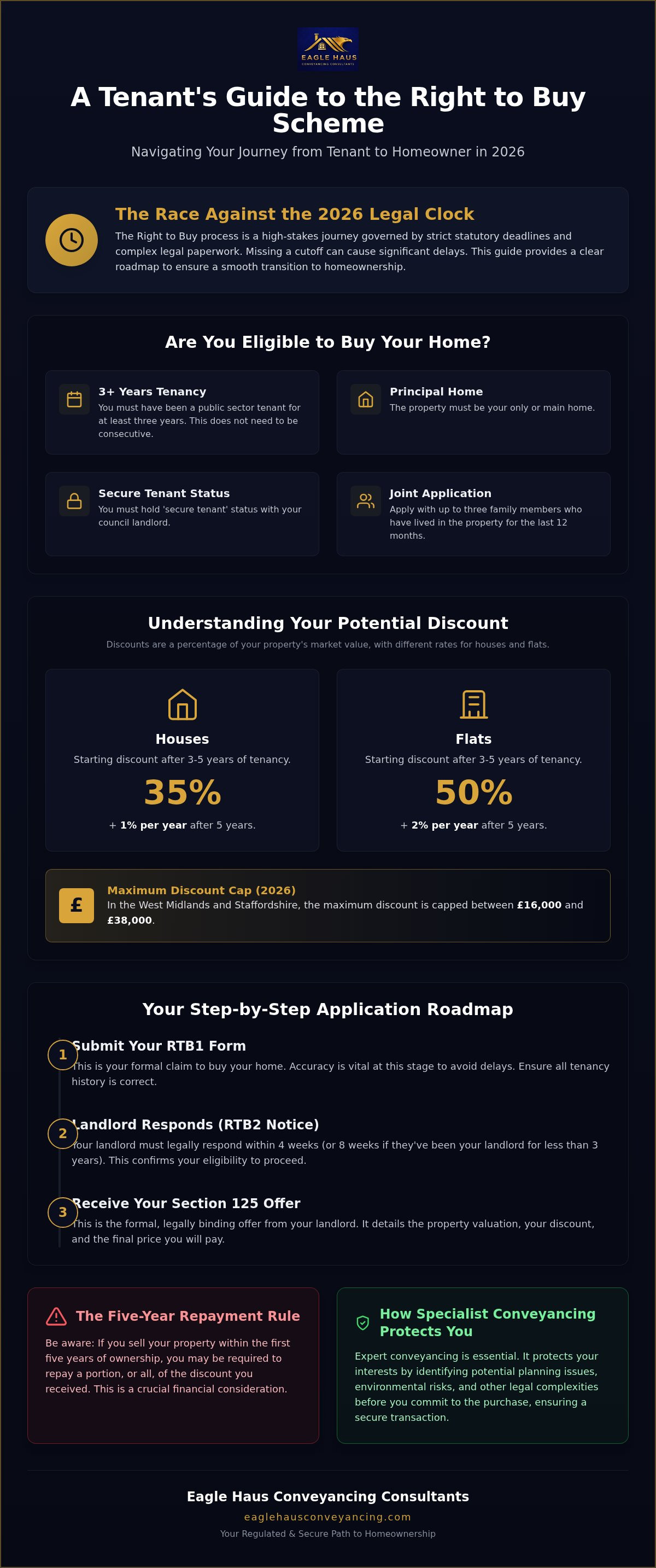
To qualify in 2026, you must have been a public sector tenant for at least three years. This period doesn't have to be consecutive or in your current home; time spent in other qualifying properties often counts. The property must be your only or principal home, and you must hold "secure tenant" status. Many people don't realise they can apply jointly with up to three family members who have lived in the property for the last 12 months. This is a great way to share the costs and responsibilities of homeownership.
Maximum Discounts and Regional Caps
The financial benefit is the main draw of the scheme. A Right to Buy discount is a percentage of the property's market value, capped by government limits. Following the significant reduction in maximum discounts on 21 November 2024, the caps for 2026 are more modest than in previous years. In the West Midlands and Staffordshire, these regional caps currently range between £16,000 and £38,000. For houses, you receive a 35% discount after three years, which increases by 1% for every extra year of tenancy. Flats start at a 50% discount and increase by 2% annually.
Navigating these figures requires precision. Market stability in 2026 has made this a popular time for tenants to transition to owners, but the lower discount caps mean you need to be certain of your property's value. Choosing a firm that specialises in right to buy conveyancing will help you understand exactly what you're entitled to before you commit to the purchase. We act as your bridge between council bureaucracy and the security of owning your own front door.
The Application Phase: Securing Your Landlord’s Offer
The journey from tenant to owner starts with a single, crucial document: the RTB1 form. This is your formal claim to buy your home. Accuracy at this stage is vital because any errors in your tenancy history can lead to immediate delays or even a rejection. Once you've submitted your claim, your landlord has a legal obligation to respond within four weeks (or eight weeks if they've been your landlord for less than three years). This response is known as the RTB2 notice of eligibility. Before you fill out the paperwork, it's a good idea to check the official Right to Buy eligibility guidelines to ensure you meet all the current 2026 requirements.
Navigating the RTB1 and RTB2 Forms
Documenting your tenancy history is where most applicants stumble. If you've moved between different local authorities or had a break in your tenancy, you need to provide clear dates and addresses. Gaps in your history can cause friction, especially if your current landlord needs to verify your status with a previous housing association. If you receive a "No" on your RTB2 notice, don't panic. It often stems from a simple administrative error or a misunderstanding of your previous tenancies. You can often resolve this by providing additional evidence of your time as a public sector tenant.
Stock transfers also add a layer of complexity. If your council home was sold to a housing association while you were living there, you might have "Preserved Right to Buy" rather than the standard scheme. Identifying these nuances early is a core part of effective right to buy conveyancing, as it determines which rules apply to your specific purchase.
Analysing Your Section 125 Offer
If your eligibility is confirmed, the next major milestone is receiving the Section 125 Notice. This document is your formal offer. It arrives within eight weeks for freehold properties or 12 weeks for leaseholds. This notice is a comprehensive breakdown that includes the market valuation, your calculated discount, and the final purchase price. It also describes the property and any land included in the sale.
For those buying flats or maisonettes, pay close attention to the service charge estimates. The Section 125 Notice must provide an itemised list of projected costs for the first five years. This includes maintenance, repairs, and management fees. If the valuation in the offer feels unfairly high compared to similar properties in your part of the West Midlands, you have the right to appeal. You must request an independent valuation from the District Valuer within three months of receiving your offer. This is a legal process that can result in a lower price, though it's important to remember the price could also stay the same or even increase.
You have 12 weeks to formally accept the offer once you're happy with the terms. If you're feeling overwhelmed by the technical language in your Section 125 Notice, you might find it helpful to speak with a specialist who can provide a clear breakdown of your offer. Taking the time to understand these terms now ensures there are no surprises once the right to buy conveyancing process moves into the final legal stages.
The Conveyancing Journey: Legal Essentials for Right to Buy
Once you've accepted your landlord's offer, the legal heavy lifting begins. Instructing a solicitor who understands the nuances of right to buy conveyancing is your next priority. This isn't just a standard property purchase. It involves specific statutory requirements and interactions with local government departments that a general practitioner might overlook. Your solicitor acts as the essential link between you, the council, and your mortgage lender to ensure every detail is legally sound before you sign the contract.
The process moves through several stages, starting with a thorough review of the title deeds. We look for restrictive covenants that might limit how you use the property once you own it. Simultaneously, we coordinate with your mortgage provider. Lenders have strict criteria for Right to Buy properties, particularly regarding the valuation and the discount applied. We ensure all financial threads are pulled together so that funds are ready and waiting for the day of completion.
Title Deeds and Local Authority Searches
We place high importance on the Official Search, particularly across the West Midlands and Staffordshire. This process uncovers vital information about your property's history and future. We specifically check for Article 4 Directions. These are legal instructions that can limit your ability to develop the property, such as changing windows or adding extensions, without full planning permission. Local searches protect the buyer from future council infrastructure projects near the home, such as new road schemes or utility works that could impact your quiet enjoyment or resale value.
Structural Considerations: Airey and Non-Traditional Builds
Many council estates in our region feature non-traditional construction methods. Pre-cast Reinforced Concrete (PRC) homes and "Airey" house types are common in Midlands housing stock. While these properties are part of our local history, they often present hurdles for modern mortgage lenders. If your home is a PRC build, it's vital to check the Official Right to Buy guidance regarding structural integrity.
Your solicitor's role here is to verify that a valid repair certificate exists. Most lenders won't release funds for a non-traditional build unless it has been repaired to a specific, industry-recognised standard. We investigate the property's structural history to ensure the "Airey" or PRC requirements are met. This proactive approach prevents the right to buy conveyancing process from stalling at the final hurdle. By identifying these issues early, we help you secure a home that isn't just affordable, but is also a sound long-term investment.
Navigating Risks: Valuation Appeals and the Five-Year Rule
Buying your home is a major milestone, but it's vital to look ahead at the legal strings attached. Right to Buy isn't just about the initial purchase; it's about understanding the financial obligations that follow you for years. Our role in right to buy conveyancing is to ensure you aren't caught out by the fine print once the keys are in your hand. We help you weigh up the risks and benefits so your transition to homeownership is based on solid facts.
The District Valuer (DV) Appeal Process
If you believe your landlord's valuation is too high, you have a legal path to challenge it. You must write to your landlord within three months of receiving your Section 125 offer to request a determination from the District Valuer. This is an independent professional who will re-assess the property's market value based on current 2026 conditions. It's a formal process that requires precise timing.
Be aware that the DV's decision is final. The price could go down, but it could also go up or stay the same. We handle the complex paperwork and ensure your appeal is submitted within the strict statutory deadlines. This prevents you from losing your right to buy while the dispute is being settled. It's about getting a fair price without jeopardising your application.
Selling Your Home: The Five-Year Repayment Rule
The most significant risk for new owners is the "repayment of discount" rule. If you sell your property within the first five years, you'll likely have to pay back some or all of the discount you received. This isn't a fixed cash amount; it's a percentage of the property's value at the time you sell. If your home has increased in value, the amount you owe back will also increase.
The sliding scale works as follows:
Year 1: 100% of the discount is repayable
Year 2: 80% is repayable
Year 3: 60% is repayable
Year 4: 40% is repayable
Year 5: 20% is repayable
After the fifth anniversary of your purchase, no repayment is required. There are limited exemptions to this rule, such as transfers of equity between partners or cases of inheritance. Additionally, the "Right of First Refusal" lasts for 10 years. This means if you sell within a decade, you must offer the property back to your former landlord or another social landlord in the West Midlands before putting it on the open market. We manage these disclosures during the right to buy conveyancing process to protect your future resale rights.
For leaseholders in flats, we also look at protecting you against future service charge spikes. We scrutinise the five-year forecast provided by the council to ensure your investment remains affordable. If you're concerned about how these rules might affect your specific situation, you can speak to our specialist team today for a clear explanation of your obligations.
Finalising Your Purchase with Eagle Haus Conveyancing
Reaching the final stage of your property purchase is an exciting milestone. After navigating the application and valuation phases, the focus shifts to the technical legal transfer. Choosing Eagle Haus Conveyancing Consultants for your right to buy conveyancing ensures the final exchange of contracts happens without any last-minute hitches. We act as your proactive partner, managing the fine details so you can focus on the practicalities of moving into your own home. Our role is to ensure the transition from tenant to owner is as seamless as possible.
Our partnership with Taylor Rose is a key part of our service. It allows us to offer the security and regulatory peace of mind of a large, established firm while keeping the personal touch of a boutique consultant. We handle the final exchange of contracts and legal completion with precision. This involves coordinating the mortgage funds, settling the final accounts with the council, and ensuring the legal title is ready for registration. We don't just process paperwork; we guide you through the momentum of the final few weeks.
Expert Support in Wolverhampton, Birmingham, and Beyond
Local knowledge is vital when dealing with council bureaucracy. We have deep experience with the specific procedures used by local authorities across Wolverhampton, Birmingham, Cannock, Walsall, and Telford. This regional expertise means we understand the internal workflows of West Midlands landlords, helping us push through delays that might stall a non-local firm. We use modern, clear communication to keep you updated, avoiding the dense jargon that often makes legal processes feel distant. For a broader look at how we handle property transfers, see our guide on Residential Purchases and Sales: A Modern Guide to Conveyancing in 2026.
Completion and Beyond: Your New Status as a Homeowner
On completion day, your status officially changes from tenant to homeowner. Eagle Haus Conveyancing Consultants manages the final steps, including the payment of any Stamp Duty Land Tax and the formal registration of your ownership with HM Land Registry. This registration is the final proof of your new status. Once the legal work is done, we recommend updating your Will to reflect your new asset. It's a simple step that provides long-term security for your family and ensures your home is protected for future generations. If you're ready to take this final step toward owning your council home, you can get a transparent conveyancing quote for your Right to Buy purchase today.
Your Path to Secure Homeownership Starts Here
Transitioning from a tenant to a homeowner is a significant life change that requires careful legal planning. By understanding the 2026 eligibility rules and mastering the strict application deadlines, you've already cleared the first major hurdles. Whether you're navigating the specific structural requirements of property in Wolverhampton or managing the five-year repayment rules, having expert support ensures your investment is protected from the start.
Our team acts as your dedicated bridge between council bureaucracy and the security of property ownership. Eagle Haus Conveyancing Consultants specialises in right to buy conveyancing across Staffordshire and the West Midlands, providing transparent, fixed-fee quotes so there are no surprises at completion. Through our regulated partnership with Taylor Rose, we combine professional authority with a modern, tech-savvy approach that puts your needs first.
Don't let confusing paperwork or tight landlord deadlines stand in the way of your future. Secure your Right to Buy discount with Eagle Haus Conveyancing Consultants today and take the final step toward owning your home. We look forward to helping you achieve this milestone with ease and confidence.
Frequently Asked Questions
How long does the Right to Buy conveyancing process take in 2026?
The entire process typically takes between three and six months from the moment you accept your landlord's offer. While the initial application phase involves statutory waiting periods of up to 12 weeks, the legal transfer usually moves at a similar pace to a standard house purchase. Delays often occur if there are complexities with the property's title or if your mortgage lender requires additional structural reports.
Do I need a solicitor before I apply for Right to Buy?
You don't need to instruct a solicitor until you have received and formally accepted your Section 125 offer notice. The initial application is a matter between you and your landlord using the RTB1 form. However, once you decide to proceed with the purchase price stated in the offer, having a specialist ready to start the right to buy conveyancing work will help you meet the strict 12-week acceptance window.
Can I lose my Right to Buy discount if I don’t use a solicitor?
While you won't lose your discount directly for not having a solicitor, failing to meet strict legal deadlines can put your application at risk. You cannot legally complete a property transfer in the UK without a qualified professional to handle the Land Registry requirements. If the process stalls because you haven't appointed a representative, the council may send you a "notice to complete," which could lead to your application being cancelled if ignored.
What happens if the council takes too long to process my application?
If your landlord misses their statutory deadlines, you have the right to submit an "Initial Notice of Delay" using form RTB6. This forces the council to explain the holdup or move the process forward. If they still don't take action, you can move to an "Operative Notice of Delay," which may allow you to deduct the rent you pay during the delay from the final purchase price of your home.
Can I buy my council house if I have debts or CCJs?
Having debts or County Court Judgments (CCJs) does not automatically disqualify you from the Right to Buy scheme itself. The council's main concern is your tenancy status and history. However, your main challenge will be securing a mortgage. Most mainstream lenders have strict criteria regarding credit history, so you may need to seek advice from a specialist broker who deals with "adverse credit" property purchases.
Is Right to Buy conveyancing more expensive than a standard house purchase?
Fees for right to buy conveyancing are generally comparable to standard residential purchases, though the legal work is more specialised. Solicitors must verify statutory discount calculations and handle specific local authority covenants that don't exist in the private sector. We provide transparent, fixed-fee quotes to ensure you know exactly what the legal costs will be before you commit to the purchase.
What are the service charges like for a Right to Buy flat?
Service charges for flats are determined by the council and cover your share of communal maintenance, building insurance, and management costs. These can vary significantly depending on the age and condition of the block. Your Section 125 offer will include a mandatory five-year estimate of these costs. It's vital to review this document carefully, as you'll be responsible for these payments on top of your mortgage once you become the owner.
Can I add someone else to the mortgage during a Right to Buy purchase?
You can add family members to your purchase, provided they have lived in the property as their main home for at least 12 months. Up to three family members can join a joint application with you. This is a common way to make the purchase more affordable, but everyone named on the mortgage must also be named on the property's title deeds during the legal transfer stage.



Comments