Residential Property Transactions: A Complete Guide to the Conveyancing Process in 2026

Could a simple misunderstanding of a legal term be the only thing standing between you and your dream home? Most people find that residential property transactions are often filled with unexpected hurdles, from the constant fear of a chain collapsing to the frustration of waiting for a mortgage offer to be finalised. It's completely natural to feel overwhelmed by technical jargon and the pressure of protecting your largest financial investment.
You deserve a move that's efficient, predictable, and entirely transparent. We're here to help you master the complexities of buying, selling, or refinancing your home with an expert breakdown of the legal journey in England and Wales. This guide previews the updated 2026 regulations, explains how to avoid common delays in the search stage, and provides the clear timelines you need for a stress-free completion. By the end, you'll have the confidence to manage your property goals with ease.
Table of Contents
What are Residential Property Transactions? Defining the Legal Scope
At its heart, the term residential property transactions refers to the formal legal process of moving property ownership from one person or entity to another. While many people associate this strictly with buying a first home or selling a family residence, the scope is actually much broader. It encompasses remortgages, company purchases, and transfers of equity where ownership is shared or shifted between family members.
Think of the process as the legal bridge that connects your accepted offer to the day you finally pick up the keys. When asking What is Conveyancing?, it's best to view it as a series of protective steps that verify titles and settle funds. Because these transactions involve life-changing sums of money, they're strictly regulated. Firms are overseen by the Solicitors Regulation Authority (SRA) or the Council for Licensed Conveyancers (CLC) to ensure consumer funds remain safe. Eagle Haus provides these regulated legal services through Taylor Rose, giving you the security of a large, established firm with a modern, personal touch.
The Different Forms of Property Ownership
Understanding your ownership type is vital because it dictates the complexity of your legal searches. Freehold ownership means you own the building and the land it sits on indefinitely. It's the most straightforward structure. Leasehold, however, means you own the right to live in the property for a set term, often involving ground rents or service charges. By 2026, the provisions of the Leasehold and Freehold Reform Act 2024 have changed how these are handled, making it easier for many to extend leases or manage their blocks. We're also seeing a rise in commonhold structures for new flats, which aim to give residents more control over their communal spaces without the traditional landlord-tenant dynamic.
Key Parties Involved in the Transaction
You aren't walking this path alone. Your legal team acts as a central hub, protecting both your interests and those of your mortgage lender. They ensure the property is a sound investment that meets the lender's strict criteria. Alongside your solicitor, estate agents and mortgage brokers play active roles in keeping the chain moving. They coordinate communication and ensure financial offers are ready for the exchange of contracts. Finally, the Land Registry acts as the ultimate authority. It's the centralised digital record that confirms you're the rightful owner once the transaction completes. Having professional oversight ensures that every interaction between these parties is documented and legally binding.
The Step-by-Step Journey of a Standard Conveyancing Transaction
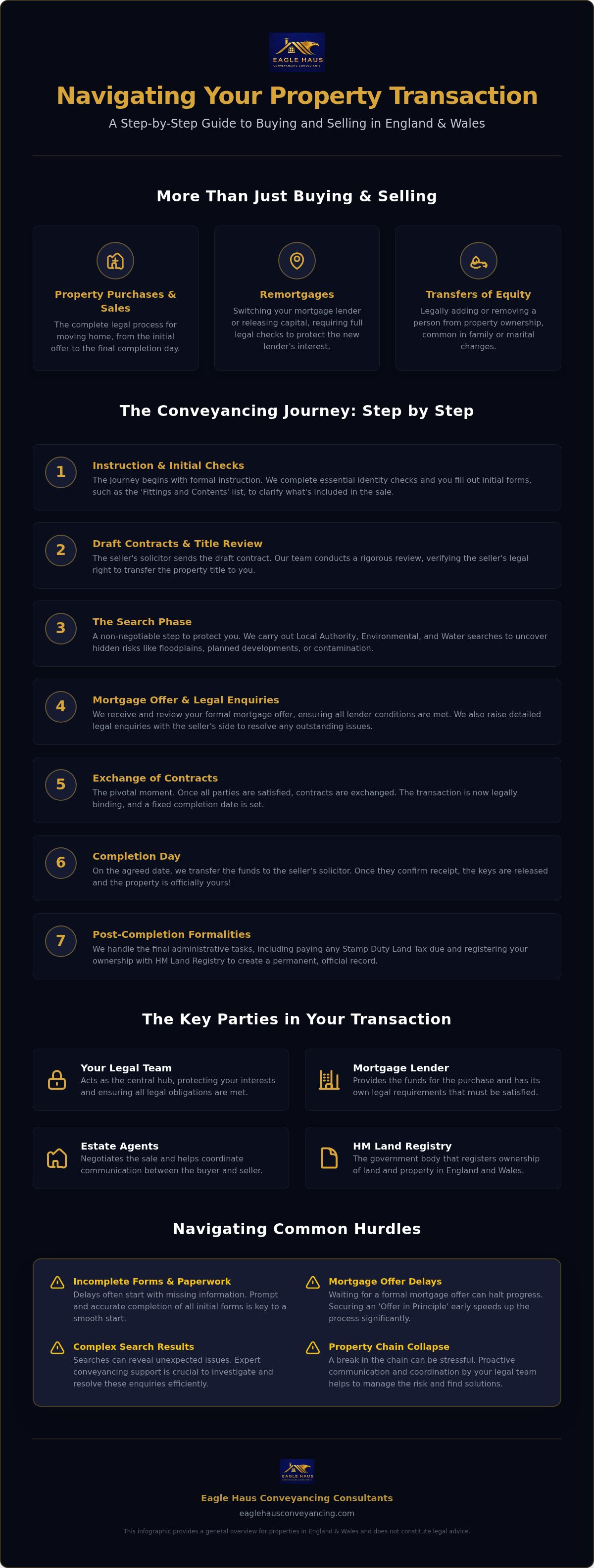
Once you've chosen your legal partner, the journey begins with formal instruction. This foundation involves essential identity checks and the completion of "Fitting and Contents" forms, which clarify exactly what is included in the sale. In 2026, residential property transactions are increasingly digital, yet the core legal requirements remain as vital as ever. Your legal team will review the draft contract and begin the rigorous process of verifying the seller's right to transfer the title.
The search phase follows, acting as your early warning system. Local authority, environmental, and water searches are non-negotiable steps that reveal everything from planned road developments to flood risks. Simultaneously, your solicitor manages mortgage offers and enquiries, ensuring the lender's conditions align with the seller's disclosures. If you're feeling unsure about the specifics of your move, seeking professional conveyancing support early can prevent many common headaches.
Pre-Contract Enquiries and the Search Process
Common enquiries often focus on property boundaries or historical planning permissions that lack proper sign-off. By 2026, modern digital searches have significantly streamlined this timeline, allowing for faster data retrieval from local councils. These searches protect you from hidden liabilities like chancel repair obligations or coal mining risks that aren't visible during a standard viewing. This proactive investigation ensures you aren't inheriting costly legal problems alongside your new home.
Achieving a Successful Completion
The exchange of contracts is the pivotal moment where the transaction becomes legally binding and a completion date is set. On moving day, the logistics of transferring funds through the banking system take centre stage. If a chain collapses, your solicitor acts as a shield, managing the financial risks and coordinating with other parties to get the move back on track. Once the keys are in your hand, the final steps involve paying Stamp Duty Land Tax (SDLT) and updating the Land Registry. For a standard property valued up to £125,000, the SDLT rate remains at 0%, whilst higher value brackets require precise calculations to ensure full compliance with HMRC.
Specialist Transactions: Remortgages, Equity Transfers, and Company Purchases
While standard moves get the most attention, many residential property transactions involve complex legal shifts that don't involve moving house at all. Remortgaging is a prime example. Even if you're staying in the same property, switching lenders requires legal oversight to ensure the old charge is removed and the new one is correctly registered. With the Bank of England base rate sitting at 3.75% as of July 2026, many homeowners are proactively seeking new deals to manage their monthly outgoings. Professional oversight ensures these transitions happen smoothly without risking your credit rating or your home's security.
Bridging loans are another specialist area requiring expert handling. These high-speed financial tools are often used to secure auction properties or fund major renovations before traditional finance kicks in. Because the interest rates on these loans are typically higher, your legal team must work quickly to meet strict completion deadlines. We act as your proactive partner, ensuring the paperwork is flawless so you can move from initial offer to final resolution without unnecessary delay.
Legal Support for Property Investors
Modern investors are increasingly moving away from individual ownership. Instead, they're utilising Special Purpose Vehicles (SPVs) to manage their portfolios. Choosing company purchases can offer significant tax efficiencies and long-term growth potential. However, these transactions require additional corporate compliance checks that aren't present in a standard purchase. Your solicitor ensures that the company's structure is sound and that the mortgage lender's requirements for corporate borrowing are fully satisfied, protecting your investment from the start.
Refining Your Ownership Structure
Life changes often necessitate a shift in who actually owns a property. Whether you're getting married, separating, or planning for future inheritance tax, transfers of equity allow you to add or remove people from the title deeds legally. It's often most efficient to handle these alongside a remortgage, as this allows you to settle any financial interests whilst securing a better interest rate. We manage the necessary Land Registry amendments to ensure your deeds accurately reflect your current situation, providing the professional oversight needed to protect everyone's financial interests and provide peace of mind.
Navigating Common Hurdles and Avoiding Completion Delays
Even the most straightforward residential property transactions can encounter friction. Often, the culprit is the Property Information Form (TA6). If a seller forgets to mention a minor boundary change or fails to provide a FENSA certificate for a new window, it triggers a chain of enquiries that can add weeks to the timeline. Being meticulous with these initial disclosures is the best way to keep the momentum going from the very start.
Financial delays are equally common in the current market. Modern lenders require comprehensive "Know Your Customer" (KYC) data before they'll formalise a mortgage offer. If there are gaps in your employment history or unexplained large deposits, the process grinds to a halt. We recommend that you contact our specialists to ensure your financial documentation is audit-ready before the lender even asks. This proactive step prevents the mortgage offer stage from becoming a bottleneck.
Boundary disputes and complex chains add another layer of risk. A chain is only as fast as its slowest link. If one party in a five-house chain has an unresolved issue with a garden fence or an unrecorded easement, everyone waits. Identifying these red flags during the initial search phase allows your solicitor to negotiate solutions, such as indemnity insurance, before they become deal-breakers. Professional oversight is vital here to manage the competing interests of multiple parties simultaneously.
Proactive Communication with Your Solicitor
Transparency is the antidote to moving-day anxiety. Choosing a fixed-fee service ensures you won't face surprise costs, whilst digital portals allow you to track every milestone from your smartphone. You should aim to organise your source of funds documentation at least a month before exchange to avoid last-minute compliance checks. This proactive approach keeps you in control and ensures your legal team can act immediately when the other side is ready. Clear communication prevents the "radio silence" that so often leads to buyer stress.
Preparing for the "Moving House" Checklist
The final stretch is as much about logistics as it is about law. One golden rule remains: never book a removal van until contracts have been formally exchanged. Until that point, either party can withdraw without a financial penalty. Once exchange happens, you can safely notify utility providers and take final meter readings for the handover. For a more detailed breakdown of these final steps, check out our checklists for home movers. This ensures that on completion day, you're focused on your new home rather than chasing electricity bills or missing paperwork.
Expert Conveyancing Support in Staffordshire and the West Midlands
Local knowledge isn't just a bonus; it's a necessity for smooth residential property transactions in the West Midlands. Whether you're moving in Wolverhampton or investing in Birmingham, understanding the specific quirks of local authorities can save weeks of back-and-forth. For instance, properties in Cannock or Telford often require specific environmental or mining searches that a national firm might overlook. We pride ourselves on being a modern professional guide, offering the individual attention of a boutique consultant whilst providing the regulated security of Taylor Rose.
Eagle Haus represents a forward-thinking approach to the legal side of moving. We've moved away from the high-volume, impersonal model of traditional firms. Instead, we focus on a proactive partnership that keeps you informed at every stage. By combining tech-savvy efficiency with traditional reliability, we ensure your financial interests are protected from the first enquiry to the final registration at the Land Registry. You aren't just another file to us; you're a partner we're helping through a major life transition.
Our Approach to Residential Transactions
We aim to alleviate the stress of moving through clear, punchy communication that avoids dense legalese. Because our services are provided through the regulated firm Taylor Rose, you have the peace of mind that your transaction meets the highest professional standards. This balance of personal connection and corporate security is why property investors across Shropshire and Walsall trust us with complex bridging legals. We understand the high-speed requirements of short-term finance and work methodically to ensure your portfolio growth remains on track without unnecessary delays.
Start Your Journey with Eagle Haus
Starting your next move should be exciting, not exhausting. We provide accurate conveyancing quotes that reflect the true scope of your transaction, whether it's a standard purchase or a complex remortgage. Our deep understanding of the landscape from Birmingham to Stafford means we can anticipate hurdles before they cause delays. We've built our reputation on transparency and ease, ensuring that every client feels secure in their investment. If you're ready for a stress-free move supported by local expertise, Contact Eagle Haus today for expert residential property advice.
Moving Forward with Confidence in 2026
Success in 2026 property markets depends on more than just finding the right home. It requires a proactive legal strategy that anticipates hurdles before they cause delays. Whether you're navigating complex company purchases or a standard move, understanding the step-by-step conveyancing journey gives you the control you need for a stress-free completion. By prioritising digital transparency and local West Midlands expertise, you can protect your financial interests whilst staying ahead of shifting regulations.
Eagle Haus provides the modern oversight necessary for all types of residential property transactions. We combine specialised knowledge in bridging loans and investment legals with the regulated security of Taylor Rose. Our team is dedicated to providing the individual attention you deserve, ensuring your legal bridge is solid and your timelines are clear. You don't have to face the complexities of the legal system alone when you have a professional guide by your side.
Secure your property transaction with Eagle Haus Conveyancing today and take the first step toward a successful, secure move. We look forward to helping you achieve your property goals with ease and professional excellence.
Frequently Asked Questions
How long do residential property transactions typically take in 2026?
Residential property transactions in 2026 typically take between 12 and 16 weeks to reach completion. Whilst digital reforms and upfront "sales packs" aim to speed things up, the actual timeline depends on the complexity of the chain and local search speeds in areas like Wolverhampton or Walsall. Being proactive with your initial paperwork and having your mortgage offer ready can significantly reduce the time spent in the pre-exchange phase.
What is the difference between exchange and completion?
Exchange of contracts is the moment your move becomes legally binding and you pay your deposit. Completion is the actual moving day when the remaining funds are transferred to the seller and you receive the keys. Until exchange happens, either party can withdraw from the transaction without a financial penalty. It's the most critical milestone because it provides the legal certainty needed to book removal vans and finalise your move.
Do I need a solicitor if I am only transferring equity to a family member?
Yes, you'll need professional legal support to ensure the Land Registry records are updated correctly. Even if money isn't changing hands, a transfer of equity involves changing the legal ownership of a high-value asset. If there's an existing mortgage on the property, your lender must also give formal consent to the change. Having a solicitor protects all parties involved and ensures the deeds accurately reflect the new ownership structure.
What are the most common causes of delays in the conveyancing process?
Delays often stem from incomplete paperwork, slow responses from other solicitors, or chain issues. In 2026, we also see hold-ups caused by the rigorous "Know Your Customer" checks required by mortgage lenders. To avoid these, ensure you have your source of funds documentation organised early. Local search delays in busy West Midlands councils can also play a role, making local expertise a vital asset for managing your move's timeline.
How much are the typical legal fees for a residential purchase in England?
Legal fees vary depending on the property's value and whether it's freehold or leasehold. Generally, leasehold transactions are more expensive because they require a detailed review of the lease and communication with freeholders or management companies. You should also account for disbursements, such as Land Registry fees and search costs. We recommend requesting a clear, fixed-fee quote at the start of your transaction to ensure you can budget effectively for your move.
Can a solicitor handle a property transaction for a limited company?
Absolutely, and this is a growing trend for property investors. Specialist firms handle company-led residential property transactions by ensuring the corporate structure meets the lender's requirements for a mortgage. This process involves verifying the company's directors and checking the Articles of Association. It's more complex than a standard move, so having a partner who understands the intersection of corporate law and residential conveyancing is essential for a smooth completion.
What searches are absolutely essential when buying a house?
The three essential searches are local authority, environmental, and water and drainage. These reveal vital information about planning permissions, flood risks, and connection to public sewers. In specific parts of Staffordshire and the wider West Midlands, a coal mining search is also mandatory. These investigations protect you from "hidden" liabilities and ensure that the property you're buying is a safe investment that meets your mortgage lender's strict criteria.
What happens if the other party pulls out before the exchange of contracts?
If a buyer or seller withdraws before the exchange of contracts, there is usually no legal obligation for them to pay compensation. This is why the pre-exchange period can be so stressful for many people. To mitigate this risk, we focus on maintaining momentum through clear communication and digital tracking. Reaching the exchange stage as quickly as possible is the best way to secure your move and prevent the chain from collapsing.



Comments