Remortgage Legal Advice: The Essential 2026 Homeowner’s Guide

With around 1.8 million fixed-rate mortgages forecasted to mature across the UK in 2026, you're certainly not alone if you're currently hunting for a better deal. While you might be focused on the Bank of England's 3.75% base rate, securing professional remortgage legal advice is the secret to ensuring your transition actually happens on time. It's easy to feel overwhelmed by the prospect of hidden solicitor fees or the potential for Land Registry delays, especially when you're just trying to secure your financial future.
We believe that moving to a new lender should be a straightforward, transparent experience. This guide provides everything you need to know about the legal side of remortgaging, from understanding the conveyancing timeline to protecting your property title. We will break down the true costs involved and explain why independent advice often outweighs "free" lender packages. You'll gain a clear, step-by-step understanding of the process, helping you move to your new rate with total confidence and zero stress.
Table of Contents
Understanding Remortgage Legal Advice: Why It Matters in 2026
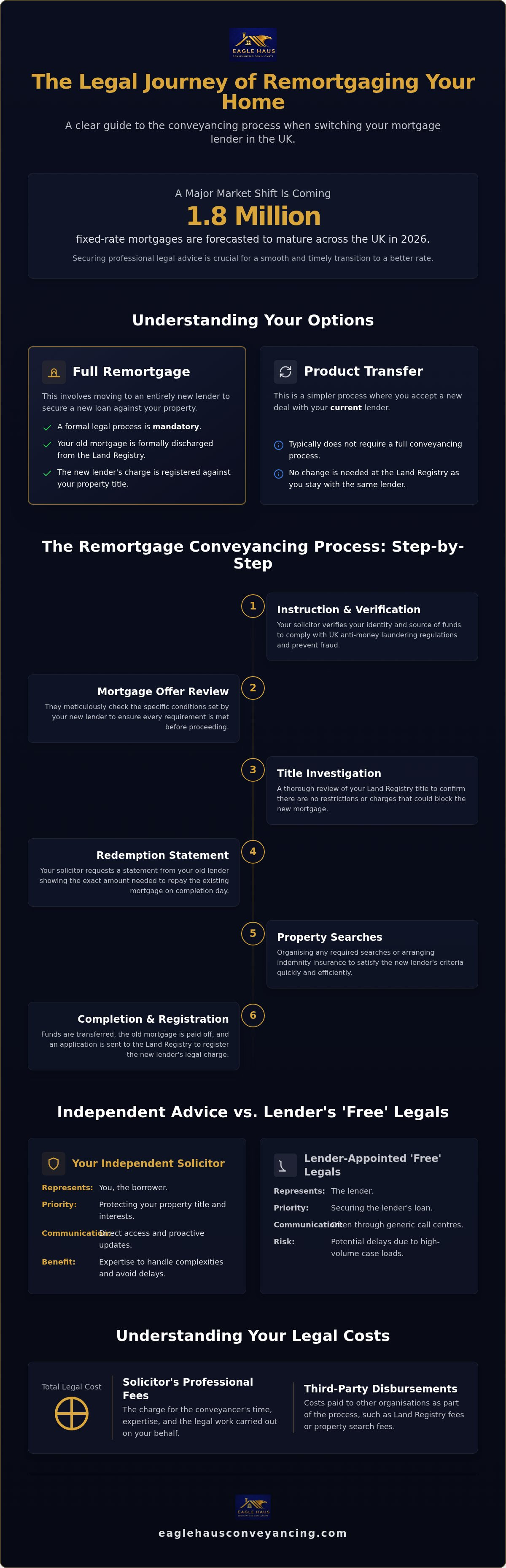
Seeking remortgage legal advice is about more than just finding a better interest rate; it's the professional process of securing a new loan against your property whilst closing the old one. Many homeowners ask, What is a remortgage? because the terminology can be confusing. It is essential to distinguish between a product transfer, where you stay with your current lender on a new deal, and a full remortgage. A full remortgage involves a different lender entirely, requiring a formal legal process to "discharge" your existing mortgage from the Land Registry and "register" the new one in its place.
While many banks offer "free legals" to attract new customers, these solicitors primarily represent the lender's interests. Choosing independent legal advice ensures you have a dedicated professional looking out for your property title. This protection is vital if you want to avoid delays or hidden complications that often arise when using high-volume, lender-appointed firms. Having your own solicitor means you get clear answers when you need them, rather than waiting in a generic call centre queue.
The Role of a Conveyancing Solicitor
Your solicitor acts as the essential link between you, your old lender, and your new financial provider. They begin by verifying your identity and the source of your funds, which is a strict requirement under UK anti-money laundering regulations. This step protects everyone involved from fraud. Once the checks are complete, they conduct a "Report on Title". This document confirms to the new lender that the property is "good and marketable" and meets all their specific lending criteria, ensuring there are no surprises waiting in the fine print.
When is Legal Advice Mandatory?
In the UK, almost every lender requires a qualified solicitor to act on their behalf to ensure their loan is properly secured. A legal charge is the document that gives a lender security over your home. You'll definitely need professional support if your circumstances change during the process, such as adding a partner to the property deeds. This scenario requires a formal Transfer of Equity alongside the mortgage swap. By having a modern, tech-savvy partner handle these complexities, you can bypass the slow, traditional methods that often lead to missed completion dates and unnecessary stress.
The Step-by-Step Remortgage Conveyancing Process
While many homeowners focus on the interest rate, the legal "middle" of the journey is where the actual work happens. Once you receive your mortgage offer, your solicitor begins by checking the specific conditions set by your new lender. This is where remortgage legal advice shifts from theory into practice. Your solicitor must ensure that every requirement is met before they can even think about requesting the funds.
A critical part of this stage is the title investigation. Your solicitor reviews your Land Registry entries to confirm there are no "restrictions" or "charges" that could prevent the new lender from securing their loan. If you are currently repaying your equity loan as part of this move, this adds a layer of complexity. These records must be perfectly clear to ensure your home remains your greatest asset without any legal "clutter" from the past.
Requesting the Redemption Statement
Timing is everything when it comes to clearing your old debt. Your solicitor will request an official redemption statement from your current lender, which shows the exact amount needed to pay off the mortgage on the day of completion. If this is timed incorrectly, you could accidentally trigger extra interest or expensive Early Repayment Charges (ERCs). Your solicitor ensures the old mortgage is fully settled the moment the new funds arrive. For more detail on why this professional oversight is mandatory, see our guide: Do I Need a Solicitor to Remortgage? Your 2026 UK Legal Guide.
Property Searches and Enquiries
Lenders have varying requirements for property searches. Some might insist on full local authority searches, whilst others are happy to accept "no-search" indemnity insurance to keep things moving quickly. In regions like Staffordshire and the West Midlands, local factors such as historic mining activity often mean specialist searches are required. Your solicitor has a duty to flag any potential legal issues to the new lender before the funds are released. This proactive approach prevents delays that often plague more traditional, slower firms.
The final step is completion and registration. On the agreed date, your solicitor receives the funds from the new lender, pays off the old one, and handles the balance. They then update the Land Registry records to reflect the new legal charge. If you are looking for a smooth, tech-led transition to your new rate, having a partner who manages these details with precision is the best way to protect your interests.
Calculating the Real Cost: Remortgage Legal Fees and Disbursements
One of the most common stressors for homeowners is the fear of hidden costs appearing at the last minute. When seeking remortgage legal advice, you'll typically see two main categories on your quote: the professional legal fee and disbursements. The professional fee covers your solicitor’s time, expertise, and the administrative work required to manage your file. Disbursements, on the other hand, are third-party costs that your solicitor pays on your behalf to external organisations like the Land Registry.
In 2026, Land Registry fees follow a specific scale based on the value of your new mortgage. These costs are non-negotiable, but a proactive solicitor will ensure they're calculated correctly from the start. Opting for fixed-fee conveyancing is the smartest way to avoid "bill shock" at completion, as it provides a guaranteed price for the standard legal work involved. This certainty allows you to budget effectively for other costs, such as lender arrangement fees or valuation charges, without worrying about your legal bill spiralling. For a deeper dive into these numbers, read our Remortgage Legal Fees: A Comprehensive 2026 Guide to UK Costs.
Common Legal Disbursements Explained
Disbursements are essential for protecting both you and your lender. They provide the legal "proof" needed to proceed with the transaction safely. Common examples include:
Land Registry Office Copy entries: This is a small fee for obtaining the current digital snapshot of your property title to verify ownership and existing charges.
Bankruptcy searches: Lenders require proof that the borrower is not currently bankrupt before they release the new mortgage funds.
Electronic ID verification: Modern firms use secure, tech-led platforms to confirm your identity instantly, helping to prevent property fraud.
Avoiding Hidden Costs in Your Quote
Many people assume the cheapest quote is the best, but a low headline price often hides "supplementary fees" for common scenarios like leasehold properties or managing gifted deposits. These additions can quickly turn a "bargain" into an expensive headache. Transparency is the cornerstone of our service at Eagle Haus Conveyancing Consultants. We ensure you understand the full financial picture before you commit, serving clients across Wolverhampton, Telford, and the wider West Midlands. This includes following official government guidance on remortgaging if you have an existing equity loan or specific scheme to clear. By choosing a partner that prioritises clear communication over high-volume transactions, you protect your property and your wallet from unexpected last-minute charges.
When Remortgaging Gets Complex: Equity Transfers and Specialist Finance
A common misconception amongst homeowners is that you can simply "add a name" to a mortgage through a quick phone call to the bank. In reality, any change to who owns the property requires a formal legal process. When you combine this with a new loan, you are essentially performing two transactions at once. This is where expert remortgage legal advice becomes indispensable, as your solicitor must manage both the new mortgage offer and the legal change in ownership. A Transfer of Equity ensures the property title correctly reflects the new arrangement whilst satisfying the lender's security requirements.
For property investors in the West Midlands, complexity often extends into specialist finance. If you are using bridging loans to secure a fast-paced transaction in Birmingham or Wolverhampton, the exit strategy usually involves a remortgage. These cases require a solicitor who understands the pressure of tight deadlines and the specific requirements of specialist lenders. Whether you are a first-time landlord or a seasoned pro, having a modern partner who can handle the technicalities of bridging and corporate structures makes all the difference.
Remortgaging to Release Equity
Many clients in Shropshire and across the region remortgage to release cash for home improvements or to fund a second property purchase. This process involves increasing your total debt, so your solicitor's role is to ensure you fully understand the risks and the new legal obligations. They will check that the additional funds are released securely and that the new legal charge is correctly registered. If you need support with a complex ownership change, you can get a transparent quote for your remortgage today.
Specialist Buy-to-Let Remortgages
Professional landlords often face a more intricate legal maze, particularly when managing a portfolio or remortgaging through a Limited Company. These transactions require a solicitor familiar with corporate law and the specific documentation lenders demand for company-owned assets. Limited Company remortgages require a solicitor familiar with corporate law because the lender is essentially lending to a business entity rather than an individual. Portfolio remortgaging involves checking multiple titles and ensuring each "charge" is correctly handled without disrupting the rest of your investments. For more tailored advice for investors, see our guide on Choosing a Buy to Let Remortgage Solicitor: The Investor’s 2026 Guide.
The Eagle Haus Advantage: Reassuring Legal Support
Choosing the right partner for your remortgage legal advice shouldn't feel like a gamble. At Eagle Haus Conveyancing Consultants, we act as a modern professional guide through the often confusing legal maze. Unlike traditional high-street firms that might leave you waiting for weeks, we prioritise efficiency and speed. By utilising modern tech, we significantly reduce the time from your initial mortgage offer to final completion. This proactive approach ensures you aren't left on a standard variable rate whilst waiting for paperwork to clear.
Our team brings deep local expertise to every case. Whether your property is in Staffordshire, Walsall, or Cannock, we understand the specific regional factors that can impact a title check. We combine this local knowledge with the security of a large firm, as we are regulated through our partnership with Taylor Rose. This gives you the peace of mind that your home is in safe, expert hands, blending traditional reliability with a forward-thinking methodology.
Modern Conveyancing for Modern Life
We know that life doesn't stop just because you're switching lenders. Our digital onboarding process makes it easy for busy homeowners in Birmingham and beyond to provide information and track progress from their smartphones. This transparency eliminates the stress of the unknown. We focus on a proactive communication style that prevents the common legal delays often associated with "free legal" packages. If you're ready to see how we compare, you can get a transparent remortgage conveyancing quote to help you plan your budget with total confidence.
Your Next Steps to a Successful Remortgage
Timing is the most critical factor in a smooth transition. We recommend instructing a solicitor ideally three months before your current fixed-rate deal ends. This window allows plenty of time for title checks and redemption statements without a frantic rush at the end. By securing a firm that understands both local nuances and national property law, you protect your property title and your financial interests. We believe in building a personal connection with every client, ensuring you feel supported from start to finish. Contact Eagle Haus Conveyancing Consultants today for expert remortgage legal advice and take the first step towards a delay-free completion.
Take the Next Step Toward a Stress-Free Completion
Remortgaging is more than just a financial switch; it's a legal refresh for your property title. Throughout this guide, we've explored the importance of transparency, from understanding disbursements to handling complex equity transfers. Securing professional remortgage legal advice ensures that your transition to a better rate is handled with the precision your home deserves. It's about moving forward with clarity, knowing your property interest is fully protected under UK law.
At Eagle Haus Conveyancing Consultants, we combine the security of SRA regulation via Taylor Rose with the agility of a tech-forward boutique firm. Our expertise across Staffordshire and the West Midlands means we anticipate local property issues before they cause delays. We believe in fixed-fee transparency, ensuring you never face hidden costs or unexpected legal hurdles on completion day.
Get a transparent remortgage legal quote from Eagle Haus Conveyancing Consultants today. Your journey to a better mortgage deal should be smooth and predictable. With the right legal partner by your side, you can complete your remortgage with total confidence and look forward to the savings ahead.
Frequently Asked Questions
Do I really need a solicitor to remortgage my house in 2026?
Yes, you almost always need a solicitor if you're switching lenders. The new lender requires a legal professional to ensure the property is a valid security for the loan. They must register a new legal charge at the Land Registry and discharge the old one. Even in 2026, lenders mandate this to protect their investment and ensure the title is free of unexpected restrictions or competing claims.
How much are remortgage legal fees on average in the UK?
Standard legal fees for a freehold remortgage are typically around £725 plus VAT, while leasehold properties often cost roughly £795 plus VAT. You should also budget for disbursements, such as Land Registry office copies at £6 plus VAT and search fees ranging from £230 to £400. While some lenders offer "free legals", choosing your own solicitor provides more comprehensive remortgage legal advice and ensures your specific interests are protected.
How long does the legal side of a remortgage take to complete?
The process generally takes between four and eight weeks from the moment you receive your mortgage offer. This timeline depends on how quickly your current lender provides a redemption statement and how fast the new lender's requirements are met. Using a modern firm with digital onboarding can often speed this up. It's best to start the process three months before your current deal expires to avoid falling onto a standard variable rate.
What is the difference between "free legals" and hiring my own solicitor?
"Free legals" are provided by a solicitor appointed and paid for by your lender, meaning they primarily represent the bank's interests. If you hire your own independent solicitor, they work directly for you. This often leads to faster communication and more personalised service. Independent solicitors are also better equipped to handle complexities like equity transfers, which high-volume, lender-appointed firms might struggle to manage efficiently.
Can I remortgage and add a partner to the deeds at the same time?
Yes, you can certainly add a partner to your property deeds whilst you remortgage. This process is known as a Transfer of Equity and must be handled by your solicitor alongside the new mortgage application. Your solicitor will draft the necessary deed to change ownership and ensure the new lender is happy with the arrangement. This is a common scenario where seeking independent remortgage legal advice is vital to ensure both parties understand their rights.
What legal documents do I need to provide for a remortgage?
You'll need to provide valid photo identification, such as a passport or driving licence, and proof of address like a recent utility bill. Your solicitor will also require your current mortgage account number and proof of your source of funds for any "top-up" payments. If the property is leasehold, you must also provide details of your management company or freeholder to ensure all service charges and ground rents are up to date.
Will my solicitor need to do new property searches for a remortgage?
Lenders have different rules regarding searches. Some insist on a full suite of local authority, water, and environmental searches, which can cost between £230 and £400. Other lenders accept "no-search" indemnity insurance, which is often cheaper and faster. Your solicitor will advise which option your specific lender requires. In areas like Staffordshire, specialised searches for historic mining activity may also be necessary to satisfy the lender's security requirements.
What happens on the day of remortgage completion?
Completion day is when the financial transfer actually happens. Your solicitor receives the funds from your new lender and uses them to pay off your existing mortgage balance in full. Any remaining money, minus fees and disbursements, is then transferred to your bank account. Once the debts are cleared, your solicitor notifies the Land Registry to update the property title, removing the old lender and registering the new legal charge.



Comments