Remortgage and Transfer of Equity: The 2026 Professional Legal Guide

Last week, a homeowner in Wolverhampton discovered that their plan to add a partner to their property deeds was stalled because their lender wasn't satisfied with the proposed ownership structure. This scenario is becoming more frequent as homeowners look to remortgage and transfer of equity simultaneously to capitalise on the 3.75% base rate. It's a major life transition that often triggers anxiety over high Stamp Duty (SDLT) costs or the confusion of choosing between Joint Tenants and Tenants in Common.
We agree that the legal side of property ownership should feel supportive and transparent, not like a hurdle to your financial progress. As a trading name of TRW Legal Consulting Ltd with services delivered through Taylor Rose, we prioritise a proactive and modern approach to your conveyancing needs. This guide will help you master the complexities of changing ownership whilst securing a new mortgage deal with our expert legal framework. We will outline the latest 2026 tax thresholds, explain how to satisfy lender requirements, and help you confirm the correct ownership structure with minimal disruption to your application.
Table of Contents
What is a Remortgage and Transfer of Equity?
A combined transaction simplifies your life by handling two major legal changes at once. You are switching to a more competitive mortgage deal whilst simultaneously adjusting who legally owns the home. What is a transfer of equity? At its core, it's the legal process of adding or removing someone from the property deeds. When you pair this with a remortgage, you're essentially starting a fresh financial chapter with a revised list of owners. The process relies on the Transfer Deed, specifically the TR1 form, which officially notifies the Land Registry of the change in ownership structure for 2026.
Most people encounter a remortgage and transfer of equity during significant life milestones. You might be adding a partner to the title after marriage to share the responsibility of a new fixed-rate deal. Conversely, you might be removing an ex-partner following a separation to take full control of the property. In either case, your new lender must provide "Consent to Transfer". They need to be certain that the remaining or new owners meet their strict affordability criteria before the remortgage can complete.
The Legal Necessity of a Solicitor
You might wonder if you can handle the paperwork yourself to save on costs. If a mortgage is involved, the answer is a firm no. Lenders won't release funds unless a regulated solicitor is acting for them. This protects their security and ensures the title is clear of any unexpected legal hurdles. We also ensure that the person leaving the title receives independent legal advice (ILA). This is a vital safeguard that prevents future disputes and confirms that everyone understands the financial implications of giving up their share. It's about building a foundation of trust and transparency for all parties involved.
Key Parties Involved in the Transaction
Successful coordination is the secret to a smooth transition. The transaction involves the outgoing owner, who is relinquishing their legal interest, and the incoming owner, who is joining the deeds. The mortgage lender is the third critical party, as they must approve the new ownership structure before issuing a formal offer. Eagle Haus, as a trading name of TRW Legal Consulting Ltd, acts as your modern professional guide. We work alongside Taylor Rose to manage these moving parts, ensuring that the remortgage and transfer of equity stays on track. Our digital-led approach keeps communication open and reduces the friction typically associated with traditional conveyancing.
Joint Ownership: Choosing the Right Structure
Deciding on your ownership structure is perhaps the most significant step when you organise a remortgage and transfer of equity. It determines your legal rights today and what happens to your home in the future. There are two primary joint property ownership structures to consider: Joint Tenants and Tenants in Common. Each has distinct implications for how you manage your assets and how lenders view your application.
As Joint Tenants, you both own the whole property together rather than having specific shares. If one person passes away, the property automatically goes to the survivor, regardless of what is written in a will. This is known as the "right of survivorship". It's a common choice for married couples who want a straightforward, unified approach to their home. However, it offers less flexibility if you want to protect a specific financial contribution or leave your portion of the home to children from a previous relationship.
Alternatively, Tenants in Common allows you to own defined shares of the property, such as 70/30 or 50/50. This structure is essential if you want to leave your share to someone other than the co-owner. Tenants in Common is the preferred choice for unmarried partners or friends. This flexibility is vital for protecting individual interests, especially if one person provides a larger deposit or pays more towards the monthly mortgage costs.
Joint Tenants vs Tenants in Common
Choosing between these structures depends on your long-term goals and family dynamic. Joint Tenants offers simplicity but lacks protection for complex estates. Tenants in Common provides that protection but usually requires a "Declaration of Trust" to define those shares clearly. If your circumstances change, you can "sever" a joint tenancy to become Tenants in Common. We often facilitate this during a remortgage to ensure your deeds remain relevant to your current life situation. When you speak with our team, we can help you determine which path aligns with your financial reality.
The Role of the Land Registry
In 2026, the Land Registry records these details on the Title Register to provide public proof of ownership. For Tenants in Common, a "Restriction" (often a Form A restriction) is added to the register. This prevents a sole survivor from selling the property without a second trustee, ensuring the deceased's share is protected. Your ownership choice also ripples into future moves; lenders for equity release or subsequent remortgages will check these structures to determine who must sign the mortgage deed. Ensuring your deeds reflect your actual financial contributions now prevents significant legal headaches later.
Why Combine Your Remortgage with a Transfer of Equity?
Combining these processes is often more efficient than treating them as separate projects. By completing a remortgage and transfer of equity at the same time, you consolidate your legal requirements into a single, streamlined timeline. This approach reduces the administrative burden on you. You only need to provide your documentation and identity verification once. It's a proactive way to align your financial commitments with your actual living situation without doubling the paperwork.
Cost-effectiveness is another major advantage. When you use one firm to handle both aspects, you minimise the disbursements you'd otherwise pay twice, such as Land Registry search fees and electronic ID checks. You also benefit from lender synergy. By updating the ownership deeds at the exact moment you switch to a new mortgage deal, you ensure that the new lender's security matches the legal title from day one. This prevents future legal hurdles, such as disputes during a property sale or issues when trying to release equity later in life.
Understanding Stamp Duty (SDLT) Implications
Many homeowners worry that adding someone to a deed will trigger a massive tax bill. In reality, Stamp Duty is calculated on "chargeable consideration". This isn't just cash changing hands; it also includes the value of any mortgage debt the new owner takes on. For example, if you add a partner to a property with a £300,000 mortgage, their 50% share of that debt (£150,000) counts as consideration. Since the 0% SDLT threshold for 2026 is £125,000 for residential properties, this specific scenario might attract a tax charge on the amount above that limit. However, exemptions often apply for transfers following a divorce or a court order. These can significantly reduce or eliminate the bill entirely.
Managing Lender Requirements
Every lender has a different appetite for risk when it comes to changing ownership. Some are very flexible, whilst others require rigorous affordability and credit checks for any new party being added to the mortgage. We manage this by coordinating the redemption of your existing mortgage whilst simultaneously setting up the new one. Our team ensures that your new lender's "Consent to Transfer" is secured early in the process. This proactive communication prevents delays. It ensures that your remortgage and transfer of equity completes smoothly without disrupting your transition to a better interest rate.
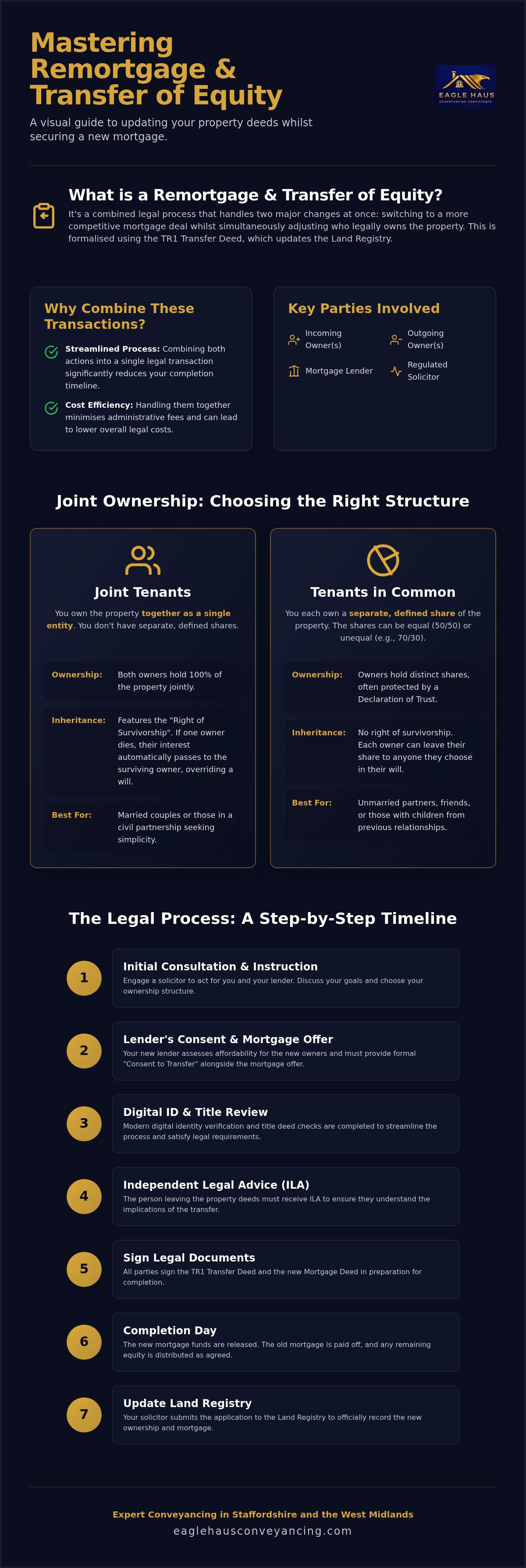
The 2026 Legal Process: A Step-by-Step Timeline
The journey to a successful remortgage and transfer of equity is methodical and highly organised. By following a structured legal framework, we ensure that every detail, from lender consent to Land Registry updates, is handled with precision. Our modern approach prioritises clear communication to keep your application moving forward without unnecessary stress. Here is how the process unfolds in five clear stages:
Step 1: Instruction and Digital ID – We begin by verifying your identity using modern digital tools. This eliminates the need to post original documents and speeds up the initial setup.
Step 2: Reviewing Title and Mortgage – Our team examines your current Title Register and reviews the terms of your new mortgage offer to ensure they align with your ownership goals.
Step 3: Drafting and Consent – We draft the Transfer Deed and formally request "Consent to Transfer" from your new lender. This is a critical point where the legal and financial aspects of the deal meet.
Step 4: Completion – On the day of completion, funds move from your new lender to redeem your old mortgage. Ownership officially changes at this moment.
Step 5: Post-Completion – We finalise the transaction by registering the changes with the Land Registry, ensuring your property title is updated and accurate for the 2026 records.
Preparation and Documentation
Gathering your documentation early is the best way to ensure a smooth transition. You will need your current mortgage statements and a formal "Redemption Statement" from your existing lender, which shows the exact amount required to pay off your debt. In 2026, the legal landscape has shifted heavily towards digital signatures. Whilst some documents still require traditional wet-ink signatures, many lenders now accept Mercury-compliant digital signatures, which significantly reduces the time spent waiting for the post. Having your proof of funds and ID ready at the start prevents the most common administrative bottlenecks.
Estimated Timelines for Completion
A combined remortgage and transfer of equity typically takes between 8 and 12 weeks to complete. This timeline accounts for the coordination required between you, your solicitor, and the mortgage lender. Factors such as a clear credit history and proactive communication can often speed this up. To avoid delays at the Land Registry stage, we ensure all paperwork is error-free before submission, as even minor discrepancies in names or addresses can lead to lengthy requisitions. If you are ready to start your journey, you can get a tailored quote today to see how our modern methodology can work for you.
Expert Conveyancing in Staffordshire and the West Midlands
When you're managing a remortgage and transfer of equity, choosing a partner with deep roots in the West Midlands property market offers a distinct advantage. Local knowledge isn't just about geography; it's about understanding the specific property trends in Wolverhampton and Birmingham. This insight allows us to anticipate potential valuation issues or lender-specific requirements that national-only firms might overlook. We offer a reassuring, modern service that combines the gravity of legal expertise with a warm, client-focused approach.
Our personality is that of a modern professional guide. We position ourselves as your partner in the process rather than a distant service provider. By addressing common concerns and procedural questions upfront, we create a rhythmic flow that leads you through a structured journey from your initial inquiry to final resolution. This proactive attitude ensures you feel secure and informed at every stage of your property transition.
Serving Our Local Communities
Our commitment extends across Staffordshire and the wider Shropshire area. Whether you are based in Cannock, Walsall, or Telford, we use modern technology to bridge the gap between traditional reliability and contemporary speed. Digital-led conveyancing means you don't need to visit a physical office to get your transaction moving. We understand the nuances of local property values, ensuring that your ownership structure is recorded accurately and reflects the reality of your local market. This efficiency is designed to alleviate the stress typically associated with major life changes.
The Eagle Haus Difference
Eagle Haus operates as a trading name of TRW Legal Consulting Ltd, with all legal services delivered through our regulated partners at Taylor Rose. This structure gives you the best of both worlds: the national strength and regulated excellence of a large firm, paired with the boutique, personal attention of a local specialist. We strip away the archaic legalese that often confuses homeowners, replacing it with clear, proactive communication. Our fees are transparent, so you won't face unexpected costs during your transition.
We pride ourselves on a forward-thinking, efficient methodology that prioritises individual attention. Instead of high-volume, impersonal transactions, we focus on building a sense of security and trust through clear, direct communication. If you are ready to secure your financial future and update your property deeds, we are here to help. Request your tailored remortgage and transfer of equity quote today and experience a more supportive way to handle your legal needs.
Take the Next Step Towards Secure Property Ownership
Taking control of your property ownership whilst moving to a better financial deal is a strategic step for any homeowner. By combining a remortgage and transfer of equity into a single transaction, you reduce administrative delays and minimise legal disbursements. Whether you are adding a partner or adjusting shares as tenants in common, the key is ensuring your legal structure matches your long-term goals. Our modern approach replaces archaic legalese with clear, proactive communication. This makes the transition feel supportive rather than stressful.
As a trading name of TRW Legal Consulting Ltd, we provide regulated legal services via Taylor Rose. We combine national excellence with deep expertise in complex Staffordshire property transactions. Our digital-led methodology ensures your application moves at the speed of 2026 without losing the personal touch of a boutique service. You don't have to navigate these legal complexities alone. We are here to guide you through every step with transparency and ease.
Ready to secure your home's future? Secure your property’s future with an Eagle Haus remortgage and transfer of equity today. We look forward to helping you achieve a smooth and successful transition.
Frequently Asked Questions
Do I need a solicitor for a remortgage and transfer of equity?
Yes, a solicitor is essential for a remortgage and transfer of equity. Lenders won't release funds for a new deal unless a regulated professional acts for them to secure the property title. Our team, working through Taylor Rose, ensures that all legal owners sign the new mortgage deed. This protects your interests and guarantees that the Land Registry records are updated accurately to reflect the new ownership structure and the lender's charge.
How much does a transfer of equity cost in 2026?
Total costs depend on your property value and the complexity of the legal work involved. You'll encounter legal fees for both the transfer and the remortgage, alongside essential disbursements. For instance, Land Registry fees in 2026 range from £230 for properties up to £200,000 to £1,105 for those over £1 million. Combining these transactions into a single process often saves you money on administrative disbursements like electronic ID checks and office copy entries.
Can I remove someone from a mortgage without their consent?
No, you cannot remove a legal owner from a property deed without their voluntary consent. Every person named on the title has a legal interest that cannot be extinguished without their signature on a Transfer Deed. The only exception is a court order, which might be granted during divorce proceedings. Both parties must agree to the change, and the outgoing person typically needs independent legal advice to confirm they're relinquishing their rights and liabilities.
Will I have to pay Stamp Duty on a transfer of equity?
Stamp Duty Land Tax (SDLT) is often payable if the "consideration" is above the 2026 threshold of £125,000. Consideration isn't just cash; it includes the share of the mortgage debt the new owner takes on. If you add a partner to a £300,000 mortgage, their £150,000 share of the debt counts as consideration. Since this is above the threshold, tax may be due. Exemptions exist for court orders or formal separation agreements, which we can help identify.
How long does the Land Registry take to update deeds after a transfer?
Completion is immediate on the day funds move, but the Land Registry update takes longer. Simple applications might be processed within a few weeks, but more complex cases can take several months. We use digital submission tools to ensure your application is prioritised and error-free. Even whilst the Registry is processing the change, your legal position is protected by the completed Transfer Deed and the priority search we conduct before the point of completion.
Can I remortgage and transfer equity if I have a Help to Buy loan?
You can, but you must get formal approval from Homes England before you start. This involves providing a RICS valuation and paying an administration fee to the Help to Buy scheme. The administrator needs to be satisfied that the new ownership structure doesn't breach their terms. We manage the extra communication required between you, your new lender, and the Help to Buy administrator to ensure the remortgage and transfer of equity stays on track.
What happens if my lender refuses the transfer of equity?
If your lender refuses, it's typically because the remaining owners don't satisfy their specific affordability or credit checks. You won't be able to complete the transfer with that particular lender. In this situation, you could try applying to a different mortgage provider with more flexible criteria. We can help you review your options or suggest alternative routes to ensure you can still achieve the ownership change you need whilst securing a viable, competitive mortgage deal.
Do both parties need their own solicitor for a transfer of equity?
Usually, yes. Whilst one solicitor can often represent the incoming owner and the lender, the person leaving the title must have independent legal advice. This is a vital safeguard to ensure they aren't being pressured into the transfer and fully understand they're giving up their legal rights. We facilitate this by coordinating with the outgoing party's representative, ensuring the entire process remains transparent, professional, and compliant with modern legal standards for 2026.



Comments