Limited Company Conveyancing: A 2026 Legal Checklist for Property Investors

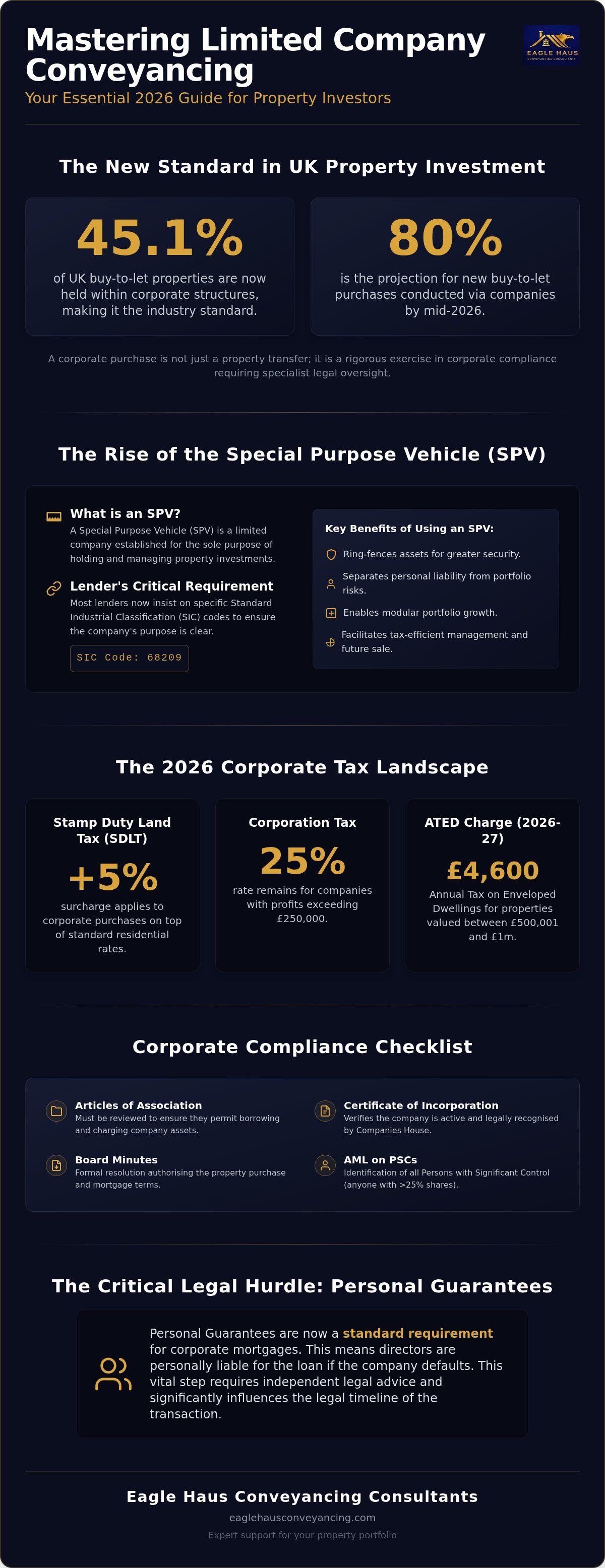
With 45.1% of UK buy-to-let properties now held within corporate structures, limited company conveyancing has officially moved from a niche strategy to the industry standard for serious investors. However, as many landlords discover during their first SPV purchase, buying through a company isn't just a simple property transfer. It's a rigorous exercise in corporate compliance. You're likely already aware that the process involves significantly higher legal fees and much more stringent lender requirements than a personal purchase.
It's natural to feel concerned about the complexity of modern SDLT calculations or the extra layers of due diligence that can slow down your completion. We understand that you need a process that's as agile as your investment strategy. This 2026 guide will help you master these legal complexities, ensuring your transactions remain smooth, compliant, and tax-efficient. We'll preview the essential steps for the year ahead, from navigating the latest ATED thresholds to ensuring your solicitor uses the modern, proactive communication tools you expect.
Table of Contents
The 2026 Landscape: Why Limited Company Conveyancing is Different
The property market has shifted significantly. By mid-2026, approximately 80% of all new buy-to-let purchases are conducted through corporate structures. This surge means that limited company conveyancing is no longer an outlier; it's the core of professional portfolio management. While the fundamental conveyancing process involves the same transfer of legal title, the layer of corporate scrutiny added by lenders and HMRC makes it a different beast entirely. Standard residential conveyancers often focus purely on the property, but a company purchase requires a deep dive into your business's constitution and its ability to hold debt.
Aligning your legal strategy with your accountant's advice is vital. Your solicitor isn't just checking boundaries. They're ensuring the purchase doesn't trigger unexpected tax traps or breach your company's internal rules. In 2026, the margin for error is slimmer than ever, and a simple oversight in your company's filings can lead to a mortgage offer being withdrawn at the eleventh hour.
The Rise of the SPV in 2026
A Special Purpose Vehicle (SPV) is a limited company set up solely for property investment. In 2026, lenders have become incredibly specific about how these entities are formed. Most mortgage providers now insist on specific Standard Industrial Classification (SIC) codes, typically 68209 for "letting and operating of own or leased real estate." If your company is registered with the wrong code, your application will likely stall before it even reaches the legal stage.
Ring-fencing assets within an SPV provides a layer of security. It separates your personal liability from the risks associated with the property portfolio. It's a clean, modular way to grow, allowing you to sell the company itself in the future rather than just the bricks and mortar. This structure also helps in managing the 2026 Corporation Tax rates, which remain at 25% for companies with profits over £250,000.
Tax Implications and Legal Responsibility
Tax efficiency is often the primary driver for incorporation, but the 2026 landscape is complex. Companies purchasing residential property are subject to higher rates of Stamp Duty Land Tax (SDLT). Currently, a 5% surcharge applies to these transactions on top of the standard residential rates. Your solicitor plays a critical role here, as they must verify that your company qualifies for any available reliefs, such as those for property development or rental businesses.
Compliance doesn't end with SDLT. For the period from 1 April 2026 to 31 March 2027, the Annual Tax on Enveloped Dwellings (ATED) charge for residential properties held by companies valued between £500,001 and £1 million is £4,600. Miscalculating these liabilities can lead to severe HMRC penalties, making specialist limited company conveyancing oversight essential for every transaction.
Corporate Compliance: Documentation Your Solicitor Needs
Success in limited company conveyancing depends on more than just a signed contract. It requires a meticulous paper trail that satisfies both the Land Registry and your lender's compliance department. Whilst a personal purchase focuses on you as an individual, a corporate transaction shifts the spotlight to the structure and legitimacy of your business. Having these documents ready at the outset can shave weeks off your completion timeline.
Articles of Association and Borrowing Powers
Your company's Articles of Association serve as its constitutional backbone. Lenders will scrutinise these to ensure there are no restrictive clauses that prevent the directors from borrowing money or charging company assets. It's surprisingly common for generic "off-the-shelf" companies to have outdated Articles that don't quite align with modern lending requirements. If a conflict is found, you'll need to organise a formal amendment through a special resolution, a process that our team can help you navigate alongside your company purchase.
Beyond the Articles, you must provide a Certificate of Incorporation and proof of your registered office. These verify that the entity is active and legally recognised by Companies House. Lenders also require specific Board Minutes authorising the purchase of the property and the terms of the mortgage. This document proves that the directors have collectively agreed to the debt, providing a clear audit trail for the transaction.
Anti-Money Laundering (AML) for Companies
AML protocols for corporate bodies are significantly more intensive than for individuals. Your solicitor must identify all Persons with Significant Control (PSC), typically anyone holding more than 25% of the shares. This transparency is mandatory to prevent the "enveloping" of properties for illicit purposes. You'll need to provide clear evidence of the initial capital injection used to fund the deposit, showing exactly where the money originated before it hit the company bank account.
The role of the solicitor here is to verify that the corporate structure complies with the latest Stamp Duty Land Tax rules and AML regulations. This involves distinguishing between the "source of funds" for the specific property and the "source of wealth" for the ultimate beneficial owners. By preparing this evidence early, you demonstrate the transparency that modern lenders demand for limited company conveyancing, ensuring your portfolio grows on a foundation of total compliance.
Mortgages and Personal Guarantees: The Legal Hurdle
Securing finance for a corporate purchase adds a significant layer of legal friction that personal buyers rarely encounter. Lenders view limited companies as separate legal entities, which, whilst providing tax benefits, also creates a perceived risk for the bank. As a result, limited company conveyancing involves much more than just title checks; it requires a deep dive into the security the company can offer and the personal commitment of its directors.
Understanding Personal Guarantees
A Personal Guarantee (PG) is essentially a director's promise to step in if the company defaults on its mortgage payments. Since a Special Purpose Vehicle (SPV) often holds no assets other than the property being purchased, lenders use PGs to ensure they have a secondary route to recover their funds. It's a serious legal commitment that makes you personally liable for the company's debt.
Because of the high stakes involved, lenders mandate that every director signing a PG must receive Independent Legal Advice (ILA). This is a non-negotiable step where a separate solicitor explains the risks to you in a face-to-face or video meeting. Your primary conveyancing solicitor cannot provide this advice. Doing so would create a conflict of interest, as their main duty is to the company and the lender, not your personal financial position. To keep your transaction on track, you should organise your ILA solicitor as soon as the mortgage offer is issued. Speed is essential.
Lender-Specific Requirements
Limited company mortgage offers in 2026 come with a suite of conditions that are far more granular than standard buy-to-let agreements. As of June 2026, five-year fixed mortgage rates for limited companies typically sit between 5.14% and 5.49%, reflecting a slight premium over personal products. Lenders will often insist on specific wording in the mortgage deed and may require your solicitor to confirm that the company is in good standing with Companies House before funds are released.
If your investment strategy involves rapid renovations or auction purchases, you might be using short-term finance. In these cases, it's vital to seek specialised bridging loan legal advice. Bridging loans carry their own set of legal hurdles, particularly regarding the "exit strategy" that your conveyancer must verify. Coordinating between the lender’s solicitors and your own team requires a proactive approach to prevent delays that could jeopardise your deposit.
The 2026 Limited Company Conveyancing Checklist
Managing a property portfolio through a corporate structure requires a disciplined approach to the timeline. Unlike a personal purchase where you might wait for your solicitor to prompt you, limited company conveyancing demands proactive coordination between your accountant, your lender, and your legal team. This five-step checklist ensures no detail is overlooked.
Step 1: Company formation and SIC code verification. Ensure your SPV is registered with the correct SIC codes, usually 68209, to satisfy lender requirements from day one.
Step 2: Instructing a specialist corporate conveyancing partner. Choose a firm that understands the nuances of SPV purchases and can bridge the gap between traditional law and investor speed.
Step 3: Corporate AML and source of funds verification. Gather your source of wealth evidence early, including the initial capital injection used to fund the company.
Step 4: Review of mortgage offer and Personal Guarantee ILA. Once the offer is issued, immediately organise your Independent Legal Advice to avoid delays at the end of the process.
Step 5: Board approval and execution of the transfer deed. Formally record the decision to purchase in your board minutes before the directors sign the final transfer documents.
Pre-Exchange Corporate Checks
Before you commit to the exchange of contracts, your solicitor must confirm that the company is in "Good Standing" with Companies House. This means all annual returns and accounts are up to date. Lenders will often perform their own check on your company's status just days before completion, so keeping your filings current is essential. We also recommend verifying that the final purchase price, including all associated costs, remains within the authorised corporate budget to prevent any internal compliance issues. Reviewing the draft contract for corporate-specific clauses is equally vital, as it ensures the entity is correctly identified as the purchaser.
Completion and Post-Completion
On the day of completion, the focus shifts to the Land Registry. Registering a corporate owner involves providing the company's registration number and ensuring the title deed correctly reflects the SPV's legal name. This final stage of limited company conveyancing is where attention to detail prevents future issues when you eventually decide to sell or remortgage. Your solicitor will also submit the SDLT1 return on behalf of the company, ensuring any corporate surcharges are paid within the mandatory 14-day window. Finally, remember to update your company’s internal asset register. This is a vital step for your annual accounts and helps maintain a clear overview of your portfolio's growth.
If you are ready to start your next acquisition, you can instruct our specialist team today to ensure your timeline remains on track.
Expert Support for Your Property Portfolio
Purchasing property through a corporate structure shouldn't feel like a battle against bureaucracy. At Eagle Haus, we've designed our service to simplify the complexities of limited company conveyancing, acting as a modern bridge between traditional legal expertise and the high-speed requirements of property investors. Whether you are acquiring your first Special Purpose Vehicle (SPV) or managing a growing portfolio across the West Midlands, we provide the clarity and momentum you need to succeed.
Our unique position allows us to offer the best of both worlds. As a trading name of TRW Legal Consulting Ltd, Eagle Haus provides regulated legal services through our partnership with Taylor Rose. This means you benefit from the robust, regulated excellence of a national firm whilst enjoying the boutique, personalised attention of a specialist consultant. It's a partnership built on transparency and a commitment to keeping your investment journey moving forward without unnecessary delays.
A Modern Approach to Property Law
Investors tell us that the biggest frustration in legal services is a lack of communication. We've solved this by adopting a proactive, tech-savvy methodology that prioritises openness. By leveraging modern communication tools and streamlined digital processes, we speed up the corporate conveyancing process, ensuring you're never left wondering about the status of your transaction. This approach is particularly vital when you're looking to scale, as efficient legal support becomes the foundation of a managed property portfolio.
Consistency is key as your portfolio matures. Once you've completed a purchase, your next move might be to release equity for further acquisitions. Understanding how to transition between these phases is essential, so we recommend choosing a buy to let remortgage solicitor who understands your long-term goals and corporate structure.
Your Next Steps in Property Investment
We provide specialist support across Staffordshire, Wolverhampton, and Birmingham, combining local West Midlands market knowledge with national standards. Our team is particularly adept at handling the high-pressure environment of bridging loans and complex financing, where speed is often the deciding factor in a deal's success. We don't believe in hidden fees or opaque processes; we provide transparent quotes that allow you to calculate your ROI with confidence.
If you're ready to discuss your 2026 investment strategy, our Staffordshire-based team is here to help. We can guide you through the intricacies of company purchases and ensure your legal structure is as robust as your business plan. Contact us today for a consultation and discover how we can help you build a secure, compliant, and efficient property portfolio.
Securing Your 2026 Property Investment Strategy
The shift towards corporate structures has redefined the property market, making limited company conveyancing a specialised discipline that requires more than just standard residential expertise. To succeed in 2026, you must ensure your SPV is correctly formed with specific SIC codes and that your Articles of Association align with lender requirements. Navigating the hurdles of Personal Guarantees and Independent Legal Advice is much smoother when you have a proactive partner who anticipates these steps before they become bottlenecks.
At Eagle Haus, we bridge the gap between traditional legal reliability and the speed investors demand. Through our partnership with the regulated firm Taylor Rose, we provide expert legal services with a deep focus on West Midlands property investment. Our team specialises in complex bridging and SPV finance, ensuring your portfolio remains both agile and compliant. If you are ready to move forward with confidence, Get a Professional Quote for Your Company Purchase today. We look forward to helping you build your property legacy with ease and transparency.
Frequently Asked Questions
Do I need a different solicitor for limited company conveyancing?
You should instruct a specialist firm because standard residential solicitors often lack the expertise to handle corporate structures. Limited company conveyancing involves specific due diligence on your business's constitution and its ability to hold debt. At Eagle Haus, we provide these regulated services through our partnership with Taylor Rose. Investors across Birmingham and Wolverhampton find that specialist support is vital for satisfying the complex requirements of corporate mortgage lenders.
How much more does limited company conveyancing cost in 2026?
Professional fees for company purchases are generally higher than personal transactions due to the increased legal scrutiny involved. Your solicitor must perform additional tasks, such as reviewing Articles of Association, verifying corporate AML, and coordinating more complex mortgage deeds. Whilst we don't provide fixed prices here, investors should budget for the extra time required to meet 2026 regulatory standards. This investment ensures your corporate structure is robust and fully compliant with HMRC rules.
Can I buy a property through a company I already own?
You can, but lenders usually prefer a dedicated Special Purpose Vehicle (SPV) that only holds property assets. If your existing company has other trading activities or significant liabilities, it could complicate your mortgage application or lead to a rejection. We assist investors across Staffordshire in assessing whether their current business structure is suitable. Often, it's cleaner and more tax-efficient to form a new entity specifically for your West Midlands property portfolio.
How long does the conveyancing process take for a limited company?
A corporate purchase typically takes 8 to 12 weeks, which is slightly longer than a personal transaction. This timeline accounts for the extra layer of lender compliance and the requirement for directors to obtain Independent Legal Advice. In fast-moving markets like Walsall and Cannock, proactive communication is essential. Having your corporate paperwork and SIC codes verified early in the process can significantly reduce the risk of delays during the final stages of completion.
What is a Personal Guarantee and why does the lender require one?
A Personal Guarantee is a legal promise that you will personally repay the mortgage if your company defaults. Lenders require this because a new SPV often has no assets other than the property itself, making it a higher risk for them. It's a standard requirement in 2026. You'll need to meet with an independent solicitor to discuss the risks involved before signing, as your main conveyancing solicitor cannot provide this specific advice due to conflict rules.
What SIC code should my property company use for conveyancing purposes?
Most mortgage providers in 2026 insist on SIC code 68209, which represents "letting and operating of own or leased real estate." If your company is registered with an incorrect code, your lender may refuse to release funds until it's corrected at Companies House. We check this for our clients in Telford and Shropshire at the start of the transaction to ensure the company's registration perfectly aligns with the requirements of your chosen mortgage offer.
Is Stamp Duty higher when buying through a limited company?
Yes, companies are generally subject to a 5% surcharge on top of standard residential Stamp Duty Land Tax rates. This higher rate applies from the first pound of the purchase price for residential properties. However, certain reliefs may be available for businesses involved in property development or large-scale rentals. We ensure your SDLT1 return is filed accurately, reflecting the correct 2026 corporate rates whilst claiming any legitimate exemptions that apply to your specific investment.
Can I transfer a property I already own into a limited company?
This is treated as a sale to your own company and requires a full legal transfer of equity process. You'll likely need to pay Stamp Duty and Capital Gains Tax based on the property's current market value, even if no money changes hands. It's a complex strategic move that requires close coordination between your accountant and our legal team to ensure the transfer is compliant and your corporate registration is handled correctly by the Land Registry.



Comments