Licensed Conveyancer vs Solicitor in the UK: What Is the Difference?

The professional with the broader legal title isn’t automatically the better fit for your move. If you’re weighing the licensed conveyancer vs solicitor UK options, the practical difference is their training and scope: licensed conveyancers specialise in property law, while solicitors have broader legal training. Both have professional regulators, but the titles alone don’t tell you which expertise best matches your transaction.
Before trusting someone with a purchase, sale or remortgage, it helps to know who will handle the legal work, which regulated firm is responsible and whether the professional has experience with your type of transaction. This guide explains how each professional qualifies and is regulated in England and Wales, what they can do during a property transaction, and which service factors may matter when your circumstances are straightforward or more complex.
Eagle Haus Conveyancing Consultants supports residential purchases, sales, remortgages and transfers of equity. Eagle Haus is a trading name of TRW Legal Consulting Ltd, with legal services provided through the regulated firm Taylor Rose. This guide will help you compare support by transaction fit, communication and relevant experience, rather than assuming one title is superior.
Table of Contents
Licensed Conveyancer vs Solicitor: What Do These Titles Mean?
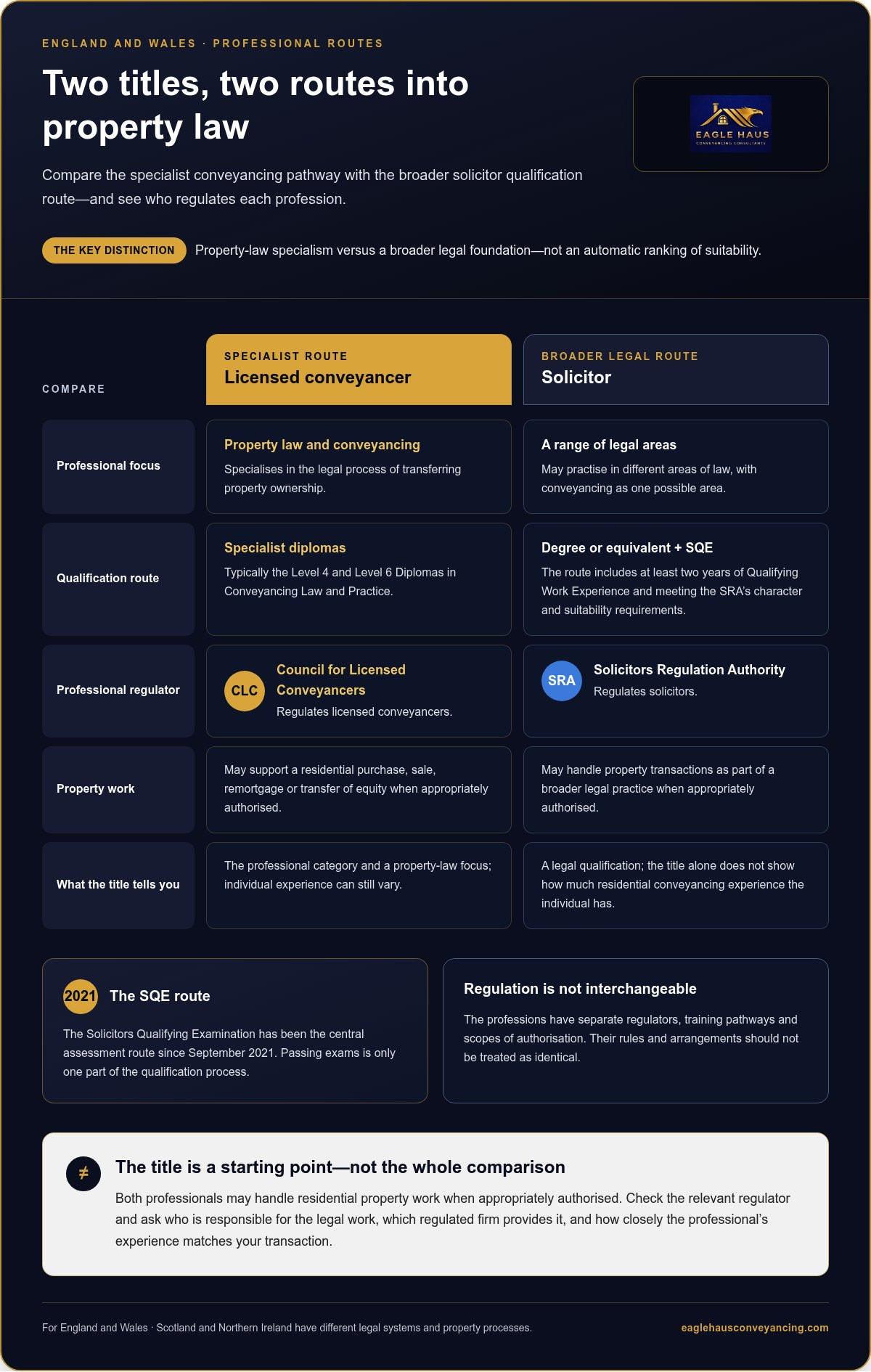
Both licensed conveyancers and solicitors can support a residential property transaction when appropriately authorised to carry out the legal work. The distinction isn’t that one can handle a purchase and the other can’t. It comes down to professional training and area of practice, as well as experience with the transaction you’re undertaking.
The licensed conveyancer vs solicitor UK comparison in this section relates to England and Wales. Scotland and Northern Ireland have different legal systems and property processes, so the same professional titles and explanations may not apply there.
What does a licensed conveyancer do?
A licensed conveyancer is a specialist property-law professional whose work focuses on conveyancing: the legal process involved in transferring property ownership. That can include legal work for a home purchase or sale, remortgage or transfer of equity. The Conveyancing process involves more than exchanging paperwork; it moves the transaction towards the legal transfer of ownership.
The word licensed matters. “Conveyancer” may be used as a general job description, but that wording alone doesn’t establish that someone holds the professional title of Licensed Conveyancer. Licensed conveyancers are regulated by the Council for Licensed Conveyancers (CLC). Their specialist focus can be relevant to a home move, though individual professionals have different experience and may handle different types of property matters.
For example, one professional may regularly work on straightforward residential purchases, while another may have more experience with leasehold transactions or transfers of equity. The title identifies the professional category, not every detail of an individual’s background. When comparing support, ask how closely their experience matches the transaction you’re planning.
What does a solicitor do in conveyancing?
A solicitor is a qualified legal professional who may practise in a range of legal areas. Conveyancing is one area of practice, so solicitors can handle property transactions as part of a broader legal practice. The solicitor title alone doesn’t tell you how much residential conveyancing experience that individual has or which types of property transaction they handle most often.
In short, a licensed conveyancer specialises in property law, while a solicitor is a qualified legal professional who may include conveyancing in a broader practice. Neither description makes one professional automatically more suitable. If you’re buying, selling, remortgaging or transferring a share of a property, compare the work involved with the professional’s relevant experience.
It can also help to distinguish between the person managing your matter, the professional responsible for the legal work and the organisation providing the service. Those roles may not be described by the same title. Find out who is responsible for the legal work and which regulated firm provides it before comparing qualifications and regulation.
How Solicitors and Licensed Conveyancers Are Qualified and Regulated
Professional titles are supported by different qualification routes and regulatory frameworks. In England and Wales, solicitors are regulated by the Solicitors Regulation Authority (SRA), while licensed conveyancers are regulated by the Council for Licensed Conveyancers (CLC). Each regulator oversees its own profession, including professional standards and authorisation. The regulators are separate, so their rules and arrangements shouldn’t be treated as interchangeable.
Which regulators oversee the professions?
The regulator attached to a professional title gives you a starting point for understanding who oversees that individual or firm. The Council for Licensed Conveyancers (CLC) regulates licensed conveyancers, and the SRA regulates solicitors. Official regulator registers can help you check a professional’s or firm’s regulatory status. Make sure the name and organisation you find match the legal service you’re considering.
Both professions are regulated, but that doesn’t mean their training, permitted work, insurance or compensation arrangements are identical. Those details depend on the relevant regulator’s current rules and the authorisation held by the individual or firm. Treat regulation as a framework for oversight, rather than assuming it provides precisely the same protections in every respect.
What do the different qualification routes mean for clients?
The routes reflect different professional foundations. In England and Wales, the solicitor qualification route includes a degree or equivalent, the Solicitors Qualifying Examination (SQE), at least two years of Qualifying Work Experience and meeting the SRA’s character and suitability requirements. The SQE has been the central assessment route since September 2021, but passing exams is only one part of the process.
Licensed conveyancers typically qualify through the Level 4 and Level 6 Diplomas in Conveyancing Law and Practice. This is a specialist route focused on conveyancing law and practice. The qualifications aren’t interchangeable labels: each profession has its own regulator, training pathway and scope of authorisation.
A professional title indicates a qualification route, while transaction-specific experience shows how familiar that professional is with the work your property matter involves. For instance, a solicitor may have broad legal training but limited experience with residential conveyancing; a licensed conveyancer may focus on property work but have varying experience across transaction types. Neither title, by itself, answers every question about the support a particular purchase or remortgage needs.
For a useful comparison, look beyond the letters after someone’s name. Consider who is authorised to provide the legal service, which regulated firm is responsible for it, and whether the professional has experience relevant to your transaction. That’s a more practical way to approach the licensed conveyancer vs solicitor UK question than treating one route as a guarantee of better service.
Eagle Haus Conveyancing Consultants is a trading name of TRW Legal Consulting Ltd, and legal services are provided through the regulated firm Taylor Rose. For residential purchases, sales, remortgages and transfers of equity, explore Eagle Haus residential conveyancing support.
Which Professional Fits Your Property Transaction? Compare the Work, Not Just the Title
For many residential matters, either a solicitor or a licensed conveyancer may be suitable, provided they’re appropriately authorised and have relevant experience. The useful question isn’t simply which title they hold. It’s whether their experience and approach fit the work your transaction involves. Start by identifying the type of transaction, then consider what property, mortgage or ownership details could affect the legal work.
For a straightforward purchase or sale
A typical purchase involves checking the title, raising enquiries about the property and handling the legal steps needed to transfer ownership. A sale also involves preparing relevant information and documents for the buyer’s legal representative. These are broad outlines, not a checklist for every transaction. For a closer look at residential transaction support, explore the residential purchases and sales guide.
A straightforward freehold sale may call for different work from a leasehold purchase or a transaction linked to another property. A solicitor’s broader legal training doesn’t automatically mean greater conveyancing experience. Equally, a specialist title doesn’t guarantee familiarity with every type of property matter. Compare experience with the specific type of property and transaction, rather than relying on the title alone.
For remortgages, ownership changes and complex matters
With a remortgage, the lender’s requirements shape the legal work. A transfer of equity changes the ownership, and the details can differ depending on whether a mortgage or other arrangements are involved. Unusual title features, connected transactions or finance arrangements may add steps or require particular experience. That doesn’t make every remortgage or ownership change complex; the facts of the matter determine the work involved.
If ownership is changing, the guide to transfers of equity explains the transaction in more detail. For information about solicitor regulation, the Solicitors Regulation Authority (SRA) provides an authoritative reference.
Communication matters throughout. You should be able to understand what is happening, what information is needed from you and when an issue could affect the transaction. In the licensed conveyancer vs solicitor UK decision, compare the fit between your transaction and the professional’s relevant experience, clear explanations and authorised role, rather than making assumptions based on title alone.
How to Decide: Five Factors That Matter More Than the Job Title
Once you know the difference between the professional titles, focus on how the support fits your transaction. These five factors make the licensed conveyancer vs solicitor UK decision more practical, whether you’re buying, selling, remortgaging or changing property ownership.
Authorisation. Identify the regulated firm responsible for providing the legal service and the professional’s role within it. This tells you who is accountable for the work, rather than leaving you to rely on a job title or trading name alone.
Relevant transaction experience. Look for experience that relates to the work you need. A residential purchase, leasehold sale and remortgage can involve different issues, so consider how closely the professional’s background matches your transaction.
Communication. Clear updates help you understand what is happening and what information is needed from you. The service should explain developments in plain English and make responsibilities clear, so you know what to do and what happens next.
Scope of work. Understand what the legal service covers and how additional work or complications will be handled. The scope may depend on details such as the property title, lender requirements or whether another transaction is linked to yours.
Fee clarity. Look for an understandable breakdown of the legal work and any third-party disbursements, such as payments made to other organisations as part of the transaction. Check what is included so you can compare like with like, rather than assuming a lower headline figure covers the same work.
Match legal experience to the transaction
The details matter. Leasehold ownership may involve documents and enquiries that don’t arise in the same way for a straightforward freehold purchase. A remortgage involves lender requirements, while a transfer of equity changes who owns a property. Linked transactions or complex finance arrangements can add further considerations. Eagle Haus provides residential conveyancing support for purchases, sales, remortgages and transfers of equity. For more help comparing service fit, read the guide to choosing a conveyancing partner.
Understand service scope and communication
A clear quote should distinguish the professional’s legal fees from disbursements and explain what work each covers. It should also make clear who is handling the legal work and how updates will be shared. Eagle Haus Conveyancing Consultants is a trading name of TRW Legal Consulting Ltd, with legal services provided through the regulated firm Taylor Rose.
For transaction-focused support with a residential purchase, sale, remortgage or transfer of equity, explore Eagle Haus conveyancing support.
How Eagle Haus Supports Property Clients Across England and Wales
Once you’ve compared the roles, the practical next step is to consider the legal support available for your move. Eagle Haus Conveyancing Consultants handles residential property transactions across England and Wales, including purchases, sales, remortgages and transfers of equity. Its local coverage includes Staffordshire, Wolverhampton, Telford, Birmingham, Shropshire, Cannock and Walsall.
Eagle Haus Conveyancing Consultants is a trading name of TRW Legal Consulting Ltd. Legal services are provided through the regulated firm Taylor Rose. This explains how the trading name and the firm providing the legal services are connected.
What support can Eagle Haus provide?
The legal work depends on what you’re doing with the property. A purchase or sale involves the legal steps needed to transfer ownership. A remortgage relates to changing mortgage arrangements, while a transfer of equity changes who owns the property. Eagle Haus supports these residential transaction types, with the scope of the legal work shaped by the details of each matter.
For a purchase, the legal work relates to acquiring a home and transferring ownership.
For a sale, it relates to the legal transfer to the buyer.
For a remortgage, it relates to the property and new mortgage arrangements.
For a transfer of equity, it relates to a change in property ownership.
These are distinct instructions, not interchangeable versions of the same task. The property title, mortgage arrangements and other transaction details help define the work involved. That’s why the licensed conveyancer vs solicitor UK comparison is most useful when considered alongside your specific transaction, rather than as a choice based on title alone.
What happens when you are ready to discuss your move?
A clear starting point helps make the conversation practical. Outline what you’re planning, such as buying, selling, remortgaging or changing ownership. Include the property’s location and any key dates that may affect your plans, for example a target moving date or an agreed transaction date. You don’t need to explain the legal details yourself; a straightforward summary gives the team context to discuss the relevant service and its scope.
From there, you can focus on what the transaction involves, the legal support it requires and how the service relates to your circumstances. Sharing the basics at the outset helps make responsibilities and next steps easier to understand.
Take the Next Step with Confidence
The right legal support should make your next move feel clearer, not add another layer of uncertainty. Rather than getting caught up in the licensed conveyancer vs solicitor UK debate, focus on what your transaction involves and what will help you stay informed as it progresses. A useful first step is to note your plans, any important dates and questions you’d like answered about the legal work.
You don’t need to know every legal detail before starting a conversation. Sharing the outline of your move can help clarify the support you need and the next steps. Eagle Haus Conveyancing Consultants is a trading name of TRW Legal Consulting Ltd, and its legal services are provided through the regulated firm Taylor Rose.
Discuss your property transaction with Eagle Haus and take a considered next step towards your move. With clear information and support suited to your transaction, you can move forward with greater confidence.
Frequently Asked Questions
Is a licensed conveyancer as qualified as a solicitor?
There isn’t a simple higher-or-lower ranking: the professions follow different qualification routes. Licensed conveyancers specialise in conveyancing, while solicitors qualify in the wider legal profession and may practise property law. For your transaction, focus on whether the professional and responsible firm are authorised for the work, and whether their experience suits your circumstances. The phrase licensed conveyancer vs solicitor UK describes a comparison, not a measure of one person’s competence against another.
Can a licensed conveyancer handle a house purchase?
Yes, an appropriately authorised licensed conveyancer can handle residential purchase conveyancing within their permitted scope. The work may include reviewing title information, dealing with enquiries and progressing the legal transfer. A purchase in Birmingham, for example, may involve different property documents from another home purchase. If the transaction includes unusual title or finance issues, those details can affect the work required and the experience that is relevant.
How can I check whether a solicitor or licensed conveyancer is regulated?
Use the regulator’s official website to find its register and search for the professional or firm by name. For solicitors, start with the Solicitors Regulation Authority (SRA); for licensed conveyancers, use the Council for Licensed Conveyancers (CLC). Check that the name and organisation match the service you’re considering. This helps distinguish a regulated professional from someone using “conveyancer” only as a general job description.
Are licensed conveyancers cheaper than solicitors?
Not necessarily. A professional’s title alone doesn’t determine the total fee. The transaction type, work required and service scope can all affect a quote. Compare what each quote includes, including the legal fee and any third-party disbursements, which are payments made to other organisations for parts of the transaction. For instance, check whether the same searches and registration-related work are included before comparing totals.
Can either a solicitor or licensed conveyancer deal with a leasehold property?
Either may handle leasehold conveyancing if appropriately authorised and competent for the work. Leasehold matters can involve reviewing the lease and dealing with additional property information and enquiries, but documents and issues vary from one property to another. A flat in Shropshire, for example, may have different lease terms from another flat. The property’s title and transaction details shape the legal work involved.
Does the difference between a solicitor and licensed conveyancer apply across the whole UK?
No. This comparison covers England and Wales, where the SRA regulates solicitors and the CLC regulates licensed conveyancers. Scotland and Northern Ireland have distinct legal systems and professional arrangements, so the same titles, regulators and conveyancing process may not apply. If your property transaction is outside England and Wales, check the relevant jurisdiction’s official guidance before relying on this comparison.



Comments