Joint Tenants vs Tenants in Common: UK Differences

Updated: 13 hours ago
Could the way you own a home decide who inherits your share? It can. The joint tenants vs tenants in common difference UK buyers need to understand is what happens to an owner’s interest when they die, not just how the property is held day to day.
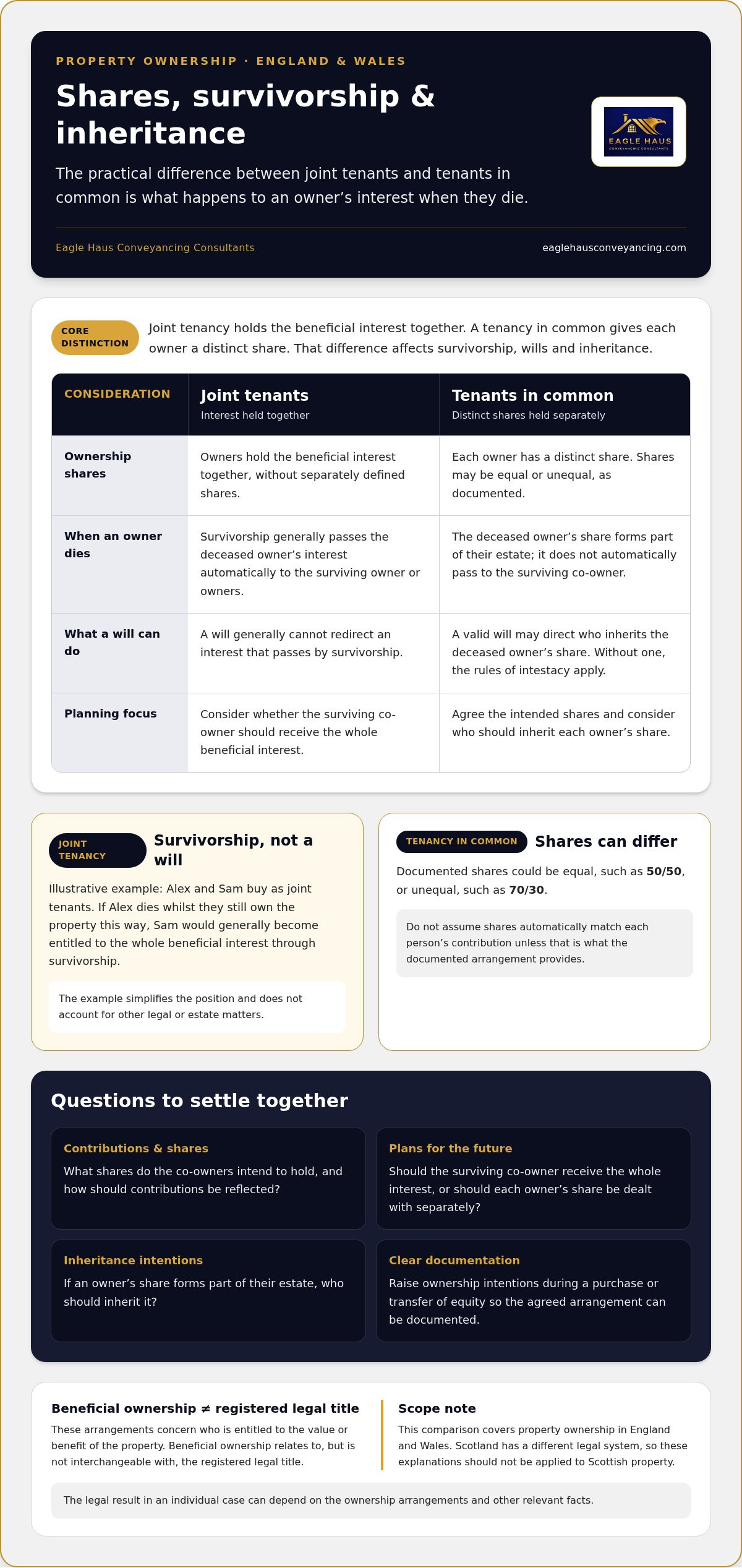
It’s understandable to feel unsure, especially when you’re buying with a partner or family member and may have contributed different amounts. As joint tenants, co-owners have a right of survivorship: when one dies, their interest generally passes automatically to the surviving owner or owners. As tenants in common, each person owns a distinct share, which may be unequal and can usually be left to a chosen beneficiary in a will.
This guide explains how the arrangements differ in England and Wales, how inheritance is affected, and what to discuss before buying or changing ownership. You’ll also learn how the arrangement is recorded and where conveyancing support can help make your intentions clear. Eagle Haus Conveyancing Consultants supports residential purchases and transfers of equity, with legal services provided through the regulated firm Taylor Rose.
Table of Contents
Joint Tenants vs Tenants in Common: Meaning of Terms
Joint tenants and tenants in common are two ways co-owners hold beneficial interests in a property. Both arrangements mean more than one person owns an interest, but they differ in whether each owner has a separately defined share and what happens to an interest when an owner dies.
The key difference for UK buyers is survivorship. With a joint tenancy, an owner’s interest generally passes automatically to the surviving owner or owners. With a tenancy in common, each person has a distinct share, which doesn’t automatically pass to the other co-owner when they die.
This guide covers property ownership in England and Wales. Scotland has a different legal system, and property law and terminology may differ, so the explanations here shouldn’t be applied to Scottish property.
These terms concern beneficial ownership: who is entitled to the value or benefit of the property. They’re related to the registered legal title, but the concepts aren’t interchangeable. Understanding that distinction helps make sense of what each arrangement means in practice.
What does joint tenants mean when buying a home?
As joint tenants, co-owners hold the beneficial interest together rather than each having a separately defined share, such as 50% or 70%. The right of survivorship means that if one joint tenant dies, their interest generally passes automatically to the surviving joint tenant or tenants, rather than being dealt with under their will. The outcome can depend on the legal circumstances, including whether the arrangement was validly changed before death.
Illustrative example, not legal advice: Alex and Sam buy a home as joint tenants. If Alex dies whilst they still own it as joint tenants, Sam would generally become entitled to the whole beneficial interest through survivorship. This example simplifies the position and doesn’t account for other legal or estate matters.
What does tenants in common mean for co-owners?
Tenants in common each hold a distinct beneficial share. Those shares can be equal, such as 50/50, or unequal, such as 70/30, depending on the arrangement documented. The proportions can reflect what co-owners agree about their respective interests. Don’t assume they automatically match the amount each person contributes, unless that is what the documented arrangement provides.
If a tenant in common dies, their share doesn’t automatically pass to the surviving co-owner. Instead, it will generally be dealt with through their will or, if they haven’t made one, under the rules of intestacy. The surviving owner may therefore share ownership with whoever inherits the deceased’s interest. That’s why it’s useful to consider both the intended shares and what should happen to each share on death.
In short, joint tenancy treats co-owners as holding the beneficial interest together, with survivorship generally applying on death. A tenancy in common recognises separate interests and allows each owner’s share to be dealt with separately. Neither label alone explains every legal or financial consequence, but knowing the distinction gives co-owners a clearer starting point for discussing how they want the property held.
How ownership shares, survivorship and inheritance differ
The practical difference becomes clearest when an owner dies. Joint tenancy usually means the deceased’s interest passes to the surviving co-owner or owners automatically. A tenancy in common gives each owner a distinct share, which forms part of their estate and may pass under their will or the rules of intestacy.
Survivorship is not inheritance under a will: survivorship passes a joint tenant’s interest to the surviving owner or owners automatically, whereas a tenant in common’s share is dealt with as part of their estate.
The UK Government Guidance on Joint Property Ownership explains the two forms of ownership and changing between them. The legal result in an individual case can depend on the ownership arrangements and other relevant facts.
What happens when a joint tenant dies?
Under the general survivorship principle, the deceased joint tenant’s beneficial interest passes to the surviving joint tenant or tenants. It doesn’t usually pass to a beneficiary named in the deceased’s will. The survivor’s position as co-owner therefore changes, but this doesn’t settle every matter connected with the deceased’s estate. Administration, evidence and any relevant registration steps can depend on the circumstances, so don’t assume every case follows the same process.
What happens to a tenant in common’s share after death?
A tenant in common’s share becomes part of their estate. If they made a valid will, it may pass to the beneficiary named in it. If there’s no valid will, intestacy rules may determine who inherits. The surviving co-owner doesn’t automatically acquire that share through survivorship, and may instead find themselves owning the property alongside the person who inherits it.
For that reason, consider the ownership arrangement alongside wider estate planning. Think about whether your will reflects your intentions for your share, and how the arrangement fits with your plans for the people who may inherit. The difference co-owners need to weigh up is not only about shares today, but also about the route each share takes after death.
If you’re arranging a purchase or transfer of equity, conveyancing support can help document the ownership arrangement agreed by the co-owners. Eagle Haus Conveyancing Consultants is a trading name of TRW Legal Consulting Ltd, with legal services provided through the regulated firm Taylor Rose. You can explore conveyancing support for property ownership arrangements as part of that process.
Which ownership arrangement suits your circumstances?
There isn’t one right answer for every buyer. Start by discussing three things together: how you intend to own the property, how you’ll organise your finances, and what you’d want to happen to your interest if you die. The difference co-buyers are weighing up is closely tied to those intentions.
Talk through realistic situations before settling on an arrangement. Would the survivor be expected to own the whole beneficial interest, or should each person’s share be available to pass to someone else? If one person contributes more at the start, do you both intend for that to be reflected in defined shares? Clear answers can guide your discussion with a conveyancer.
Couples: Joint tenancy may suit buyers who want the survivor to receive the property interest automatically. A couple who want separate shares or different inheritance plans may prefer to discuss tenants in common.
Friends or siblings: Defined shares may help reflect an agreed ownership arrangement and allow each owner to make separate plans for their share.
Family members: Consider whether the arrangement should reflect contributions, intended ownership and who may inherit. Family relationships alone don’t determine which form is suitable.
Buyers contributing different amounts: Agree whether those differences should affect the beneficial shares, rather than relying on assumptions.
When might joint tenants be appropriate?
Joint tenancy may be appropriate for co-buyers who want to hold the beneficial interest together and for the survivor to receive it automatically if one owner dies. Some couples, or other co-owners with shared plans, may also prefer not to set out separate beneficial shares. The key question is whether survivorship reflects what you both intend, including if your personal or family circumstances change.
When might tenants in common be appropriate?
Tenants in common may suit co-owners who want distinct shares, particularly if their intended ownership differs or they want their share to pass through their estate. Friends buying together, relatives with separate inheritance plans, or buyers agreeing unequal interests may find this structure worth considering. The shares should be clearly documented. Don’t assume a larger deposit or higher payments automatically create a larger beneficial share.
A difference in contributions is a reason to have an open conversation, not proof by itself of what each person owns. For instance, buyers might agree that their beneficial interests are equal despite contributing different amounts, or they might intend unequal shares. The arrangement needs to reflect the decision they actually make, rather than an unspoken expectation.
Before choosing, make sure everyone has the same understanding of the arrangement and its effect on survivorship and inheritance. Consider how you’ll approach future changes, such as one co-owner contributing more later or a change in your relationship. These questions don’t mean you need to predict every possibility. They help identify whether holding the interest together or defining individual shares better matches your plans.
For a purchase or a change to existing ownership, raise these intentions during the conveyancing process. Legal support can help document the arrangement you agree, so the ownership records reflect your decision as clearly as possible.
How to record your choice and protect each owner’s intentions
Once you’ve discussed the ownership structure, make sure the agreed arrangement is clearly documented. The legal title, which identifies the registered owners, and beneficial ownership, which concerns who is entitled to the property’s value, are connected but not interchangeable. The choice co-buyers make should be reflected in the appropriate documents, not left to assumptions.
A practical sequence is:
Discuss what each co-owner intends should happen to their interest during ownership and after death.
Agree whether you’ll hold the beneficial interest together or have defined shares, and decide what those shares will be.
Obtain conveyancing advice on how to put the agreed arrangement into effect.
Document the arrangement through the appropriate conveyancing and ownership records.
For tenants in common, a declaration of trust may be used to record the owners’ beneficial shares and related arrangements. Its terms should reflect what the co-owners have agreed. It is not a substitute for considering a will, which deals with what happens to a person’s estate. A will does not itself document the owners’ agreed beneficial interests in the property.
A Form A restriction on the HM Land Registry title register generally restricts registration of a disposition by a sole registered proprietor where capital money arises, unless a court order applies or the disposition is made by two trustees or a trust corporation. It relates to how certain dispositions can be registered. It doesn’t set out the owners’ shares or, by itself, establish every detail of the beneficial ownership.
What should co-buyers agree before completion?
Talk through each person’s contributions, the shares you intend to hold and what you want to happen to your interest if you die. Put the agreed position in writing so it’s less likely to be misunderstood if circumstances or relationships change. Consider making or reviewing your wills as part of wider planning, but treat them as related documents, not replacements for recording the ownership arrangement itself.
How can ownership arrangements be changed later?
Changing an arrangement can require formal legal steps, and the process depends on what is changing. Severing a joint tenancy is distinct from transferring an owner’s interest: it changes how the beneficial interest is held, but doesn’t by itself transfer ownership to someone else. If an owner is being added or removed, a transfer of equity may be relevant. Conveyancing advice can help address the change and its documentation.
For support documenting ownership intentions during a residential purchase or transfer of equity, speak to Eagle Haus Conveyancing Consultants. Eagle Haus is a trading name of TRW Legal Consulting Ltd, with legal services provided through the regulated firm Taylor Rose.
Getting conveyancing support for joint property ownership
Raise your ownership intentions early in a property transaction, before the documents are prepared and the purchase or transfer progresses. If you’re buying together, tell your conveyancer how you intend to hold the beneficial interest and, if applicable, what shares you’ve agreed. If you’re changing existing ownership, explain what is changing and why. Clear instructions give the conveyancing professional an opportunity to consider how the arrangement should be recorded as part of the transaction.
The difference buyers are weighing up isn’t simply a matter of names on a register. The registered legal title identifies the legal owners, while beneficial ownership concerns the interests in the property’s value. Conveyancing support can help clarify this distinction and ensure the agreed intentions are considered alongside the transaction documents. The right documentation depends on the co-owners’ circumstances, so there isn’t a single standard approach for everyone.
What conveyancing support can help clarify
A conveyancing professional can discuss whether your instructions concern the registered legal owners, the beneficial interests, or both. If you’ve agreed defined shares, explain what you intend those shares to be and how you reached that agreement. This gives the legal professional clear information to consider when preparing or reviewing relevant transaction documents. It doesn’t remove the need for co-owners to agree their intentions, or guarantee a particular outcome.
Discussing co-ownership during a property transaction
Buying a home together? Raise your intended ownership structure when you begin the conveyancing process, rather than leaving the discussion until documents are ready to be completed. Make sure all co-owners communicate the same decision. If the arrangement needs to change later, such as when an owner is added or removed, a transfer of equity may be relevant and should be discussed as part of the transaction.
Eagle Haus Conveyancing Consultants supports residential purchases, sales and transfers of equity across England and Wales. Its clients include people in Staffordshire, Wolverhampton, Telford and Birmingham, as well as Shropshire, Cannock and Walsall. Eagle Haus is a trading name of TRW Legal Consulting Ltd, and legal services are provided through the regulated firm Taylor Rose.
Clear instructions help bring the co-owners’ intentions into the conveyancing process, whether you’re buying, selling or changing ownership. For practical information about a purchase or sale, explore the residential purchases and sales guidance.
Make your ownership intentions clear from the outset
Before taking your next step, make time for an honest conversation with everyone who’ll own the property. Agree what feels fair, what each person expects and whether those expectations could change over time. Focus on how well the arrangement reflects your shared intentions, both now and in the future.
You don’t need to have every future scenario mapped out before moving forward. A clear starting point and informed discussion can make it easier to choose an arrangement that suits your circumstances. If you’re unsure how to put your agreed plans into the property transaction, conveyancing guidance can help you understand the next steps.
Talk to Eagle Haus about your property ownership plans and take the next step with greater confidence.
Frequently Asked Questions
Can you change from joint tenants to tenants in common without the other owner’s agreement?
Generally, yes. In England and Wales, one joint tenant can usually sever a joint tenancy without the other owner’s consent by serving written notice of their intention to sever. The legal effect depends on the notice and how it’s served, so an informal conversation may not be enough. Get conveyancing advice about the steps and any relevant registration implications for your circumstances.
Do joint tenants need a will?
Joint tenants don’t generally need a will to pass their beneficial interest to the surviving joint owner, because survivorship usually determines what happens to that interest. A will can still matter for other assets, debts and personal wishes, and may be relevant if circumstances change or the survivor later dies. A will and an ownership arrangement deal with different parts of your planning, so consider both as your circumstances develop.
Can unmarried couples own a home as joint tenants or tenants in common?
Yes. Being unmarried doesn’t, by itself, prevent a couple from choosing either arrangement in England and Wales. The key difference for couples is whether they want to hold the beneficial interest together or define individual shares, and what they intend should happen after a death. For example, buyers in Wolverhampton can discuss how their contributions and inheritance plans fit their choice.
Does a mortgage determine whether co-owners are joint tenants or tenants in common?
No. A mortgage and the beneficial ownership arrangement address different things: the mortgage relates to borrowing secured against the property, whilst the ownership arrangement concerns the co-owners’ interests. A lender’s requirements may affect how a transaction is structured, so discuss your intended shares early with your conveyancer and ensure the proposed arrangement is considered alongside the mortgage conditions. For healthcare workers seeking tailored borrowing advice, specialist brokers such as Mortgages for Doctors can help navigate lender criteria alongside ownership planning. Don’t assume that being named on a mortgage automatically establishes your beneficial share.
Can a property have more than two joint owners?
Yes. In England and Wales, several people can have interests in the same property. However, no more than four people can be registered as legal owners; where there are additional beneficial owners, the legal owners hold the property on trust for those entitled to a share. With a larger group, agree how decisions, contributions and future changes will be handled, and get advice on documenting the arrangement.
Does joint ownership mean every owner has an equal share of the property?
Not necessarily. The phrase “joint ownership” can describe more than one arrangement, so it doesn’t always tell you whether owners have equal beneficial shares. Joint tenants hold the beneficial interest together without separate defined shares; tenants in common have distinct shares that may be unequal. If equal or unequal interests matter to your plans, make sure the intended arrangement is clearly recorded rather than inferred from whose names appear on the legal title.
What happens to a tenant in common’s share if they die without a will?
If a tenant in common dies without a valid will, their share generally forms part of their estate and is dealt with under the intestacy rules in England and Wales. The surviving co-owner doesn’t automatically inherit that share simply because they own the property together. Who may inherit depends on the deceased’s circumstances, including their family situation. The outcome can affect who owns the property alongside the survivor, so estate planning advice from specialists such as Patrick D Williams Estate Planners can help clarify intentions.



Comments