Joint Tenants vs Tenants in Common: A 2026 Guide to Property Ownership

If you passed away tomorrow, would your partner automatically inherit your home, or would your share go to someone else entirely? Most buyers in England and Wales assume that being joint tenants is the standard way to own property, but that single choice dictates who gets your home if your relationship ends or you pass away. It's a decision that carries significant weight for your financial future and your family's security.
We understand that the legal paperwork can feel like a maze, particularly when you're trying to protect an unequal deposit or navigate complex inheritance rules. It's stressful to worry about losing your property rights, but getting this right from the start is the best way to build a secure foundation. This 2026 guide will help you understand the vital legal differences between joint tenants and tenants in common so you can protect your home and your future legacy. We'll break down the right of survivorship, explain how to register your ownership at the Land Registry, and help you decide which path offers the best security for your specific situation.
Table of Contents
What are Joint Tenants? Understanding Property Ownership
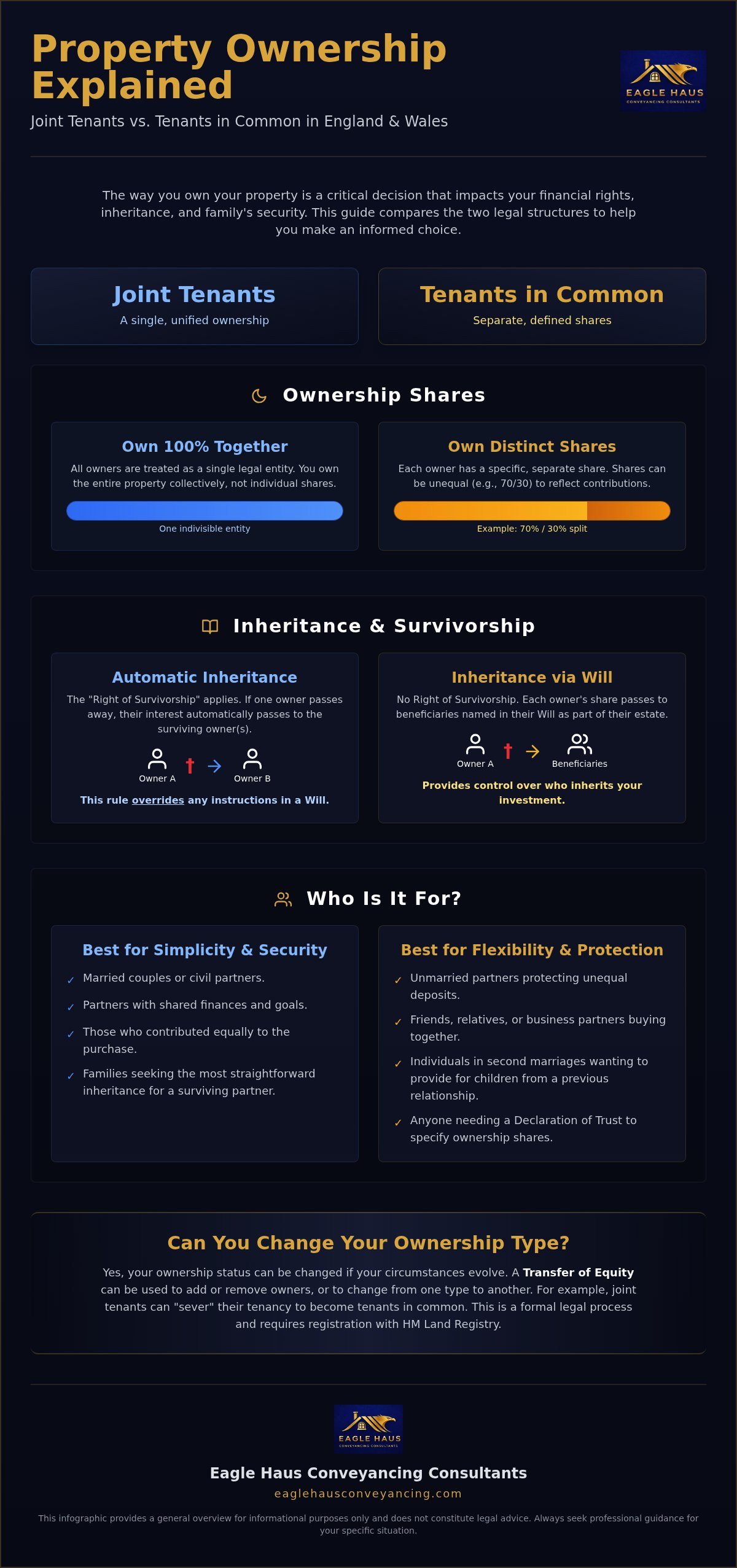
Choosing how to register your home is one of the most significant decisions you'll make during the conveyancing process. In the jurisdiction of England and Wales, becoming joint tenants means you and your co-owner act as a single legal entity in the eyes of the law. You don't own a specific percentage or a "slice" of the bricks and mortar. Instead, you both own the whole property together. This type of concurrent estate is built on the legal principle that all owners have an equal right to the entire property simultaneously.
When we register your property at HM Land Registry under this structure, the title deed simply lists the names of the owners. There are no additional notes or "restrictions" regarding specific shares. This simplicity is why it remains the traditional choice for married couples and long-term partners who view their finances as entirely shared. It reflects a commitment where the property belongs to the relationship itself rather than the individuals involved.
Key Characteristics of Joint Tenancy
The most defining feature of this setup is the total equality of rights. Regardless of whether you provided the entire deposit or just a small fraction, the law treats your interests as identical. You cannot sell your "half" or mortgage it separately because those individual shares don't exist in a legal sense. You are, for all intents and purposes, a single owner made of multiple people.
Another vital characteristic involves your Will. You cannot leave your interest in the property to someone else in your Will whilst the joint tenancy remains active. The law of survivorship takes precedence over any written instructions. This means if one owner passes away, the property stays with the surviving owner automatically, regardless of what any other legal document says. It provides a robust, if inflexible, form of security for the surviving partner.
Who Usually Chooses This Option?
Most people who opt for this path are looking for simplicity and long-term security for their partner. It's a proactive way to ensure that if the worst should happen, the surviving owner doesn't have to worry about legal hurdles or probate to keep their home. It's particularly popular amongst certain groups:
Married couples or civil partners with shared financial goals and pooled assets.
Partners who have contributed roughly equal amounts to the purchase price and ongoing mortgage.
Families who want the most straightforward inheritance process possible for the family home.
If you're buying with a friend or a business partner, or if your deposit contributions are significantly different, this might not be the right fit. However, for those seeking a unified approach to ownership, it offers a sense of total shared security that is easy to manage and understand.
Joint Tenants vs Tenants in Common: The Key Differences
Deciding between these two ownership structures often comes down to your personal relationship and your long-term financial goals. While joint tenants are treated as a single legal entity, tenants in common hold distinct, individual shares in the property. This distinction is fundamental to English property law. According to Cornell Law School on Joint Tenancy, the defining characteristic of a joint tenancy is the right of survivorship, which ensures the property stays with the surviving owner automatically. Tenants in common, however, have no such rule; their share becomes part of their estate to be distributed according to their Will.
This difference creates a massive impact on estate planning. If you own a home as a tenant in common, you can leave your 50% or 30% share to your children, a sibling, or even a charity. For those registered as joint tenants, your Will cannot override the law of survivorship. The property won't even pass through probate; it simply remains with the other owner. This is often ideal for married couples but can be a significant risk for business partners or friends who want their investment to stay within their own family line.
Ownership Shares and Flexibility
Tenants in common enjoy a level of flexibility that isn't possible with a joint tenancy. You aren't restricted to an equal split. You can own the property in any ratio you choose, such as 70/30 or 60/40. This is particularly useful for protecting unequal deposit contributions. If one person provides £50,000 and the other provides £10,000, a Declaration of Trust can be drawn up to reflect these specific percentages. Investors often favour this model because it allows them to pool resources whilst maintaining clear boundaries around their individual capital.
What Happens During a Sale or Separation?
If you decide to sell the property or if the relationship ends, your ownership type dictates how the money is divided. For those who are registered as joint tenants, the law generally assumes an equal 50/50 split of the proceeds, regardless of who paid more for the mortgage or repairs. Tenants in common have their specific equity share protected by the Land Registry and their Declaration of Trust. If your circumstances change and you need to adjust these arrangements, you might require transfers of equity to legally move from one ownership type to another. We can help you organise your property registration to ensure your financial interests are fully protected from day one.
The Right of Survivorship: A Critical Legal Concept
When you own a property as joint tenants, the right of survivorship is the most powerful legal mechanism you'll encounter. It ensures that upon the death of one co-owner, their interest in the home automatically and instantly transfers to the surviving owner. This process happens by operation of law, meaning the property doesn't form part of the deceased person's estate for the purposes of distribution. As the National Paralegal College explains Joint Tenancy, this unique feature provides a level of immediate security that other ownership types simply cannot match.
The most critical aspect of this concept is its absolute authority. The right of survivorship takes precedence over any instructions left in a Will. Even if you've specifically named a child or a relative as the beneficiary of your property in a legal Will, that instruction is effectively ignored if you remain registered as joint tenants. The law views the surviving owner as the sole remaining holder of the entire property. Whilst this offers simplicity for many couples, it can create unintended consequences for those with complex family trees or children from previous relationships.
Survivorship and Your Will
A joint tenant cannot bequeath their share of the property to anyone other than the co-owner because the right of survivorship operates independently of the probate process. This stands in stark contrast to tenants in common, who must use a Will to dictate exactly where their share of the property should go. If your family circumstances change, such as through a new marriage or the birth of a child, it's essential to review how your home is registered to ensure your legacy remains on track.
Protecting Your Legacy
For many homeowners, "bloodline planning" is a top priority to ensure that equity remains within the family for future generations. You may want to guarantee that your portion of the home's value eventually passes to your children, even if your partner remarries after your death. Choosing to be tenants in common allows you to achieve this by naming specific beneficiaries in your Will, providing a level of control that joint tenancy lacks. By taking these proactive steps, you can ensure your final wishes are legally enforceable whilst providing security for your loved ones.
How to Choose and Change Your Ownership Type
Your initial choice of ownership doesn't have to be permanent. Life moves fast, and a structure that worked when you were first-time buyers might not suit you after a marriage, a career change, or the arrival of children. When you're deciding, look closely at your financial contributions. If one person is providing a significantly larger deposit, registering as tenants in common with a Declaration of Trust is often the most sensible way to protect that capital. Conversely, if you want the absolute simplicity of the right of survivorship, staying as joint tenants remains the gold standard for many couples.
Changing your ownership type later is a common part of a Transfer of Equity. You might choose to move from tenants in common to a joint tenancy after getting married to simplify your estate. Alternatively, you might need to move in the opposite direction to protect your children's inheritance. This flexibility ensures that your property registration always aligns with your current life stage and financial priorities.
Severing a Joint Tenancy
If you decide that you need to own specific shares in your home, you can "sever" your joint tenancy at any time. This doesn't require the property to be sold or remortgaged. It's a procedural change that turns you into tenants in common. The process is methodical and requires specific steps to ensure the Land Registry records are accurate.
Step 1: Serve a Notice of Severance. You must formally notify the other owner in writing of your intent to end the joint tenancy. This can be done with or without their consent.
Step 2: Apply to the Land Registry. You'll need to submit Form SEV to record a "Form A restriction" on the title. This tells future buyers or lenders that there is a beneficial interest to consider.
Step 3: Update your Wills. Because the right of survivorship no longer applies, your share won't pass automatically. You must specify who inherits your portion of the property in a legal Will.
Ownership for Property Investors
Professional landlords and those involved in company purchases often face more complex requirements. When buying through a limited company, the legal title is held by the business, but the beneficial interest is managed amongst the shareholders. In these scenarios, the flexibility of tenants in common is essential for tax planning and managing different levels of investment. We specialise in guiding professional landlords through these transitions, ensuring that every shareholder's equity is clearly defined and legally protected. If you're unsure which path fits your current portfolio, you can contact our team for expert advice on your property registration.
Professional Conveyancing Support in the West Midlands
Choosing how to register your property is more than a box-ticking exercise; it's about securing your long-term financial future. At Eagle Haus, we act as your modern professional guide, helping you weigh up whether being joint tenants or tenants in common fits your specific life goals. Our team specialises in residential conveyancing across Staffordshire and the West Midlands, providing proactive support that removes the typical stress from property transitions.
Local knowledge is vital for a smooth ownership transition. Our expertise in the Birmingham and Wolverhampton property markets allows us to anticipate potential hurdles before they cause delays. We understand the specific requirements of regional Land Registry offices and local authorities, ensuring your registration is handled with precision and speed. By blending traditional reliability with a tech-savvy methodology, we keep you informed at every stage of the process.
Bespoke Advice for Local Homeowners
Every property purchase is unique. Whether you're a first-time buyer in Telford or an investor expanding a portfolio in Cannock or Walsall, you need advice that reflects your personal situation. We provide personalised support that addresses your concerns about deposit protection and inheritance. If you're searching for property solicitors near me, our Staffordshire-based team offers the local insight and professional authority you need to move forward with clarity.
Start Your Property Journey with Confidence
We believe that legal services should be transparent and accessible. Our commitment to clear communication means you'll always understand the practical steps involved in your purchase or transfer of equity. We offer fixed-fee conveyancing to give you financial certainty from the very beginning. This openness builds trust and allows you to focus on the excitement of your new home rather than worrying about hidden costs or complex legalese.
Securing your home is a major life transition, but it doesn't have to be overwhelming. Whether you're registering as joint tenants for the first time or modifying your ownership through a transfer of equity, we're here to ensure your legacy is protected. You can start your journey today by requesting a quote and seeing how our supportive, proactive approach makes all the difference. Let's work together to build a secure foundation for your future.
Secure Your Property Future with Confidence
Choosing between being joint tenants or tenants in common is one of the most important decisions you'll make when buying a home. It dictates how your property is inherited and protects your individual financial contributions. Whether you need the automatic security of survivorship or the flexibility to leave your share to children in a Will, your registration must reflect your personal goals. Your choice today builds the foundation for your family's security tomorrow.
At Eagle Haus, we offer a modern, tech-led approach to property law that takes the stress out of complex ownership decisions. Regulated by the Council for Licensed Conveyancers via Taylor Rose, our team specialises in residential purchases and transfers of equity throughout Staffordshire and the West Midlands. We combine professional authority with a warm, supportive style to ensure your home remains a secure asset for your future legacy.
If you're ready to move forward with clarity, contact Eagle Haus for expert conveyancing advice in the West Midlands. We'll guide you through every step of the legal process with transparency and care. Let's work together to make your next move as smooth and rewarding as possible.
Frequently Asked Questions
Can one joint tenant sell the property without the other's consent?
No, all legal owners must agree to the sale of a property in England and Wales. If you own a home in Birmingham or Wolverhampton with another person, you both need to sign the contract and the transfer deed. If one owner refuses to sell, the other may need to apply for a court order for sale. Whilst you can't sell alone, you can unilaterally change your status from joint tenants to tenants in common.
What happens to the mortgage if we change from joint tenants to tenants in common?
Your mortgage remains a joint and several liability, meaning both parties are still 100% responsible for the debt. Changing how you hold the beneficial interest doesn't usually require a new mortgage, but you must notify your lender. If you are carrying out a transfer of equity in Staffordshire or Telford, we'll guide you through the lender's requirements to ensure the transition is handled smoothly without affecting your borrowing status.
Do I need a new Will if I am a joint tenant?
Whilst your property passes automatically to the survivor, you still need a Will to manage your other assets like savings, vehicles, and personal items. If you ever decide to sever the joint tenancy and become tenants in common, a Will becomes critical for the property itself. Without one, your specific share would follow the rules of intestacy rather than your personal wishes, which could leave your loved ones in a difficult position.
How much does it cost to change from joint tenants to tenants in common in 2026?
The total cost depends on whether you're simply serving a notice or performing a full transfer of equity with a mortgage company involved. You will need to account for professional legal fees and the current Land Registry fees for 2026. Because every case in Cannock or Walsall is unique, we recommend requesting a bespoke quote. This ensures you have a transparent breakdown of the costs involved in securing your specific share of the property.
Can a joint tenancy be severed without the other person's agreement?
Yes, you can legally sever a joint tenancy without the other owner's consent by serving a formal Notice of Severance. Once this notice is delivered to their last known address, the joint tenants arrangement ends, and you become tenants in common. You must then register a Form A restriction at the Land Registry. This is a vital tool for individuals who wish to protect their inheritance rights or financial share during a relationship breakdown.
Is it better for a married couple to be joint tenants or tenants in common?
There isn't a single right answer, as it depends on your family structure and financial history. Joint tenancy offers simplicity and peace of mind for many couples in Shropshire, as the home passes automatically to the surviving spouse. However, if you have children from a previous relationship or provided a larger deposit, tenants in common might be more appropriate. This structure allows you to ringfence your equity and control exactly who inherits it.
What is a Declaration of Trust and why do I need one for a tenants in common arrangement?
A Declaration of Trust is a legal document that records the specific financial shares of each owner. Since the Land Registry doesn't record percentages like 70/30 or 60/40, this document is the only way to prove your individual entitlement. It's essential for friends or partners buying in the West Midlands who want to protect their initial deposit. It provides a clear roadmap for how sale proceeds should be divided if the property is sold later.
How does owning a property as joint tenants affect Inheritance Tax?
HMRC generally treats joint owners as having an equal share for tax purposes, even if the right of survivorship applies. In the 2026/27 tax year, the individual nil-rate band remains frozen at £325,000, making property ownership a key part of your tax planning. If your estate in Staffordshire exceeds the available thresholds, your share may be subject to a 40% tax rate. We recommend professional advice to ensure your ownership type aligns with your overall inheritance tax strategy.


Comments