Indemnity Insurance in Conveyancing: A Staffordshire Buyer’s Guide

Could accepting an indemnity policy help your Staffordshire purchase move forward while leaving the property issue untouched? That distinction is central to indemnity insurance conveyancing Staffordshire buyers may encounter. A policy can provide financial protection against a defined risk, but it doesn’t repair a defect or automatically resolve every concern.
Before agreeing to a policy, make sure you understand what specific issue it is intended to cover, which exclusions or limits apply, who is expected to pay and whether your mortgage lender will accept the wording. The answers depend on the policy and the circumstances of the transaction.
This guide explains what a conveyancing indemnity policy may cover, what it cannot fix and what to examine before deciding. You’ll learn how to compare policy wording with the property issue and your lender’s requirements, and what to discuss with your conveyancer before choosing a way forward.
Table of Contents
Indemnity insurance in Staffordshire conveyancing: what problem can it address?
What indemnity insurance may cover, and what it leaves unresolved
Indemnity insurance, further investigation or remediation: how to compare options
What to check before accepting a conveyancing indemnity policy
Getting conveyancing advice on indemnity insurance in Staffordshire
Indemnity insurance in Staffordshire conveyancing: what problem can it address?
A proposed indemnity policy has appeared during your Staffordshire property purchase, and you’re unsure what it means for the home or your plans. The key question is not simply whether insurance is available. It’s what specific risk the policy is intended to address, and whether that protection fits the facts of your transaction.
In conveyancing, indemnity insurance is cover intended to protect against a defined legal or title risk, subject to the policy’s wording, exclusions and conditions. The term Understanding Indemnity can help explain the wider concept, but a property policy has its own scope. It might respond to certain financial consequences if a covered issue leads to a claim or loss. It doesn’t, by itself, investigate the concern, carry out building work or provide missing permission.
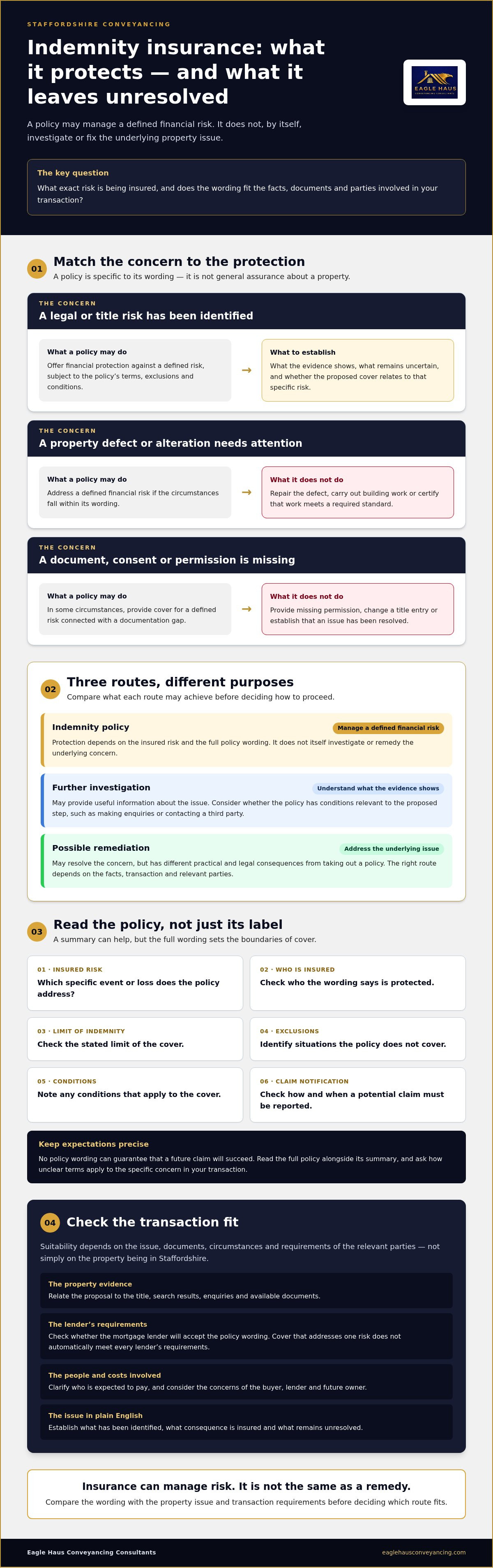
Insurance may cover financial risk, but it doesn’t fix a property defect. A policy can be one way to manage a concern, but it isn’t proof that the underlying issue has been resolved. Its suitability depends on the issue, the documents and transaction circumstances, the wording offered and the requirements of relevant parties, which may include a mortgage lender.
Why might a conveyancer raise an indemnity policy?
A conveyancer may consider a policy when reviewing the title or transaction documents brings a particular legal concern to light. For example, a document that would usually clarify a right or consent may be missing. In some circumstances, cover may be considered for a defined risk connected with that gap.
Not every missing document, unclear right or property concern can be insured. First, the significance of the gap needs to be understood. Your conveyancer can explain what the available evidence establishes, what remains uncertain and whether a policy relates to that specific risk. In indemnity insurance conveyancing Staffordshire transactions, assess the policy against the actual concern rather than treating it as general assurance about the property.
What does Staffordshire location change, and what does it not?
The county label doesn’t determine whether a policy is suitable. The property’s title, search results, documents and individual circumstances are more relevant. Local searches form part of the evidence for the transaction. Consider each result for what it says about that property, rather than treating it as proof that a particular risk is common across Staffordshire.
Ask for the concern to be explained in plain English: what has been identified, what consequence is being insured against and what the policy leaves unresolved. Transaction-specific conveyancing advice can connect the proposal to the documents and parties involved. Eagle Haus Conveyancing Consultants is a trading name of TRW Legal Consulting Ltd, and legal services are provided through Taylor Rose.
What indemnity insurance may cover, and what it leaves unresolved
A policy’s name can sound reassuring, but it doesn’t tell you exactly what protection it provides. Cover depends on the risk identified in the policy, how key terms are defined, who is insured and which exclusions and conditions apply. A policy concerning a restrictive covenant, for example, may address a particular financial risk linked to an alleged breach. It won’t necessarily cover every consequence connected with that issue.
The policy wording, not the policy label, defines the cover. A short summary or a description such as “title indemnity” isn’t a complete explanation. The full wording sets out the insurer’s obligations and the boundaries of any protection.
How to read the important parts of a policy
Start with the insured risk: what specific event or loss does the policy address? Then check who is insured, the limit of indemnity and any conditions that apply. Exclusions describe situations the policy doesn’t cover, while notification requirements may explain how and when a potential claim must be reported. These details matter. No wording can guarantee that a future claim will succeed.
Read the full policy alongside any summary. A summary can help orient you, but may not include every definition, exclusion or condition. If a term is unclear, ask your conveyancer how it applies to the concern identified in your transaction, rather than relying on a broad description of the product.
Why a policy may not resolve the underlying problem
Insurance is not the same as a remedy. It doesn’t itself provide missing consent, change an entry on the title or carry out physical work. If a property alteration lacks relevant documentation, for instance, a policy may address a defined risk only if its wording applies. It doesn’t certify the work or establish that it meets any required standard.
Investigating or remedying an issue may provide useful information or resolve the underlying concern, but these steps can have different practical and legal consequences from taking out a policy. The right route depends on the facts, the transaction and the relevant parties. Before acting, ask your conveyancer to consider whether the policy has conditions relevant to the proposed step, such as making enquiries or contacting a third party. This is about understanding the terms, not withholding information.
For indemnity insurance conveyancing Staffordshire buyers should also consider whether the policy addresses the concerns of the people involved in the transaction. A buyer may want clarity about future ownership, while a lender may have its own requirements. Cover for one defined risk doesn’t automatically settle every buyer, lender or future-owner concern. Your conveyancer can compare the wording with the title documents and transaction circumstances, then explain what remains outside the cover.
If you’re buying or selling a home, residential conveyancing support can help put a proposed policy in context. Eagle Haus Conveyancing Consultants is a trading name of TRW Legal Consulting Ltd, and legal services are provided through Taylor Rose.
Indemnity insurance, further investigation or remediation: how to compare options
If a conveyancing concern has been raised, insurance is only one possible response. Further investigation may clarify what has happened, while remediation may address the underlying issue. These routes serve different purposes, and none is automatically suitable. The right option depends on the precise concern, the evidence available, the transaction and advice from your conveyancer.
The key distinction is straightforward: insurance may manage a defined financial risk, but it doesn’t cure the cause. A policy won’t itself provide missing consent or carry out work. To understand how a proposed response fits into the purchase as a whole, see the residential conveyancing guide.
Option
Purpose and information gained
Possible transaction effect
Key uncertainty
Indemnity policy
May provide financial cover for a defined risk. It may not explain how or why the issue arose.
Could form part of the transaction response, subject to relevant parties’ requirements and the policy terms.
Whether the specific risk and parties are covered, and whether exclusions or conditions apply.
Further investigation
Seeks to clarify the facts through relevant records, documents or enquiries.
May add steps or affect timing, depending on the enquiry and transaction.
What evidence is available and whether the findings resolve the concern or raise further questions.
Possible remediation
May seek to address the underlying issue, for example through relevant work or a formal process.
Could involve practical arrangements and additional steps before or after completion.
Whether a remedy is possible, appropriate and sufficient in the circumstances.
When might further investigation be relevant?
Investigation may be worth considering when the available paperwork doesn’t make the concern clear enough to assess a response. Your conveyancer can identify what information is missing and whether further enquiries are appropriate. Enquiries or other steps can affect the transaction timetable and may bring new information to light. Investigation isn’t always available, necessary or risk-free, so weigh its purpose and possible consequences before proceeding.
When might a policy be considered instead?
A policy may be considered where its wording appears to match the identified risk and the relevant parties’ requirements can be addressed. The seller’s circumstances, any lender requirements and the policy’s conditions can all matter. Don’t assume insurance is quicker, cheaper or preferable to investigation or remediation. For indemnity insurance conveyancing Staffordshire buyers should compare what the policy protects against with what remains unresolved, then discuss the trade-offs with their conveyancer before deciding.
What to check before accepting a conveyancing indemnity policy
Before agreeing to a policy, make sure you can explain in plain English what concern it addresses and what protection it offers. A clear review helps you distinguish a policy that fits the identified issue from one that leaves important questions unanswered. Use this checklist with the full policy wording and your conveyancer’s advice.
1. Identify the exact concern. Start with the issue raised in the title documents or conveyancing enquiries. Check that the policy describes that concern, rather than a broader or different risk.
2. Check who is insured. See whether the cover applies to you and any other relevant parties, such as a mortgage lender. Check whether future owners or successors are included, and note any limits on who can benefit.
3. Read the insured risk and definitions. Look at what event or loss the policy covers and how key terms are defined. Compare this with the facts of the property, not just the policy’s general title or summary.
4. Review the limit of indemnity. Understand the maximum amount payable under the policy and whether the wording explains how that limit applies to the insured risk.
5. Find the exclusions. Check what circumstances are outside the cover. An exclusion may be particularly important if it relates to the concern identified in your transaction.
6. Note the conditions and claim process. Look for notification duties, time limits or other steps required if a potential claim arises. Ask your conveyancer to clarify any wording you don’t understand.
7. Consider the transaction and alternatives. Discuss whether further enquiries or possible remedial steps are relevant, and what each route could mean for timing and the parties involved.
8. Address the lender’s position where relevant. If you’re buying with a mortgage, your conveyancer should consider the lender’s instructions as part of the transaction. Don’t assume a policy is acceptable to every lender.
Check the full policy, not only a quote or summary. The wording and conveyancing enquiries should line up. If the enquiries describe one concern but the policy insures a different risk, ask your conveyancer to explain the difference before deciding. For indemnity insurance conveyancing Staffordshire buyers should also understand who is arranging the policy, who is expected to pay and what decision they are being asked to make. Your conveyancer can explain the options and transaction implications, but you should feel clear about the choice before proceeding.
For wider context on the role of legal support during a purchase, explore this guide to choosing a conveyancing partner. If a policy has been proposed for your transaction, get conveyancing guidance on the policy so its wording can be considered alongside the property documents and relevant lender instructions.
Getting conveyancing advice on indemnity insurance in Staffordshire
A policy raised during a purchase or sale can feel like another complication. A conveyancer can clarify the decision by relating the proposed cover to the title documents, enquiries and circumstances of your transaction. The aim is to understand the issue and the available next steps, not to treat insurance as an automatic answer.
For indemnity insurance conveyancing Staffordshire buyers and sellers, the review can follow a clear sequence:
Identify the issue. Pinpoint what the title papers, searches or enquiries have revealed, and what remains unclear.
Understand the options. Consider whether further information, possible remedial action or a policy is relevant to the specific concern.
Review the wording. Compare the proposed cover with the issue and note who is insured, what is excluded and which conditions apply.
Decide next steps. Consider the transaction circumstances and, where a mortgage is involved, the relevant lender’s position before proceeding.
This advice is specific to your transaction. It can explain how the legal concern, policy terms and any relevant lender instructions fit together, and identify questions that still need an answer. It isn’t a guarantee that an insurer will pay a future claim, nor does it mean every lender will accept every policy. The documents and circumstances matter.
To make the discussion practical, have the proposed policy wording or summary available alongside the relevant title documents and conveyancing enquiries. Include any correspondence explaining why the policy has been suggested, and details of the lender’s position if this has been addressed. These materials help your conveyancer assess the proposal in context and explain what the wording may leave unresolved.
Eagle Haus Conveyancing Consultants manages residential purchases and sales in Staffordshire, helping clients understand conveyancing issues as part of their property transaction. The firm also supports clients in Wolverhampton, Telford, Birmingham, Shropshire, Cannock and Walsall. Eagle Haus Conveyancing Consultants is a trading name of TRW Legal Consulting Ltd. Legal services are provided through Taylor Rose.
If you’re weighing a proposed policy or need clarity on the next step, discuss your Staffordshire conveyancing matter with Eagle Haus and share the relevant wording and transaction documents for a focused discussion.
Take your next step with clarity
A proposed policy doesn’t have to leave you guessing. Before moving forward, make sure you know what decision is needed, what information would help you make it and whether anything in the transaction needs attention first. Keeping the policy wording and related correspondence together can make the next conversation more focused.
For indemnity insurance conveyancing Staffordshire buyers and sellers, the useful next step is a discussion grounded in the actual property documents and transaction. You can then consider the available options with a clearer view of what each means for your circumstances.
Discuss your Staffordshire conveyancing matter with Eagle Haus Conveyancing Consultants. A clear, considered decision can help you move ahead with greater confidence.
Frequently Asked Questions
Does indemnity insurance affect a mortgage lender’s decision?
It can be relevant, but a policy doesn’t guarantee that a lender will approve a mortgage or accept the proposed cover. The lender’s requirements and the details of the property and issue matter. For indemnity insurance conveyancing Staffordshire buyers should have their conveyancer consider the lender’s instructions alongside the policy wording, rather than assuming a policy accepted in another transaction will meet this lender’s requirements.
Who usually pays for an indemnity policy in a property sale?
There’s no universal rule about who pays. The buyer and seller may agree who will meet the premium as part of resolving the issue, and that arrangement can depend on the circumstances of the sale. A conveyancing solicitor usually arranges the policy through an insurer. Make sure the proposed payment arrangement is clear before proceeding, including whether the quoted amount covers the policy only or any other agreed costs.
Can an indemnity policy be cancelled or transferred to a future owner?
That depends on the policy terms. Some policies may extend cover to later owners, but you shouldn’t assume yours does or that it can be transferred by simply notifying the insurer. Check who is insured and whether successors are included. If you’re selling the property, your conveyancer can review the wording and explain whether the policy’s benefits extend to the buyer under its terms.
Does indemnity insurance expire?
There isn’t one expiry rule that applies to every policy. Some are arranged as one-off cover, but the policy wording determines how long protection lasts and whether any conditions apply over time. Check the schedule and full terms for an end date, the insured parties and any requirements that could affect continuing cover. If the policy documents don’t make the duration clear, ask your conveyancer to explain them.
Can I make changes to a property after taking out indemnity insurance?
Possibly, but proposed work or enquiries about the insured issue could affect cover, depending on the policy conditions. For example, applying for retrospective planning permission where a policy covers a planning concern may invalidate that cover. Before contacting an authority or starting work, have your conveyancer review the proposed step against the wording. Don’t withhold relevant information. The aim is to understand the consequences before acting.
Is indemnity insurance the same as fixing a property’s legal problem?
No. Insurance may provide financial protection for a defined risk, but it doesn’t itself supply a missing consent, change a title record or make alterations compliant. For example, cover relating to missing approval for work isn’t the same as obtaining approval or carrying out any work required. Buyers and sellers in Staffordshire and nearby areas such as Wolverhampton, Telford, Birmingham, Shropshire, Cannock and Walsall should treat cover and resolution as distinct options.



Comments