How Long Does Conveyancing Take? A Guide to 2026 Property Timelines

Did you know that one in three agreed property sales in the UK currently falls through before completion? It's a sobering statistic that often stems from the uncertainty and silence that can plague the legal process. You've likely spent months searching for the right property or the perfect buyer, so it's natural to feel a sense of dread when asking how long does conveyancing take and receiving only vague answers in return. We understand that you aren't just moving house; you're trying to organise your future while navigating a complex system of searches, contracts, and chains.
This guide replaces that uncertainty with a clear roadmap for the 2026 property market. We'll explore why standard moves currently average between 12 and 20 weeks, while chain-free transactions can be completed in as little as 8 to 10 weeks. You'll also learn how the introduction of mandatory sales packs and recent legislative shifts are beginning to reshape the process. By breaking down each stage from instruction to completion, we provide the actionable tips you need to avoid common delays and keep your move on schedule.
Table of Contents
The 2026 Conveyancing Timeline: What is the Current Average?
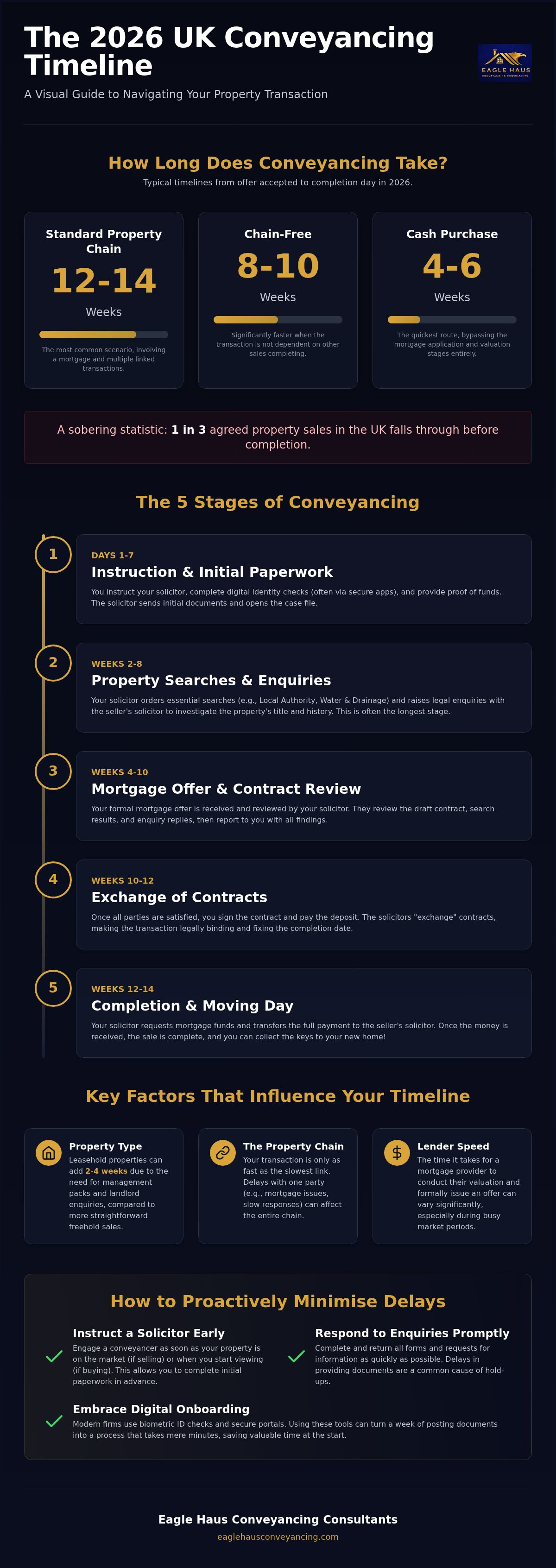
If you are planning a move this year, the most pressing question on your mind is likely how long does conveyancing take in the current market. In 2026, the average residential conveyancing process typically takes between 12 and 14 weeks from the moment your offer is accepted to the day you receive your keys. While this represents the standard experience for many, it's important to remember that the "national average" is merely a benchmark. Your specific journey could be shorter or longer depending on the unique variables of your transaction. For instance, cash purchases often complete significantly faster, sometimes in as little as 4 to 6 weeks, because they bypass the lengthy mortgage valuation and offer stages.
To understand the context of these timelines, it helps to first define the legal transfer of property. What is conveyancing? Essentially, it is the legal process that ensures a property's title passes safely and legally from the seller to the buyer. Because this involves multiple parties, including lenders, local authorities, and other solicitors, the timeline is rarely within the control of a single person.
Why 2026 is Different for Property Movers
The property market has evolved, and the way we handle legal transactions has changed with it. By 2026, the widespread adoption of biometric digital identity checks has transformed the initial instruction phase. What used to take a week of posting physical documents now happens in minutes via secure apps. Similarly, HM Land Registry's ongoing digital transformation has started to streamline search turnaround times in many local authority areas. At Eagle Haus, we believe that a modern, tech-enabled legal firm should use these tools to be proactive. Rather than waiting for updates, a forward-thinking solicitor uses real-time tracking to identify potential bottlenecks before they cause a delay, ensuring that how long does conveyancing take for your specific move is kept to the absolute minimum.
Key Factors That Influence Your Moving Date
Several variables can shift your completion date by weeks or even months. The type of property is a primary factor; freehold houses are generally straightforward, whereas leasehold flats involve management packs and landlord enquiries that can add 2 to 4 weeks to the process. The stability and length of the property chain also play a critical role. A chain is only as fast as its slowest link, and if one party's mortgage offer is delayed or a survey reveals issues, the entire group is affected. Finally, the speed at which mortgage lenders formally issue offers remains a variable. Even with digital applications, some lenders require more rigorous checks that can extend the timeline during busy periods.
Breaking Down the Stages: From Instruction to Completion
Understanding the sequence of a property transaction helps manage expectations and reduces the stress of the unknown. While every move has its own rhythm, the legal journey follows a structured path of five distinct milestones. When you start the process and ask how long does conveyancing take, you are essentially looking for these key markers to gauge your progress towards moving day.
Stage 1: Instruction and Initial Paperwork (Days 1-7). This involves choosing your legal representative, completing digital onboarding, and providing proof of identity and funds.
Stage 2: Property Searches and Enquiries (Weeks 2-8). Your solicitor orders searches and begins the detailed investigation into the property's legal history.
Stage 3: Mortgage Offer and Contract Review (Weeks 4-10). Once your mortgage offer arrives, your solicitor reviews the full contract pack to ensure everything aligns with the lender's requirements.
Stage 4: Exchange of Contracts (Weeks 10-12). The point where the transaction becomes legally binding and a completion date is fixed.
Stage 5: Completion and Moving Day (Weeks 12-14). The final transfer of funds occurs, and you finally collect the keys to your new home.
The Search and Enquiry Phase: The Engine Room of Conveyancing
This stage is often where the most time is spent because it relies on external parties. Local authority searches can vary significantly in speed depending on the region; some councils return results in 48 hours, whilst others may take several weeks. Simultaneously, the enquiry process begins. This is a detailed dialogue where your solicitor asks the seller's legal team to clarify specific points, such as building regulations for an extension or rights of way. This loop is where timelines often stretch, as it depends entirely on the seller providing accurate information promptly. Following official guidance for sellers can help speed this up, but thoroughness here is vital. It prevents expensive legal surprises after you have moved in. If you are looking for a team that manages this dialogue with proactive efficiency, we can help with your residential sales and purchases.
Exchange vs Completion: The Final Countdown
Reaching the final countdown is a significant moment for any mover. Exchange of contracts is the point of no return. Once contracts are physically exchanged, the deal becomes legally binding; neither party can pull out without facing heavy financial penalties. Usually, there is a gap of one to two weeks between exchange and completion. This time allows for the final movement of funds and the coordination of removals. On completion day, the buyer's solicitor transfers the remaining balance to the seller's solicitor. Once the money is confirmed as received, the estate agent is authorised to release the keys. It is a methodical process designed to ensure that when you finally ask how long does conveyancing take, the answer ends with a secure and successful handover.
Why Timelines Vary: Chain-Free vs Complex Transactions
While the previous sections outlined a standard 12 to 14 week window, the reality is that no two property deals are identical. When asking how long does conveyancing take, the answer depends heavily on the "chain." Chain-free transactions, such as first-time buyers moving into a vacant property, naturally move faster because they aren't waiting for others to sell. Conversely, leasehold properties involve managing agents and freeholders, which often adds 2 to 4 weeks to the timeline. New build homes introduce another layer of detail, requiring expert oversight of structural warranties and complex site-specific legalities that aren't present in older homes.
For those involved in company purchases, the process involves distinct corporate authority checks. These transactions require bespoke legal structures that differ from individual residential moves. This often requires a more specialised approach to ensure all directors and legal entities are correctly represented in the title deeds, ensuring the purchase remains compliant with current UK corporate law.
The Speed Advantage of Cash Buyers
Eliminating the need for a mortgage offer can shave up to 4 weeks off the total timeline. Cash buyers bypass the valuation stage and the requirement for a lender's solicitor to review the file. This streamlines the legal work significantly. However, even with this speed, we still advise cash buyers to carry out full local authority and environmental searches. Speed shouldn't come at the cost of security; knowing about a planned development or a flood risk is essential before you commit your capital to a property.
Leasehold and Shared Ownership Complexities
The most common cause for delay in leasehold sales is waiting for the Management Information Pack. These packs, provided by freeholders or managing agents, contain vital details about service charges and planned maintenance. In 2026, whilst many agents have digitised these records, some still take weeks to respond. Shared Ownership transactions add further complexity, particularly during "staircasing" where a tenant buys a larger share of their home. These moves require additional checks and approvals from housing associations. At Eagle Haus, we manage these external dependencies by establishing early contact with managing agents to maintain momentum throughout the transaction, ensuring that how long does conveyancing take for your leasehold move is as short as possible.
Specialist Timelines: Bridging Loans and Company Purchases
While standard moves follow a predictable path, specialist property finance operates in a different lane. If you are an investor or a business owner, your version of how long does conveyancing take is usually measured in days rather than months. Bridging loans, for instance, are designed for extreme speed. These often complete in just 10 to 21 days. This rapid turnaround is essential for those securing a property before a traditional mortgage is in place or for those buying at auction, where the strict 28-day completion rule is non-negotiable. Failing to meet these deadlines can result in the loss of a deposit or the collapse of a lucrative deal.
Company purchases and property portfolio management require a different calibre of legal expertise. Unlike a standard residential move, these transactions involve specific corporate authority checks. We must verify that the company has the legal power to borrow and that the directors are correctly authorised to sign on its behalf. This bespoke legal structure ensures that the purchase is compliant with both the lender’s requirements and current UK corporate regulations.
Facilitating Complex Bridging Loans
The success of a bridging transaction depends on having a solicitor who understands the inherent urgency. We coordinate directly with lenders to ensure that all legal requirements are met in days. Common pitfalls, such as delayed valuation reports or incomplete proof of exit strategies, can stall a deal. By managing these dependencies proactively, we ensure that the finance is ready exactly when you need it. If you are working against a tight deadline, you can find out more about our specialised bridging loans services.
Legal Services for Property Portfolios and Companies
Managing the legalities of a transfer of equity for business or family reasons requires a methodical approach. We assist property investors in moving quickly on high-stakes opportunities by streamlining the due diligence process. Whether you are adding a single unit to a portfolio or restructuring multiple holdings, we ensure the legal framework is robust. When asking how long does conveyancing take for a company purchase, the timeline is often dictated by the complexity of the corporate structure, but with the right partnership, it remains a swift and efficient process.
How to Proactively Minimise Delays in Your Transaction
While external factors like local authority searches are out of your hands, your own proactivity plays a massive role in determining how long does conveyancing take for your move. The most successful movers are those who treat the legal process as a partnership. By taking early action and staying organised, you can often shave weeks off the standard 2026 timelines. This begins with instructing your solicitor the moment your offer is accepted; or even better, as soon as you list your home for sale. Having your file opened and initial checks completed before a buyer is even found puts you in a position of significant strength.
Modern legal services rely on speed, and you can support this by embracing digital tools. We recommend completing and returning all digital onboarding forms and biometric ID checks within 24 hours of receipt. Delays in providing basic information often create a backlog that is difficult to clear later. Similarly, ensure your mortgage 'Agreement in Principle' is fully updated and ready to go. Financing is a common bottleneck, so having your lender's initial approval in place avoids unnecessary waiting once the contract pack is issued by the seller's solicitor.
The Eagle Haus Approach: Modern, Supportive, Fast
We believe that moving home shouldn't be a source of constant anxiety. Our approach centres on modern communication, ensuring you are kept informed at every milestone without having to chase for updates. Through our partnership with Taylor Rose, we provide the national reach and regulated security of a major firm whilst maintaining a boutique service level. This means you receive individual attention from a team that understands your specific goals. By focusing on a proactive dialogue, we identify potential hurdles early, ensuring that how long does conveyancing take is a question answered with efficiency rather than excuses.
Your Pre-Completion Checklist
As you approach the final stages, a few practical steps will ensure a smooth handover. Confirm the source of your deposit funds early to satisfy anti-money laundering rules; this is a common area where solicitors must be rigorous. You should also organise your buildings insurance to start from the date of exchange, as this is when the legal risk usually transfers to you. Whilst waiting for the completion date to be set, start finalising your removal plans so you can act quickly once the keys are ready. Maintaining a regular dialogue with your legal team during this phase ensures no small detail is overlooked.
Taking Control of Your Moving Timeline
Moving house is one of life's biggest transitions, but it doesn't have to be defined by uncertainty. Understanding the stages of the legal process allows you to prepare your paperwork early and navigate the 2026 property market with confidence. Whether you are dealing with a standard freehold sale or a complex leasehold purchase, your own proactivity remains the most effective tool for maintaining momentum throughout the transaction.
While external factors play a part, the question of how long does conveyancing take is often determined by the quality of your legal partnership. At Eagle Haus, we combine a modern, client-focused approach with the regulated security of our partnership with Taylor Rose. We provide national coverage across England and Wales, offering expert legal support for everything from residential moves to specialist bridging loans and company purchases.
Your next property milestone is within reach, and we are ready to help you get there as efficiently and smoothly as possible.
Frequently Asked Questions
How long does conveyancing take with no chain?
A chain-free transaction typically takes between 8 and 10 weeks to complete in the current market. This faster timeline is possible because you aren't waiting for other sellers or buyers to coordinate their own moves. It allows your legal team to focus solely on the property at hand, which significantly reduces the risk of the deal collapsing due to external delays or complicated dependencies.
Can I speed up the conveyancing process myself?
You can absolutely influence how long does conveyancing take by taking a proactive approach to your paperwork. Instructing your solicitor early and returning digital identity checks within 24 hours prevents the initial instruction phase from dragging on. Staying in regular contact with your estate agent also ensures that any potential bottlenecks in the chain are identified and resolved before they cause a major delay.
How long does it take from searches to exchange of contracts?
It typically takes between 6 and 8 weeks to move from ordering searches to the exchange of contracts. This window provides enough time for local authorities to return their results and for your solicitor to raise and resolve legal enquiries. If searches reveal unexpected issues, such as planning discrepancies or environmental concerns, this phase can extend whilst your legal team seeks the necessary clarifications.
What is the average time between exchange and completion in 2026?
The standard gap between exchange and completion in 2026 is between one and two weeks. This period is essential for coordinating removal companies and allowing your solicitor to request the mortgage funds from your lender. Whilst it is possible to exchange and complete on the same day, most people prefer this buffer to ensure a less stressful moving day and a smoother handover of keys.
Why is my conveyancing taking so long?
Most delays are caused by slow responses from third parties, such as local councils or management companies providing leasehold packs. In a property chain, the process is only as fast as the slowest solicitor or lender involved. If one party is slow to answer enquiries or their mortgage offer is delayed, it can hold up every other transaction in the sequence, regardless of how efficient your own solicitor is.
How long does a remortgage take to complete?
A standard remortgage generally takes between 4 and 8 weeks to reach completion. Since you already own the property, the legal work is more straightforward and focuses on the new lender’s valuation and the title check. We use modern digital tools to streamline these checks, helping you transition to your new mortgage rate as quickly as possible and avoid paying higher standard variable rates.
Do I need a solicitor for a transfer of equity and how long does it take?
You must use a solicitor for a transfer of equity to ensure the deed of transfer is legally sound and correctly registered. The process usually takes between 4 and 6 weeks to finalise. If you are adding or removing someone from a mortgage at the same time, your solicitor will also need to coordinate with your lender to obtain their formal consent and ensure the new mortgage deed is signed.
How long does conveyancing take for a cash buyer?
When considering how long does conveyancing take for a cash buyer, the timeline is often reduced to just 4 to 6 weeks. This is because the process removes the mortgage lender from the equation, eliminating the need for a formal valuation and the wait for a mortgage offer. Whilst it is much faster, your solicitor will still carry out essential due diligence and searches to protect your investment.



Comments