Conveyancing for Probate Property in Staffordshire: A 2026 Guide

What if you could prepare a property sale while the estate’s legal authority is still being clarified? For executors, arranging conveyancing for probate property Staffordshire can feel like one more complex responsibility at an already difficult time. It’s understandable to be unsure whether a Grant of Probate or Letters of Administration is needed before a sale can proceed. The answer depends on how the property is owned and the circumstances of the estate.
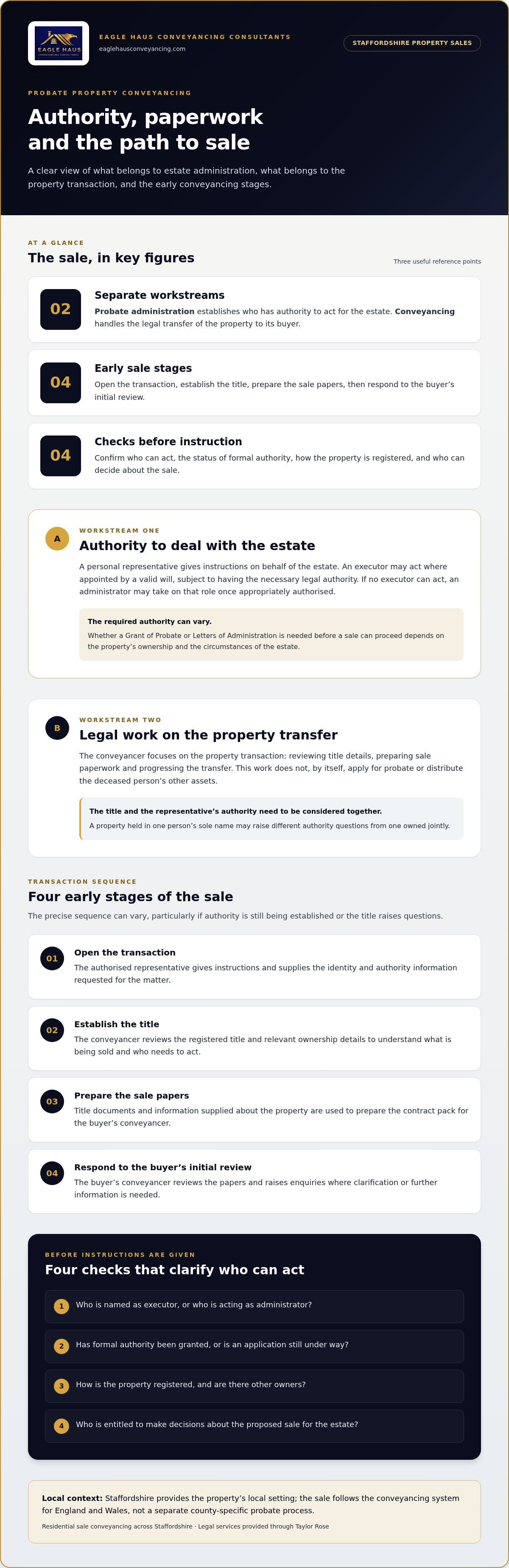
Probate administration and property conveyancing are separate processes. The first deals with authority to manage the estate; conveyancing handles the legal steps involved in transferring the property to its buyer. Knowing what each process covers makes it easier to organise the right paperwork, understand which decisions are needed and spot issues that could delay progress.
This guide explains how a probate property sale works, what executors can prepare and where conveyancing support fits in. You’ll also find practical guidance on sale documents, communication between those involved and the steps leading to completion. Eagle Haus Conveyancing Consultants supports residential property sales across Staffordshire, with legal services provided through Taylor Rose.
Table of Contents
Conveyancing for probate property in Staffordshire: what the service covers
A property sale after a death involves two related but distinct strands of work. One establishes who has authority to deal with the estate; the other handles the legal transfer of the property to a buyer. Keeping the distinction clear helps executors understand which decisions and documents relate to the sale and which belong to the wider estate administration.
Probate property conveyancing is the legal work involved in preparing and completing the sale or transfer of a property owned by someone who has died. It focuses on the property transaction, including checking title details, preparing sale paperwork and progressing the transfer. It does not, by itself, apply for probate or distribute the deceased person’s other assets.
Probate administration and conveyancing: two different responsibilities
Probate is the process of establishing authority to administer an estate where that authority needs formal confirmation. The relevant document and process depend on the circumstances. A general explanation of Probate can help clarify its purpose, but it does not determine what is needed for a particular property sale.
Conveyancing, by contrast, deals with the legal steps for transferring ownership. The conveyancer works on the property transaction, while the estate’s personal representative deals with the estate more broadly. These workstreams can progress alongside each other, but they are not interchangeable.
Who gives instructions when an estate property is sold?
Where a valid will appoints an executor, that person is generally responsible for acting for the estate, subject to having the necessary legal authority. If there is no executor able to act, an administrator may take on that role once appropriately authorised. The person instructing the conveyancer must be entitled to act for the estate, rather than simply being a relative or beneficiary.
The documents needed, and whether a Grant of Probate or Letters of Administration is required before a sale can proceed, depend on factors such as the property’s ownership and the estate’s circumstances. A property held in one person’s sole name may raise different authority questions from one owned jointly. The title and the representative’s authority need to be considered together.
Before giving instructions, it helps to establish:
Who is named as executor, or who is acting as administrator.
Whether formal authority has been granted or an application is still under way.
How the property is registered and whether there are other owners.
Who is entitled to make decisions about the proposed sale on behalf of the estate.
These checks are not a substitute for conveyancing. They help identify who can provide instructions and what information may be needed to progress the property transaction. If authority is still being established, the conveyancer can explain how that affects the sale and which property matters can be prepared in the meantime.
Eagle Haus Conveyancing Consultants handles residential sale conveyancing across Staffordshire. Its role is focused on the property transfer, with legal services provided through Taylor Rose. Understanding that boundary gives executors a clearer view of where conveyancing fits, while keeping estate administration decisions with the appropriate personal representative.
How a probate property sale moves through conveyancing in Staffordshire
A probate property sale follows the familiar stages of a residential sale, but the person giving instructions acts on behalf of an estate. For conveyancing for probate property Staffordshire, the conveyancer coordinates the transaction with the authorised representative and the buyer’s conveyancer. The precise sequence can vary, particularly if authority to sell is still being established or the title raises questions.
Probate authority and conveyancing are related but distinct: one establishes who can act for the estate, while the other handles the property transfer. Keeping both workstreams in view helps everyone understand what can progress and what depends on a decision or document being provided.
From instruction to an agreed sale
At instruction, the conveyancer gathers details about the representative, their authority and the property. They’ll also review title information and details supplied by the seller, which help shape the contract pack for the buyer. Staffordshire provides the property’s local context, but the sale follows the conveyancing system for England and Wales, not a separate county-specific probate process.
Open the transaction. The authorised representative gives instructions and supplies identity and authority information requested for the matter.
Establish the title. The conveyancer reviews the property’s registered title and relevant ownership details to understand what is being sold and who needs to act.
Prepare the sale papers. Title documents and information supplied about the property are used to prepare the contract pack for the buyer’s conveyancer.
Respond to the buyer’s initial review. The buyer’s conveyancer considers the papers and raises enquiries where clarification or further information is needed.
From enquiries to completion and transfer
Enquiries are questions about the title, paperwork or information supplied for the sale. The seller’s conveyancer passes relevant questions to the estate’s representative, explains what is needed and sends responses to the buyer’s conveyancer. Prompt, complete replies can help avoid unnecessary pauses, though some answers may require documents or input from others.
Once the parties are ready, they can agree to exchange contracts. Exchange is the point at which the sale contract becomes binding and the parties commit to the agreed terms. Completion is the later stage when the purchase money is paid, ownership transfers and the buyer can take possession under the contract. The timing depends on the transaction and should not be assumed in advance.
After completion, the sale proceeds are dealt with according to the estate’s legal arrangements. The conveyancer handles the property transaction and communicates with the authorised representative about the steps within that work. Decisions about the wider estate remain with the person responsible for administering it.
Clear communication matters throughout. The representative can help keep the transaction moving by responding to requests, sharing accurate property details and passing on questions promptly. Eagle Haus supports residential property sales in Staffordshire, with legal services provided through Taylor Rose. Executors preparing a sale can explore residential sale conveyancing support as they organise the transaction.
Probate property conveyancing: decisions that can affect the sale
An estate property isn’t automatically ready for sale simply because the family has decided to sell it. Before committing to a transaction, the representative needs to understand their authority and how the property is owned. For conveyancing for probate property Staffordshire, these early checks can help identify issues before they become obstacles later in the sale.
Progress can also depend on the quality of the information available. An unclear title, missing paperwork or unanswered questions about the property may lead to further enquiries. These points don’t necessarily prevent a sale, but they can affect what needs to be resolved before the transaction moves forward.
Selling before the grant: what executors should understand
Marketing a property, accepting an offer and legally completing the sale are separate stages. An executor may be able to take some steps before a Grant of Probate is issued, but that doesn’t mean every sale can complete without formal authority. What’s needed depends on the estate, the property’s ownership and the requirements for transferring its title.
A grant is not a universal prerequisite for every action, and an executor should not assume it can always be bypassed. The conveyancer can consider the authority documents and title as part of the transaction, and explain what must be in place for the sale to proceed. Avoid making firm commitments based on a general rule or another family’s experience, as circumstances can differ.
Property condition, title information and family agreement
Accurate information helps the conveyancer prepare the sale papers and respond to the buyer’s questions. Executors should share what they know about the property, including relevant paperwork and any details they’re uncertain about. It’s better to flag an unanswered question than to guess. If a document can’t be found, say so, so the point can be considered and addressed appropriately.
Title issues can also need attention. A restriction recorded against the title, an unclear ownership detail or missing deeds may require investigation or additional evidence. Similarly, if the property is empty and the executor doesn’t know whether work was carried out, that uncertainty should be made clear rather than presented as fact. The buyer’s conveyancer may raise further enquiries, and complete, timely information can help keep responses on track.
Family discussions can add another layer. Beneficiaries may have strong views about whether to sell, but their views and the executor’s legal authority are not automatically the same thing. The executor should make decisions in line with their responsibilities and the circumstances of the estate, rather than treating informal agreement as proof of authority. If there’s disagreement, unclear authority or uncertainty about the effect of a decision, address it before allowing the sale to progress on assumptions.
Gather title documents and known property information early.
Be clear about what is known, missing or still uncertain.
Keep the authorised representative involved in instructions and decisions.
Raise title or family concerns promptly so their effect on the transaction can be considered.
These practical steps don’t remove every complication, but they help the conveyancer identify what needs attention and explain how it may affect the sale. Any related tax or estate-administration questions should be considered separately, as they depend on individual circumstances.
Preparing a Staffordshire probate property for conveyancing
Some organisation before instruction can make the property-sale process easier to manage. Executors don’t need to have every answer ready, but gathering key papers and noting what is still unclear gives the conveyancer a useful starting point. For conveyancing for probate property Staffordshire, the property’s full address and title particulars help identify the home and establish which ownership details need attention.
Documents and information to organise
Start with the documents that show who is dealing with the estate and what is known about the property. The exact information needed depends on the estate and title, so use this as a preparation checklist rather than a complete list of legal requirements.
Authority documents: locate the will and any Grant of Probate or Letters of Administration, if obtained or applicable. Note who is named to act and whether anyone else is involved in giving instructions.
Property details: record the full address and any title number or title documents you can find. Include information about how the property is owned, if known.
Financial and occupation details: note any mortgage or other charge you know about, whether someone lives at the property and whether it is subject to a lease or tenancy.
Property information: gather available paperwork about the condition, alterations, guarantees or other known matters. Mark gaps clearly rather than filling them with assumptions.
The conveyancer will identify what transaction information is needed and can help make sense of missing or unclear details as the sale progresses. Don’t wait to share a known issue just because you don’t yet have a document that resolves it. Early clarity gives the conveyancer a chance to understand the point and consider whether it needs further investigation.
Questions to resolve before the transaction gathers momentum
Before the sale advances, establish who is authorised to instruct the conveyancer and make decisions for the estate. If there are several executors, or authority is still being established, explain that at the outset. Keep instructions consistent, and make sure important decisions and new information reach the conveyancer promptly.
It also helps to identify practical questions early: Is the property occupied? Are keys available? Is there a title restriction, missing deed or uncertainty about a boundary? Does anyone have information about work carried out at the property? You may not know the answer to everything. A clear note of what is known, unknown and being looked into is more useful than silence or a guess.
Staffordshire is relevant to the property’s address and local context, not a separate probate conveyancing system. The legal conveyancing process operates across England and Wales. Eagle Haus Conveyancing Consultants handles residential purchases and sales across England and Wales, including Staffordshire, Wolverhampton, Telford, Birmingham, Shropshire, Cannock and Walsall, with legal services provided through Taylor Rose. If you’re preparing an estate property sale, arrange residential sale conveyancing with a clear record of the property details and the representative’s authority.
Arrange probate property conveyancing with Eagle Haus in Staffordshire
Selling a property as part of an estate can involve unfamiliar paperwork and decisions, particularly while you’re also managing other responsibilities. Eagle Haus Conveyancing Consultants supports the residential sale and the legal work involved in transferring the property. It covers Staffordshire and other areas across England and Wales, with legal services provided through Taylor Rose. The focus is the property transaction, not probate applications or the wider administration of the estate.
What working with a conveyancer can help organise
A conveyancer handles the legal property-transfer stages, from reviewing title information and preparing the contract papers to dealing with enquiries and progressing towards exchange and completion. They can explain what information is needed and communicate with the buyer’s conveyancer. Clear updates help the estate’s authorised representative understand what has been completed and what still needs attention, although progress depends on the transaction and the information available.
It can help to have a few essentials ready before discussing the sale:
The property’s full address and any title details you can locate.
Your role in the estate, such as executor or administrator, and the current position on formal authority.
Whether the property is occupied, let or subject to a mortgage, if known.
Any known title, paperwork or property-information questions that may need follow-up.
You don’t need to resolve every outstanding question before discussing conveyancing. Be open about what is known and what remains uncertain. That gives the conveyancing team a clearer starting point to discuss the property transaction and identify which steps or documents may be relevant.
Your next step for a Staffordshire estate property sale
When you’re ready to discuss a sale, outline where the property is, your role in the estate and whether it is being prepared for sale, marketed or already has an offer. If a Grant of Probate or Letters of Administration has been obtained, or an application is still in progress, share that context to help frame the initial conversation. The requirements depend on the estate, the property’s ownership and the legal authority in place.
Eagle Haus is a trading name of TRW Legal Consulting Ltd. Its conveyancing support is centred on residential property sales, helping representatives progress the legal transfer while keeping wider estate responsibilities distinct. No two transactions are identical, so the steps and documents needed depend on the facts of the sale.
If you’re arranging conveyancing for probate property Staffordshire, speak with Eagle Haus about the property sale and the conveyancing support you need.
Take the next step towards a property sale
Once you know who is authorised to act and have the property details to hand, you can begin a focused conversation about the sale. You don’t need to have every document or answer ready. Being clear about what’s in place, what’s still being arranged and any known concerns gives the conveyancing team a practical starting point.
If you’re considering conveyancing for probate property Staffordshire, Eagle Haus can support the residential property transaction across England and Wales, including Staffordshire. Legal services are provided through regulated firm Taylor Rose. The next steps depend on the property, the estate’s circumstances and the authority available, so a clear discussion can help you understand how conveyancing applies to your sale.
Start a conversation about your estate property sale and take the next step with confidence.
Frequently Asked Questions
Can a probate property be sold before the Grant of Probate is issued?
It may be possible to market a property and receive an offer before the Grant of Probate is issued, but completing the sale is a separate question. If the property is registered in the deceased’s sole name, the grant may be needed to establish authority to transfer it. The position can differ depending on ownership and estate circumstances, so an executor should have the title and authority reviewed before committing to a completion date.
Who signs the contract when an inherited property is sold?
The contract is usually signed by the personal representative who has authority to sell for the estate, such as an executor or an administrator. The buyer does not sign on behalf of the estate, and a beneficiary’s status alone doesn’t make them the seller. The conveyancer will establish the correct capacity and signing arrangements from the title and authority documents, particularly if more than one personal representative is involved.
Can beneficiaries stop an executor selling a probate property?
Beneficiaries don’t generally have an automatic veto simply because they disagree with a proposed sale. An executor must act within their legal powers and responsibilities, and the will and circumstances of the estate matter. If a beneficiary believes the executor is acting improperly, or there is a genuine dispute about authority or the will, the sale may become more complicated. The parties should obtain advice specific to the dispute rather than assume it can be resolved through conveyancing alone.
Does a buyer need probate documents when purchasing an estate property?
A buyer doesn’t usually apply for probate themselves. The seller’s conveyancer may need to establish that the person selling has authority to transfer the property, and relevant evidence may form part of the transaction paperwork. A buyer’s conveyancer can raise questions if authority is unclear or documents are outstanding. For a buyer considering a home in Staffordshire, Cannock or Wolverhampton, this is one reason to allow the conveyancers to clarify the seller’s position before exchange.
Is conveyancing for a leasehold probate property different?
Yes, a leasehold sale can involve additional information beyond the property’s title and standard sale papers. The conveyancer may need details of the lease, ground rent, service charges, building management and any relevant permissions or notices. For example, an outstanding service-charge account or a missing lease document could prompt further enquiries. The precise requirements depend on the lease and property, so gather available leasehold paperwork early and flag anything you can’t locate.
Does conveyancing for a probate property include inheritance tax advice?
No. Conveyancing for probate property Staffordshire concerns the legal sale or transfer of the home; it doesn’t include advice on calculating or paying Inheritance Tax. Tax treatment depends on the estate’s wider circumstances and isn’t determined by the property sale paperwork alone. Keep tax questions separate from the conveyancing instructions, and obtain advice on the estate’s tax position from a suitably qualified adviser. The conveyancer can focus on the property transaction and its legal requirements.
For residential sale conveyancing for probate property in Staffordshire, Wolverhampton, Telford, Birmingham, Shropshire, Cannock or Walsall, contact Eagle Haus to discuss your property sale.



Comments