Bridging Loan Solicitors for Property Developers: A 2026 Legal Checklist

What if the biggest threat to your property development project isn't the rising cost of materials, but the ticking clock of a high-interest bridging loan? You likely understand that every day your legal team spends reviewing a title deed is another day of mounting interest and a potential lost deposit. It's a stressful position that can quickly derail even the most promising investment. We've seen how easily momentum stalls when communication breaks down or unexpected hurdles appear in the fine print.
We're here to ensure that doesn't happen. Partnering with proactive bridging loan solicitors for property developers is about more than just signing paperwork; it's about treating speed as a legal discipline. This 2026 checklist helps you master the complexities of short-term finance, allowing for rapid completion and a clear title for your future exit strategy. We'll preview the essential steps to integrate limited company structures and overcome common legal hurdles before they become expensive delays. From streamlining your initial instruction to ensuring your title is ready for a future sale, this guide provides the professional roadmap you need to stay ahead of the clock.
Table of Contents
Understanding the Role of Bridging Loan Solicitors
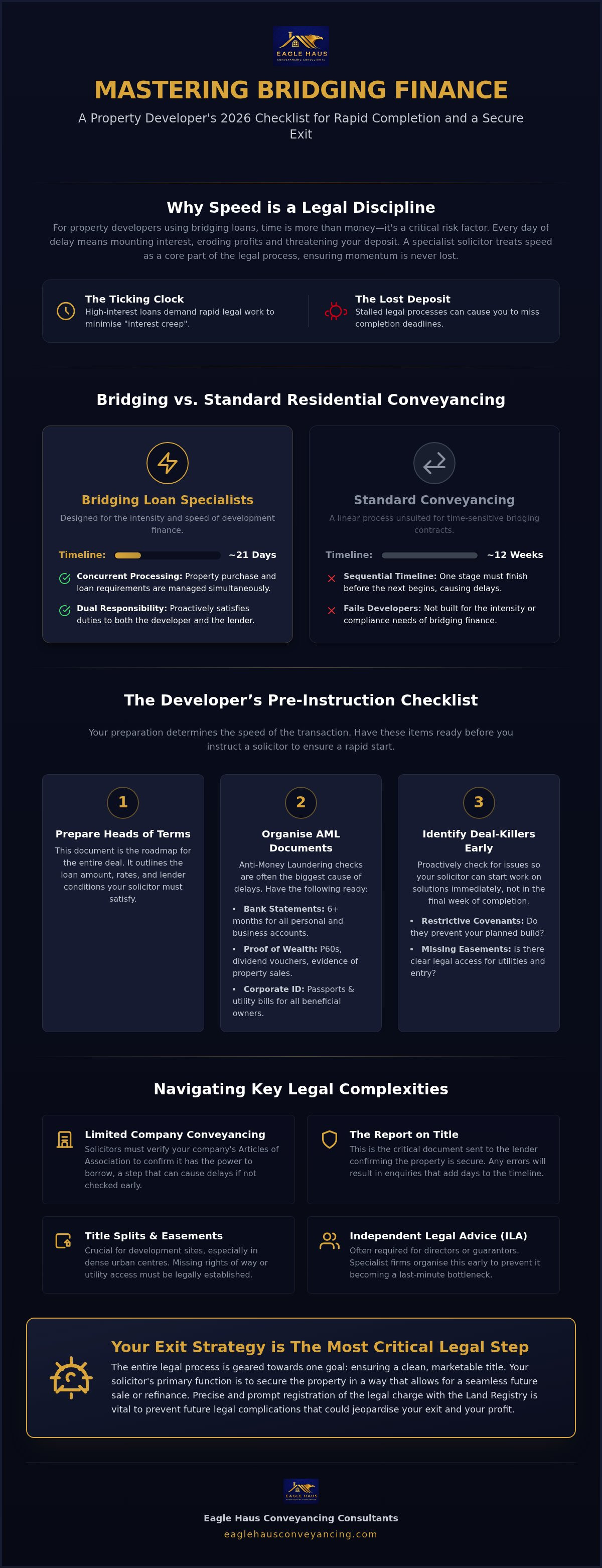
When you're securing short-term finance, the legal process needs to move at the speed of your project. Bridging loan solicitors for property developers play a role that is fundamentally different from a standard residential conveyancer. Whilst a typical house purchase might take twelve weeks, a bridging deal often needs to complete in less than twenty-one days. This accelerated pace isn't just about working faster; it's about a completely different approach to risk and communication. Every day your loan remains in legal limbo, your interest bill grows. This is often called interest creep, and it can silently erode your project's profit margins. Specialist solicitors prevent this by managing the property purchase and the loan requirements concurrently. They don't wait for one stage to finish before starting the next; they push both forward at once to ensure you aren't paying for finance you haven't yet received.
Your solicitor also carries a dual responsibility. They must act for you as the developer, but they also have a duty to the bridging lender. They need to ensure the lender's security is absolute. This means any legal issues must be resolved to a standard that satisfies a high-stakes financial institution. At Eagle Haus Conveyancing Consultants, we facilitate these regulated legal services through Taylor Rose, ensuring that the professional authority required by lenders is matched by a proactive, modern approach to client service.
Bridging vs. Standard Residential Conveyancing
Off-the-shelf conveyancing services often fail property developers because they aren't designed for the intensity of bridging contracts. Standard residential work is built on a linear timeline that assumes a certain level of patience from all parties. Bridging finance doesn't have that luxury. If a solicitor "dithers" over a minor point, the offer could expire or a deposit could be lost. Furthermore, bridging deals frequently require Independent Legal Advice (ILA). This is a specific requirement where directors or guarantors must meet with a solicitor to confirm they understand the risks of the loan. A specialist firm will organise these requirements early in the process rather than leaving them as a last-minute surprise that halts completion.
Lender Requirements and Compliance
The biggest bottleneck in any deal is usually the Report on Title. This is the document your solicitor sends to the lender to confirm the property is a safe bet for their money. Bridging loan solicitors for property developers must be meticulous here; any errors or omissions will result in the lender's own legal team sending back "enquiries" that can add days to the timeline. Compliance also extends to the Land Registry. In 2026, ensuring that the legal charge is registered correctly and promptly is vital for your future exit strategy. If the initial charge isn't handled with precision, you may find it impossible to refinance or sell the property later without significant legal corrections.
The Developer’s Pre-Instruction Checklist
Speed in property development is a legal discipline. Before you formally instruct bridging loan solicitors for property developers, your own internal preparation determines whether the deal completes in weeks or months. Don't wait for a solicitor to ask for a document; have it ready in a digital folder the moment you receive your Heads of Terms from your broker. This document is the roadmap for the entire transaction. It outlines the loan amount, interest rates, and specific lender conditions that your legal team must satisfy. Without it, your solicitor can't accurately assess the workload or the risks involved.
Proactive developers also identify potential deal-killers early. This includes checking for restrictive covenants that might prevent your planned build or missing easements for access and utilities. If you find these issues now, your solicitor can start finding solutions immediately rather than discovering them during the final week of completion. If you're looking to move quickly, you can speak with our consultants to refine your preparation strategy.
Financial Documentation Readiness
Satisfying Anti-Money Laundering (AML) requirements is often the most time-consuming part of the process. Solicitors have a professional duty to verify the source of your funds and your overall wealth. To avoid delays, prepare the following:
Bank Statements: Provide at least six months of personal and business statements showing the accumulation of your deposit.
Proof of Wealth: Gather documents like P60s, dividend vouchers, or evidence of previous property sales.
Corporate ID: If using a limited company, you'll need the passports and utility bills for all beneficial owners and directors.
Property and Site Information
Lenders are incredibly specific about the security they're lending against. Having a complete site pack ready for your solicitor will prevent the dithering that causes interest rates to mount. You should obtain a fresh copy of the title plan and register from the Land Registry to check for any unexpected charges or notices. If the project already has planning permission, include the decision notice and any building regulations certificates. Finally, confirm the status of any current occupants. If there are tenants on-site, your lender will likely require a formal deed of surrender or a specific occupational licence before they release funds.
Legal Due Diligence for Development Sites
Due diligence for a development site is more than a box-ticking exercise; it's a strategic preparation for your project’s exit. When you instruct bridging loan solicitors for property developers, they must look beyond the initial funding to ensure the site is "lender-grade" for future buyers or refinance providers. If the legal title doesn't meet the strict criteria of high-street banks, you risk being trapped on high bridging interest rates far longer than your business plan allows. The goal is to identify and resolve title defects while the project is in the ground, not when you're trying to exchange on a sale.
In densely packed urban centres like Birmingham and Wolverhampton, rights of way and easements for utilities can become significant hurdles. It's vital to identify whether a neighbour has an undocumented right of access or if a shared sewer runs directly beneath your proposed foundations. Identifying these issues during the bridging phase allows time for indemnity insurance or formal variations to be negotiated. This proactive approach ensures that when your development is complete, the legal pack is as polished as the physical build.
Title Splits and New Lease Creation
For projects involving the conversion of a single building into multiple flats or the construction of several houses, splitting the title is essential for individual sales. This process requires the creation of new leases or freehold titles that comply with Council of Mortgage Lenders (CML) requirements. If these documents aren't drafted with precision, future mortgage lenders may refuse to lend to your buyers. We focus on managing Land Registry applications meticulously to avoid "requisitions". In 2026, these requests for clarification can cause delays of several months, effectively freezing your ability to recycle capital into your next project.
Local Search Nuances in the West Midlands
The geography of the West Midlands and Staffordshire brings specific risks that generic firms often overlook. In areas like Cannock and Walsall, historic coal mining activity makes detailed mining reports a non-negotiable requirement for lenders. Without these, you may find the site is uninsurable and therefore unmortgageable. Similarly, developments in Shropshire and Telford often deal with historic building constraints or complex highways adoptions. Proactive legal advice involves engaging with local authorities early to confirm drainage and road access plans are "adoptable". This prevents a situation where a project is physically finished but legally stuck due to unresolved infrastructure issues.
Navigating Limited Company Requirements
Purchasing through a Special Purpose Vehicle (SPV) or an established limited company is the standard for modern developers. This process, known as limited company conveyancing, requires a solicitor who understands corporate law as well as property law. When you use bridging loan solicitors for property developers, their first task is to verify the corporate authority of your business. They must ensure the company is correctly incorporated and in good standing with Companies House before a lender will even consider releasing funds. This isn't just about identity checks; it's about confirming the company has the legal right to exist and enter into high-value financial contracts.
Your solicitor will review your Articles of Association to confirm your company has specific borrowing powers. Some older Articles contain restrictive clauses that prevent the company from granting the type of security bridging lenders demand. If these powers aren't clearly defined, your legal team will need to draft new resolutions or amend the Articles to satisfy the lender's requirements. You'll also need formal Board Minutes and Director Resolutions. These aren't just a formality; they're a legal record that the directors have considered the risks and approved the loan. If you're planning a corporate acquisition, our consultants can guide you through the corporate requirements.
Corporate Authority and Guarantees
Most bridging lenders require more than just the company's signature. They often demand personal guarantees from the directors. This means you're personally liable if the company fails to repay the debt. A specialist solicitor will verify your Certificate of Incorporation and ensure that all guarantees are drafted and witnessed correctly. This often involves Independent Legal Advice (ILA), which ensures every director understands their personal exposure. Getting this right early prevents the last-minute scramble that often delays completions in the West Midlands market.
Companies House Charges
One of the most critical steps in corporate bridging is managing the 'double registration'. Your solicitor must register the mortgage charge at both the Land Registry and Companies House. There's a strict 21-day window from the date of completion to register the charge at Companies House. Missing this deadline is catastrophic. If the charge isn't registered in time, it becomes void against a liquidator or other creditors, making the loan unsecured. This would be a major breach of your loan conditions. For a deeper look at these requirements, read our guide on Company Purchases: A Professional Guide to Limited Company Conveyancing in 2026. Our proactive approach ensures these filings are handled the moment your deal completes.
Securing Your Exit Strategy: The Legal Final Step
Your exit strategy isn't just a financial forecast; it's the most critical part of your legal instruction. Bridging loan solicitors for property developers must understand how you intend to repay the debt before the first pound is even drawn down. Whether you're planning to sell the finished units or refinance onto a long-term mortgage, every legal document drafted during the purchase must support that eventual goal. If the initial title work is sloppy, you'll find yourself hitting a brick wall when a high-street lender or a buyer's solicitor scrutinises your project. We treat the exit as the primary objective from day one, ensuring that the legal foundation of your project is solid enough to support a rapid capital extraction.
Managing the redemption of the bridging loan is a high-stakes task that requires precision. If your solicitor is slow to request the final redemption figure from the lender, you could face daily interest penalties that quickly erode your profit margins. At Eagle Haus, we facilitate these regulated legal services through Taylor Rose, ensuring a proactive approach to the redemption process. We coordinate with all parties to ensure the bridging charge is discharged the moment funds are available, preventing unnecessary interest accrual and allowing you to move on to your next project without delay.
Refinancing into a Buy-to-Let Mortgage
Switching from a bridge to a standard Buy-to-Let (BTL) loan requires a specific set of legal triggers. New lenders will demand a clean bill of health for the property, which means all development works must have the necessary final sign-offs. You'll need to provide building regulations completion certificates, electrical safety reports, and gas safety records. If these aren't organised as the work finishes, the refinance will stall. For a deeper look at the mechanics of these products, see our guide on Bridging Loans: A Comprehensive Guide to Fast Property Finance in 2026.
Selling the Developed Asset
If your plan is to sell, speed is your greatest asset. We recommend creating a comprehensive "Buyer’s Pack" while the development is still in the ground. This pack should include the planning permissions, warranties, and the title split documentation we discussed earlier. By having this ready, you can issue the contract pack to a buyer’s solicitor within twenty-four hours of an offer being accepted. Once the sale completes, your solicitor's final duty is to ensure the bridging lender's charge is removed from the Land Registry. This final checklist ensures your project ends with a clean title and a successful return on your investment:
Verify all building warranties (such as NHBC or similar) are in place.
Ensure the Management Company is correctly formed for multi-unit sites.
Confirm the final redemption statement matches your financial projections.
Secure the formal discharge of the bridging charge at the Land Registry.
Take Control of Your Development Timeline
Successful property development in 2026 relies on more than just site selection; it demands legal precision and proactive planning. By managing title splits early and ensuring your corporate documents are lender-ready, you eliminate the dithering that leads to interest creep. Working with specialist bridging loan solicitors for property developers ensures that your exit strategy is baked into the process from day one. This proactive approach protects your profit margins and ensures a seamless transition to your next venture.
At Eagle Haus, we specialise in high-stakes West Midlands property development and provide regulated legal services via Taylor Rose. We understand the need for rapid turnaround times when dealing with complex finance structures. You don't have to navigate these complexities alone. Contact Eagle Haus for a bespoke bridging loan quote today to keep your project moving. Your next development deserves a legal partner that moves as fast as you do.
Frequently Asked Questions
Do I need a specialist solicitor for a bridging loan?
Yes, you should use a specialist because bridging finance moves significantly faster than a standard mortgage. General conveyancers often struggle with the pace and the specific requirements of bridging lenders. Specialist bridging loan solicitors for property developers understand how to manage the purchase and the finance concurrently. This prevents the communication breakdowns that often cause projects to stall or deposits to be lost.
How long does the legal process for a bridging loan typically take?
The process typically takes between two and four weeks, though some deals complete much faster if all documentation is ready. This is significantly shorter than the twelve week average for residential sales. Your timeline depends on how quickly you provide proof of funds and how fast the lender's surveyor can visit the site. Preparation is the primary factor in determining whether you hit your completion target.
Can I get a bridging loan through my limited company?
Yes, most bridging loans are structured for limited companies or Special Purpose Vehicles (SPVs). Lenders often prefer this structure for tax and security reasons. Your solicitor will need to review your Articles of Association to confirm the company has the power to borrow. They'll also handle the necessary filings at Companies House to ensure the lender's charge is registered correctly within the 21 day legal window.
What is Independent Legal Advice (ILA) in bridging finance?
Independent Legal Advice is a requirement where a solicitor explains the risks of a loan to a director or guarantor personally. Lenders insist on this to prevent claims that you were pressured into the deal. It's a protective measure for both you and the bank. You'll usually need to meet a solicitor who is not directly involved in the main transaction to sign these documents and confirm your understanding.
Why are legal fees higher for bridging loans than standard mortgages?
Fees are higher because bridging transactions involve significantly more work within a condensed timeframe. Solicitors must often act for both you and the lender, which increases their professional liability. Additionally, the complexity of corporate structures and the need for rapid due diligence require more senior level attention. You aren't just paying for the paperwork; you're paying for the speed and the specialist expertise required to protect your profit.
What happens if my bridging loan expires before I finish the development?
If your loan expires, you'll usually face default interest rates or daily penalties that can be very expensive. You must either negotiate an extension with your current lender or arrange a refinance onto a new bridge or a term mortgage. It's vital to begin your exit strategy at least three months before the term ends. This gives your legal team enough time to process the new security documentation and avoid default.
Do I need to pay Stamp Duty when buying with a bridging loan?
Yes, Stamp Duty Land Tax (SDLT) is still payable on the purchase price of the property. The method of finance doesn't change your tax liability. Most developers buying through a limited company or purchasing a second property will be subject to the higher SDLT rates. It's important to factor these costs into your initial budget so they don't impact your project’s liquidity during the construction phase.
Can a solicitor act for both me and the bridging lender?
Yes, a solicitor can often act for both parties if the firm is on the lender's approved panel. This is common in bridging finance as it streamlines communication and speeds up the completion process. It allows one legal team to handle the Report on Title and the security documents simultaneously. However, if a conflict of interest arises, the solicitor may have to step back from acting for one of the parties.


Comments