Conveyancing services in Birmingham: fees and packages

The cheapest conveyancing quote may not be the clearest or the best fit. Choosing a conveyancer in Birmingham means comparing what each quote includes, confirming who will handle your legal work and checking that the firm can act for your mortgage lender.
It’s understandable to focus on the fee when budgeting for a move. But a headline figure can leave out searches, Land Registry fees or other disbursements, so compare what each quote includes. If you’re borrowing, confirm that the firm can act for your lender. Eagle Haus provides fixed-fee quotes based on the information you supply, with legal fees, searches, Land Registry fees and other disbursements included. Amounts vary according to the property and services required.
This guide explains how to compare fees and packages, what to look for in purchase, sale and remortgage support, and how to assess communication and service fit. It also covers how residential conveyancing works, so you can make an informed choice and know what to expect as your transaction progresses.
Table of Contents
Comparing conveyancing quotes and checking itemised fees
Compare quotes for the same transaction, such as a Birmingham freehold purchase, and look beyond the headline legal fee. An itemised breakdown helps you understand the work and third-party costs included before you appoint a conveyancer.
Legal Fees and Disbursements
A conveyancing quote should distinguish the legal fee from disbursements, which are payments to third parties for transaction-related services. Check what work the legal fee covers, whether VAT is included and which expenses are estimates. For example, search costs may be listed separately from the legal work involved in reviewing search results.
HM Land Registry fees for a Birmingham conveyancing transaction range from £20.00 to £1,105.00, according to HM Land Registry. The applicable fee depends on the transaction and application details, so compare how each quote presents this cost rather than assuming every buyer pays the same amount.
Comparing Additional Costs
Place quotes side by side and compare matching items: legal work, searches, Land Registry fees, VAT and any transaction-specific work. A lower legal fee may not mean a lower overall cost if searches or other disbursements are excluded. If one quote groups costs together and another itemises them, ask for a breakdown on the same basis.
For a leasehold purchase, check that the quote accounts for reviewing the lease and management information. For a new-build purchase, look for any additional legal work identified in the quote. Compare the stated scope, not just the total, and note which costs could change if the transaction details change.
Check Regulation and Insurance
In England, conveyancing firms are regulated by the Solicitors Regulation Authority or the Council for Licensed Conveyancers. Solicitors are legally qualified and may handle conveyancing; licensed conveyancers are specialist property lawyers authorised to handle property transactions. Both can provide conveyancing support.
To check regulation, ask for the firm’s regulator and practising details, then look up the firm on the regulator’s register. You can also ask for details of its professional indemnity insurance and how the cover applies to conveyancing work. These checks help you understand who is responsible for your transaction.
Account for Stamp Duty
Stamp duty is a tax on a property purchase, not a solicitor’s legal fee, so treat it separately from the conveyancing quote. HM Revenue & Customs says you’ll pay no SDLT up to £300,000 and 5% SDLT on the portion from £300,001 to £500,000. Your purchase price and circumstances affect the amount due.
Before comparing totals, distinguish stamp duty from legal fees and disbursements. Then check whether each quote includes VAT and identifies potential additional work. This gives you a clearer view of the costs involved and helps you compare like with like.
Checking whether a conveyancer is on your mortgage lender’s panel
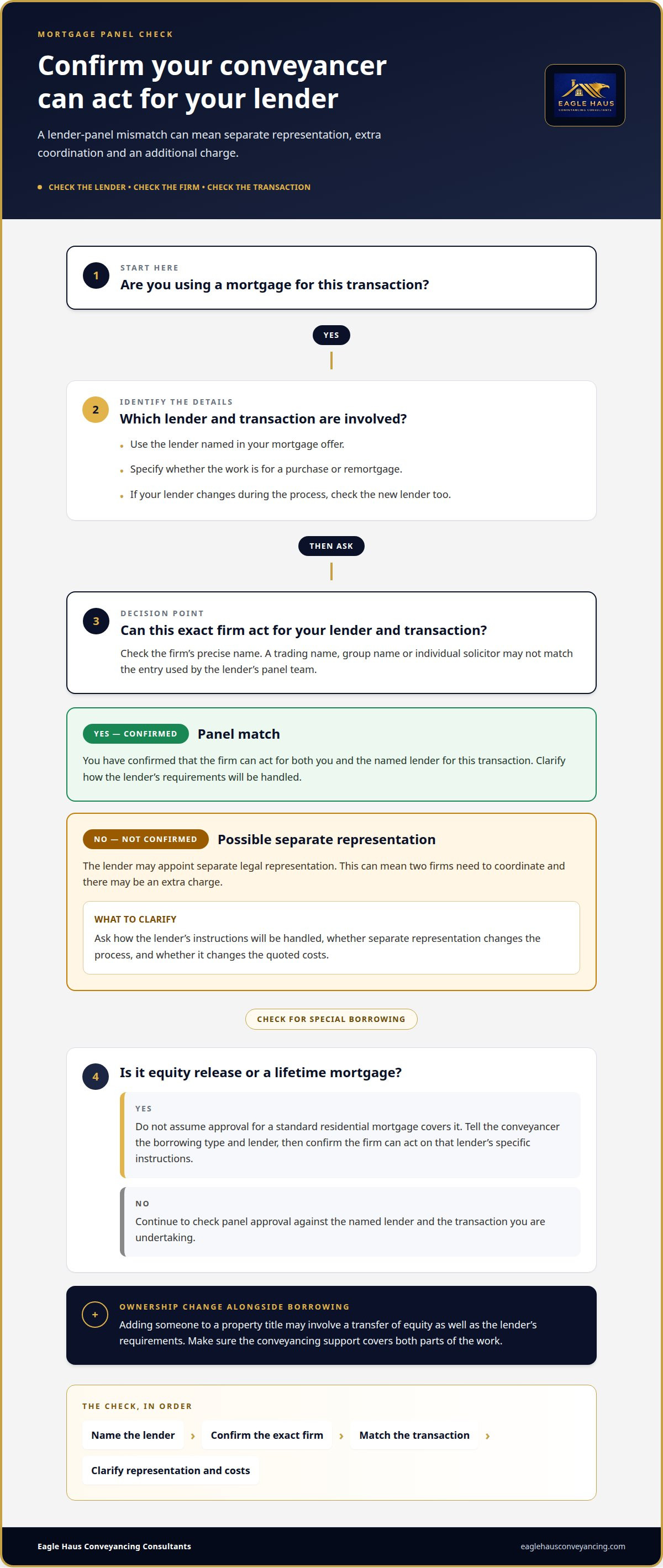
If you’re using a mortgage to buy a Birmingham property, confirm that your conveyancer can act for your lender. Panel approval relates to the lender, so check this before instructing a firm and ask how the lender’s requirements will be handled.
Confirm the lender and transaction match
Panel approval relates to the specific mortgage lender, so identify the lender named in your mortgage offer before relying on a general statement that a firm handles conveyancing. Ask whether the firm can act for that lender and for your type of transaction, such as a purchase or remortgage. If your lender changes during the process, confirm that the firm can act for the new lender too.
Check the firm’s precise name when confirming approval. A trading name, group name or individual solicitor may not be the same entry used by a lender’s panel team. Give the conveyancer the lender’s name and the transaction details, then ask for confirmation that the firm can act for both parties. This gives you a clearer answer than asking whether it “works with mortgage lenders”.
Understand the effect of using a non-panel firm
If a conveyancer cannot act for your mortgage lender, the lender may appoint separate legal representation. This can mean additional coordination between two firms and an extra charge.
Ask how the lender’s instructions will be handled and whether separate representation changes the process or quoted costs. For example, a buyer with an offer from one lender should confirm panel status before instructing a firm, rather than discovering a mismatch after the legal work starts. This check can help avoid an unnecessary handover during the transaction.
Equity release and lifetime mortgages
Equity release and lifetime mortgages involve specific lender instructions, so don’t assume that approval for a standard residential mortgage covers them. Tell the conveyancer what type of borrowing is involved and name the lender, then confirm that the firm can act on the lender’s instructions for that transaction.
Where a mortgage accompanies an ownership change, such as adding someone to a property title, the legal work may involve a transfer of equity as well as lender requirements. Transfer of equity conveyancing support can help address that ownership change alongside the transaction’s legal steps.
Use a simple sequence: identify the lender, confirm that the conveyancer can act for that lender, and clarify who will represent the lender. If separate representation is needed, understand the additional arrangements and costs before deciding. This makes lender requirements part of your choice from the outset, not a last-minute detail.
Buying, selling and remortgaging
Buying, selling and remortgaging involve different legal checks, even when the same Birmingham property is involved. The conveyancer’s work depends on the transaction type, title documents, searches and any mortgage lender’s requirements.
A typical property conveyancing process takes 8-12 weeks. A UK purchase can take 12-16 weeks, depending on matters such as search results, mortgage arrangements and the other party’s readiness. The conveyancer moves the file from initial checks through enquiries and contract exchange to completion.
For a purchase, the solicitor checks the legal title, reviews the contract papers and arranges property searches. The buyer’s mortgage lender also provides instructions that must be addressed before funds are released. Once the legal work is ready, contracts are exchanged; this makes the purchase legally binding. The agreed completion date is commonly around two to four weeks after exchange.
Local searches help identify information about a Birmingham property and its surroundings. The LLC1 search identifies local land charges, while CON29 enquiries cover matters including highways and local plans. Birmingham City Council provides separate land charges and highways-search services. The full property address matters because a postcode or nearby place name may not identify the responsible council.
For a sale, the conveyancer prepares contract papers, answers enquiries and keeps the buyer’s solicitor updated. Complete property questionnaires accurately, since missing or incorrect information can prompt further enquiries. If the property is leasehold, contact the managing company early to obtain the management pack, which the buyer’s solicitor will need to review.
If you’re buying and selling at the same time, the two transactions need to align around exchange and completion. A chain can affect timing because each linked buyer and seller must be ready to proceed. Your conveyancer coordinates the legal steps and dates; you can help by providing documents promptly and sharing any changes to your moving plans.
For a remortgage with a different lender, a conveyancer handles the legal transaction, including the lender’s requirements and registration of the new charge. The work differs from a purchase because ownership may stay the same, but the existing mortgage and the new lender’s instructions still need attention.
High-rise purchases may involve additional considerations: according to The National Archives, the Building Safety Act 2022 may affect purchases of high-rise properties in Birmingham and could require additional safety checks. This can add property-specific enquiries to the usual title, contract and search work.
Choosing a conveyancer and comparing packages
A useful package sets out the work, communication and support included for your transaction. Compare what each firm will do, not simply its headline price.
Comparing Conveyancing Packages
Start with the transaction type: a purchase, sale or company purchase can involve different documents and enquiries. Check that the package describes the work for your situation, including who handles the file and how you’ll receive updates. For example, a seller’s package should explain how contract papers and replies to enquiries are managed.
Then look at how the conveyancing process is organised. A clear service explains how to send documents, receive updates and raise questions. Ask what happens if a search result or title issue needs further attention, and whether that work is included in the stated scope or charged separately.
Convenience matters, but the format alone doesn’t establish service quality. An online process can suit someone comfortable sharing documents digitally; the important questions are how the firm handles communication and who is responsible for the file. Check these details before deciding.
Reviewing Quotes
Compare conveyancers using the same information for each quote: property type, tenure, purchase or sale, mortgage arrangements and any linked transaction. Matching details make differences between quotes easier to understand. For example, a Birmingham quote for a freehold purchase should not be compared directly with one for a leasehold property.
Read the scope alongside the total. Note what work is included, what additional tasks may arise and how changes to the transaction affect the charge. If one quote is brief and another detailed, ask about the same points before choosing rather than assuming both cover identical work.
Your conveyancer doesn’t need to be based in Birmingham, since much of the process can be handled remotely. Focus instead on whether the firm’s approach suits you: consider how you’ll provide documents, receive updates and speak to the person responsible for your file.
Before instructing a firm, write down your priorities. For example, note whether you value phone access, digital document handling or regular progress updates, then compare how each service meets them. If you’re buying and selling, check how the firm will coordinate both files and the linked transactions.
A low quote or online service isn’t automatically unsuitable. The practical risks arise when responsibilities are unclear, communication is difficult or additional work isn’t explained. A defined scope and a clear point of contact help you judge the service on fit, not price or format alone.
Residential conveyancing services
Residential conveyancing covers the legal and administrative work involved in transferring ownership. For a Birmingham buyer, this includes reviewing the contract and title, arranging searches, handling enquiries, exchanging contracts and completing the purchase. The work should reflect the property’s tenure and your plans.
For a freehold purchase, the conveyancer checks the title and investigates information that could affect the property. Local authority searches can reveal matters such as planning proposals and highway information. In Birmingham, an LLC1 search identifies local land charges, while CON29 enquiries cover matters including highways and local plans. The property’s full address helps identify the responsible council.
Searches are not interchangeable. Access to a local land charges register alone is not a full local authority search, and highway maintenance information does not establish every private access right. A conveyancer reviews search results alongside the title and raises enquiries where an entry needs clarification. For example, a recorded highway matter may need to be considered separately from a private right of way.
Leasehold transactions involve additional documents. The buyer’s conveyancer reviews the lease and the management pack, which the seller must obtain from the managing company. The pack may include buildings insurance details, accounts, ground rent and service charge records, sinking fund information and replies to leasehold enquiries. Reviewing these documents helps buyers understand the obligations attached to the property before exchange.
A residential conveyancer also coordinates practical milestones. They review contract papers, report relevant findings, respond to enquiries and prepare the file for exchange. After exchange, both parties are committed to the agreed sale, so key issues should be addressed beforehand. The conveyancer then manages the legal steps for completion and registration of ownership.
For sellers, the service includes preparing contract papers and responding to the buyer’s solicitor. Accurate replies to property questionnaires help prevent avoidable follow-up enquiries. If the property is leasehold, contact the managing company early to obtain the management pack, which the buyer’s solicitor needs to review.
For a new-build purchase, the conveyancer considers the contract terms and documents specific to the property. A high-rise property may also require additional safety enquiries. Each transaction needs a scope that reflects its title, tenure and documents, rather than a one-size-fits-all checklist.
If you’re preparing for a Birmingham purchase or sale, discuss your residential property transaction and the legal steps it involves.
Eagle Haus Conveyancing Consultants
Eagle Haus supports residential property transactions, helping make the legal steps and responsibilities clearer. Whether you’re buying or selling a home, changing property ownership, remortgaging or purchasing through a company, the right conveyancing support depends on your transaction. Eagle Haus handles Residential Purchases and Sales, Transfers of Equity, Remortgages and Company Purchases for clients throughout Birmingham and the West Midlands. The legal work is performed through Taylor Rose.
As you focus on **choosing a conveyancer in Birmingham**, gather the key details: the property, transaction type, mortgage lender if applicable, and questions about fees or the work involved. This gives you a practical starting point for discussing the support your transaction needs.
Take the next step with confidence
The right time to put your choice into action is when you have a clear picture of your transaction and the support you need. Before instructing a conveyancer, gather the property details, your preferred timescale and any mortgage information. These give you a practical starting point for discussing how the work will be handled.
Choosing a conveyancer in Birmingham is about finding support that fits your circumstances, not simply selecting a package by its headline fee. Clear communication about your transaction and its requirements helps set realistic expectations and clarify the next steps.
Eagle Haus Conveyancing Consultants can discuss your property transaction and the legal support involved. Talk to Eagle Haus Conveyancing Consultants about the next step for your move or ownership change.
With the right information in hand, you can make a considered choice and approach your transaction with greater clarity.
Frequently Asked Questions
How do I choose a good conveyancing solicitor in Birmingham?
Choose a solicitor whose experience and service fit your transaction, then establish who will handle your file and how you’ll receive updates. For example, if you’re buying and selling together, ask how the two linked files will be coordinated. Eagle Haus Conveyancing Consultants supports residential transactions across Birmingham, Staffordshire, Wolverhampton, Telford, Shropshire, Cannock and Walsall. Its legal work is performed through Taylor Rose, and formal communications after instruction come from Taylor Rose.
At what point in the sale of a property do I need to contact a specialist?
Contact a conveyancer before accepting an offer so the legal work can get underway promptly once the sale is agreed. If the property is awaiting probate, you can market it and accept offers, but completion must wait until probate is finalised. For a leasehold sale, contact the managing company early to obtain the management pack. This gives the conveyancer the information needed to respond to the buyer’s solicitor and progress the sale.
How do I choose a conveyancer in Birmingham?
Start with your transaction type, such as a purchase, sale, remortgage or transfer of equity, then match the firm’s service to your needs. If you’re buying with a mortgage, include your lender when discussing the transaction. Also consider how you prefer to communicate and send paperwork. Eagle Haus supports clients across England and Wales, so you can discuss your conveyancing without relying on the firm having an office in your neighbourhood.
What should I check when comparing conveyancers in Birmingham?
Check who will manage your file, how formal correspondence will be issued and what documents the firm needs from you. For a mortgage-funded purchase, ask how source-of-funds checks fit into onboarding. Eagle Haus requires mortgage clients to provide six months of payslips per client and six months of bank statements showing the source of funds. For cash purchases, the documents must cover twelve months.
How much do conveyancing solicitors cost in Birmingham, including disbursements?
The total depends on the property and services required, so request a quote based on your details. Eagle Haus offers fixed fees based on the information supplied. The quote includes legal fees, property searches, Land Registry fees and other disbursements; amounts vary according to the property value and services required. Provide complete transaction details when requesting a quote, since incomplete information can lead to additional fees.
What questions should I ask a Birmingham conveyancer before instructing them?
Ask who will handle your file, how you’ll receive progress updates and which documents are needed to start. For a mortgage purchase, ask what source-of-funds paperwork applies and whether the firm can act for your lender. Eagle Haus says conveyancing typically takes 8 to 12 weeks, though complexity and chain delays can affect timing. Also clarify that formal letters and emails after instruction will come from Taylor Rose.
How do I compare conveyancing quotes and avoid hidden fees?
Give each firm the same accurate details about the property, tenure, mortgage and transaction. Then compare what the quote includes and which disbursements are covered, rather than relying on the headline legal fee. Eagle Haus offers fixed fees based on supplied information, with searches, Land Registry fees and other disbursements included in its quote. Additional fees may apply if required information is incomplete.



Comments